
Loading, please wait...
_900x900.jpg "Byzantine Iron Horse Bit")
_200x200.jpg "Byzantine Iron Horse Bit")
.jpg "Byzantine Iron Horse Bit")
LOT 1126
Byzantine Iron Horse Bit
14TH-16TH CENTURY A.D.
7 3/4 in. (340 grams, 19.5 cm).
Composed of arched openwork shanks with looped terminals; one end fitted with large hoops and bar between; one end with a tripartite mouthpiece comprising two collared bars connected by a central hoop; Byzantine or early Ottoman.
ProvenanceCollection of Dr. Hanns-Ulrich Haedeke (1928-2017), author of ‘Schmuck Aus Drei Jahrtausenden’ and who became the director of the Museum of Klingenmuseum in Solingen, Germany, in 1968; the collection was formed in the early 1960s.
From an important private Dutch collection.
See Витлянов, С., Старобългарското въоъжение (The Old Bulgarian Armament), София, 1996, fig.1, pl.XXIV, and fig.5, for an identical example.
FootnotesThis type of horse bit is visible on one of the most important equestrian artworks of the 15th century - the Cappella dei Magi by Benozzo Gozzoli, a painting representing the Three Kings visiting Christ, depicted in costumes belonging to the early quarter of 15th century. All the cavalrymen in the artwork had heavy curb-bits (with short and curved shanks, as in our specimen) and heavy, single reins.
CONDITIONTimeLine Auctions follows a vetting process to ensure the authenticity and legality of all items, reinforcing our commitment to integrity and responsible trading. Each antiquity, antique, and coin lot undergoes thorough examination by a vetting committee of at least ten external specialists, professional trade association members, scientists, and archaeologists: Our Vetting Process
AUCTIONS:
TimeLine is a leading auction house specialising in antiquities, ancient art, collectables, natural history, coins, medals, and books. Our auctions offer museums, collectors, historians, and enthusiasts the opportunity to acquire unique and historically significant pieces.
LOT 1126
Byzantine Iron Horse Bit
Estimate £200 - 300€230 - 350 (for guidance only)$270 - 410 (for guidance only)
-
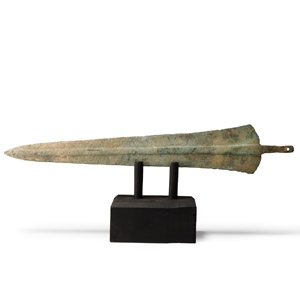
Luristan Short Sword Blade
Early 1st millennium B.C.Sold for (Inc. bp): £156
Triangular with thick rectangular-section midrib, rounded shoulders, narrow tip, short tang with hole for fixing pin for the organic grip; accompanied by a custom-made display stand. 285 grams total, 32 cm wide including stand
Acquired 1980s-1990s. From the H.N. collection, Milton Keynes, Bedfordshire, UK.
This tanged bronze blade from Luristan belongs to a category of Luristan swords still in use in the Achaemenid Period, as proved by a blade with a perished handle (probably bone or wood) of the same type, in the National Museum of Iran (2694/15633). Examples without inscriptions like our model have been classified by Grotkamp-Schepers in the Solingen Museum as pieces from Luristan. -
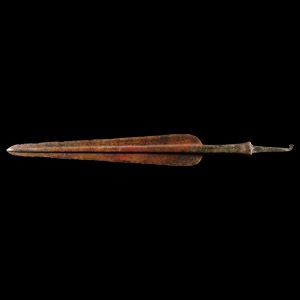
Massive West Persian Bronze Spearhead
Circa 12th-10th century B.C.Estimate: £250 - 350 (+bp*)
Opening Bid: £139
With heavily ridged and tapered blade, short collared shaft and tapered bent tang with round stud terminal. 674 grams, 52.5 cm
Acquired 1980-2015. Ex Abelita family collection.
The weapon belongs to the type 1 of the Khorasani spearhead classification, mainly from Marlik or Amlash areas. Similar pieces have been dated by Stutzinger to 1200-1100 B.C., but the period of use is attested at least until the 1000 B.C. -
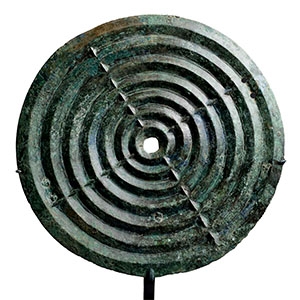
Villanovan Bronze Breast Plate
Circa 7th century B.C.Sold for (Inc. bp): £2,990
Featuring a central circular void and a series of concentric triangular-section ridges and incorporating an X or cross motif; accompanied by a custom-made display stand. 1.36 kg total, 32.6 cm high including stand
with H. Cahn, Basel. Subsequently Tajan auction, 8 February 2008, lot 251.
