
Loading, please wait...


LOT 1583
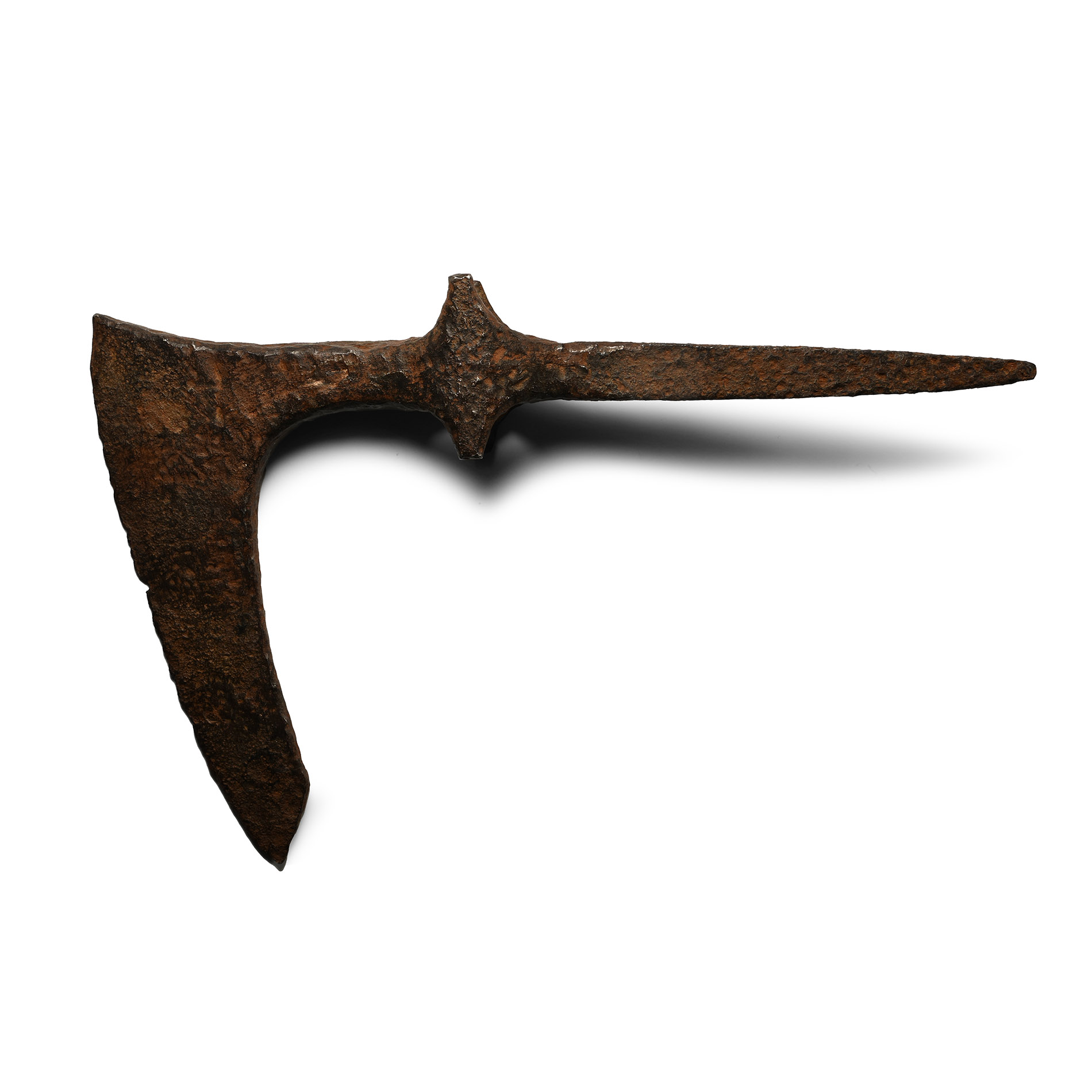
Byzantine Iron Bearded Axehead with Spike
9TH-11TH CENTURY A.D.
9 in. (411 grams, 22.7 cm).
Double-edged battle axe with broad trapezoidal blade elongated towards the bottom, with rhomboidal and blunt fixing hole shaft, the opposite end formed by a long and thick spike. [No Reserve]
ProvenanceEx USA private collection, 1970s-1990s.
This lot is accompanied by an illustrated lot declaration signed by the Head of the Antiquities Department, Dr Raffaele D’Amato.
Cf. D'Amato, R., 'Armi e strumenti di lavoro da Iasos (Tools and weapons from Iasos)' in Bollettino dell'associazione Iasos di Caria, 23, Ferrara, 2017, pp.2-13, fig. 11, p.9.
FootnotesThe double-edged axe was used by the Roman cavalry between the 9th and 11th centuries. The correspondence of this example with the types described by Emperor Leo VI the Wise, is surprising: it is clear that this typology was not a working tool but a war axe, suitable for breaking helmets, breastplates, shields and skulls since it inflicted devastating blows to the head and arms by damaging the protective equipment.
CONDITIONTimeLine Auctions follows a vetting process to ensure the authenticity and legality of all items, reinforcing our commitment to integrity and responsible trading. Each antiquity, antique, and coin lot undergoes thorough examination by a vetting committee of at least ten external specialists, professional trade association members, scientists, and archaeologists: Our Vetting Process
AUCTIONS:
TimeLine is a leading auction house specialising in antiquities, ancient art, collectables, natural history, coins, medals, and books. Our auctions offer museums, collectors, historians, and enthusiasts the opportunity to acquire unique and historically significant pieces.
-
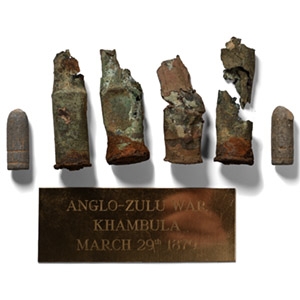
Anglo-Zulu War 'Battle of Khambula' Artefact Collection
29 March 1879 A.D.Sold for (Inc. bp): £98
Comprising: a Martini-Henry brass ‘boxer’ cartridge cases, one with firing mark to the base; two lead heads of bullets fired from the Martini-Henry rifle; supplied with brass nameplate 'Anglo-Zulu War / Khambula / March 29th 1879'. 120 grams total, 3-10.1 cm
Found by Zulu natives, Khambula, South Africa, 1990s-early 2000s. Ian Wilkinson collection, Nottinghamshire, UK, formed since 1985. This lot is accompanied by an illustrated lot declaration signed by the Head of the Antiquities Department, Dr Raffaele D’Amato.
Following defeats by the Zulu army at Isandlwana and Hiobane, the British were desperate for a victory, which they secured at Khambula. -

Norman Bronze Prick Spur
11th-12th century A.D.Sold for (Inc. bp): £299
With D-section curving arms and biconical prick to the rear. 64 grams, 12.2 cm
From the private collection of a London gentleman, from his grandfather's collection formed before the early 1970s. This lot is accompanied by an illustrated lot declaration signed by the Head of the Antiquities Department, Dr Raffaele D’Amato. -
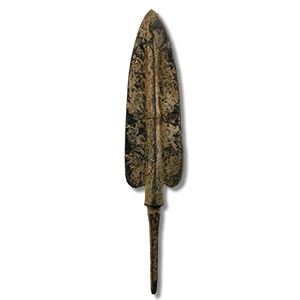
Luristan Bronze Spear Point
13th-6th century B.C.Sold for (Inc. bp): £98
Comprising a broad leaf-shaped blade with rounded shoulders, raised midrib extending to a tubular socket with tapering rectangular-section extension. 43.2 grams, 14.8 cm
Acquired 1980-2015. Ex Abelita family collection. This lot is accompanied by an illustrated lot declaration signed by the Head of the Antiquities Department, Dr Raffaele D’Amato.
