
Loading, please wait...
_900x900.jpg "Byzantine Horse Lock Plate")
_200x200.jpg "Byzantine Horse Lock Plate")
.jpg "Byzantine Horse Lock Plate")
LOT 0797
Byzantine Horse Lock Plate
7TH-8TH CENTURY A.D.
2 1/8 in. (29.5 grams, 53 mm).
A lock plate formed as a stylised horse standing right, with geometric detailing to the head, body and legs.
ProvenanceAcquired 1970-2010.
Collection of a late Japanese gentleman.
TimeLine Auctions follows a vetting process to ensure the authenticity and legality of all items, reinforcing our commitment to integrity and responsible trading. Each antiquity, antique, and coin lot undergoes thorough examination by a vetting committee of at least ten external specialists, professional trade association members, scientists, and archaeologists: Our Vetting Process
AUCTIONS:
TimeLine is a leading auction house specialising in antiquities, ancient art, collectables, natural history, coins, medals, and books. Our auctions offer museums, collectors, historians, and enthusiasts the opportunity to acquire unique and historically significant pieces.
-
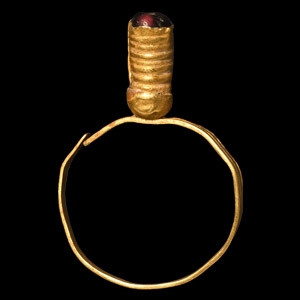
Byzantine Gold Turret Ring
6th-7th century A.D.Sold for (Inc. bp): £260
A gold finger ring with tall columnar ribbed bezel, inset garnet cabochon from a re-used bead; hoop split. 2.05 grams, 34.61 mm overall, 22.30 mm internal diameter (approximate size British V 1/2, USA 10 3/4, Europe 24.4, Japan 23)
Hoop broken.
Acquired 1970-2010. Collection of a late Japanese gentleman. -
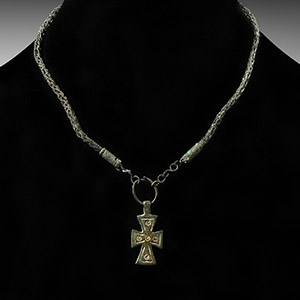
Byzantine Chain with Cross Pendant
Circa 6th-8th century A.D.Estimate: £200 - 300 (+bp*)
Opening Bid: £100
A copper-alloy trichinopoly chain with cruciform pendant, decorated on one face with a geometric design representing the five wounds of Christ. 14.5 grams, 40 cm
Acquired in the late 1990s-2000. Property of an East London gentleman. -
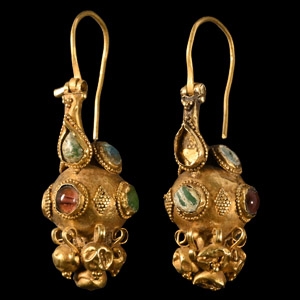
Byzantine Inlaid Gold Earrings
4th-9th century A.D.Estimate: £800 - 1,000 (+bp*)
Opening Bid: £400
A pair of non-identical gold hoop earrings, each composed of a large bulb, hinged hoop above adorned with three granulated cells set with glass (one insert absent); four circular cells to the equator set with stones of alternating blue and red colour, granulated lozenges between, pyramid bulbs below adorned with granule clusters, collar of suspension loops above; articulate hinges. 8.87 grams total, 42 mm each
Acquired 1980-2015. Ex Abelita family collection.
