
Loading, please wait...
LOT 1076
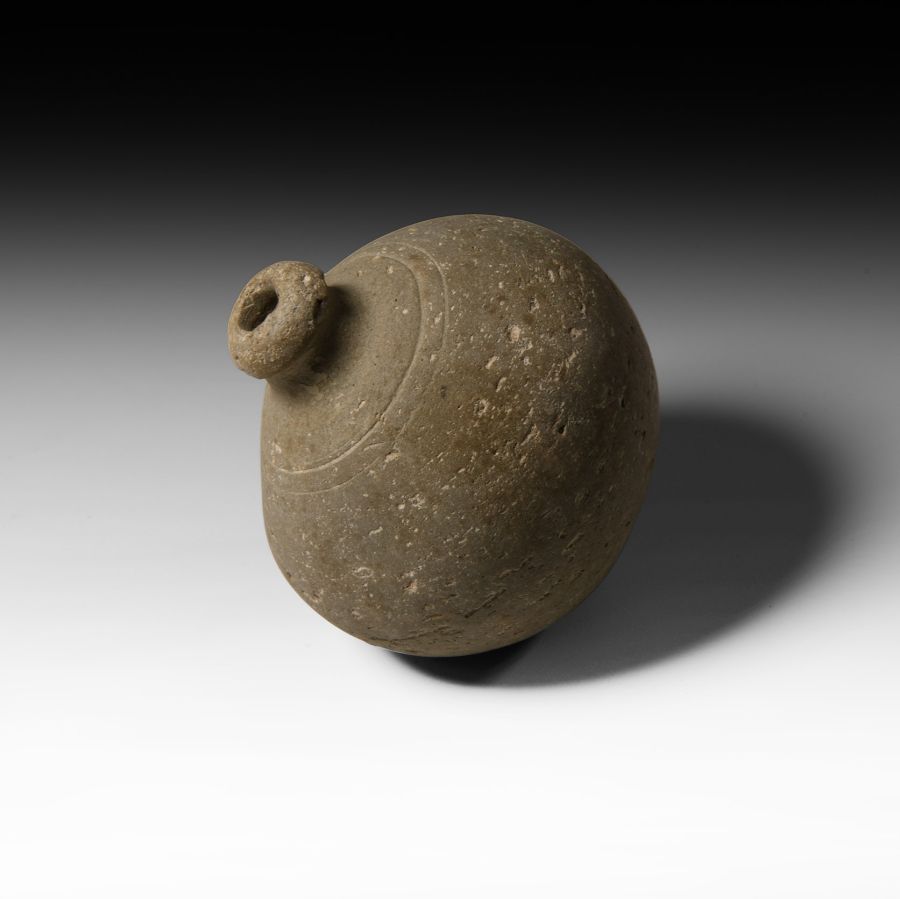
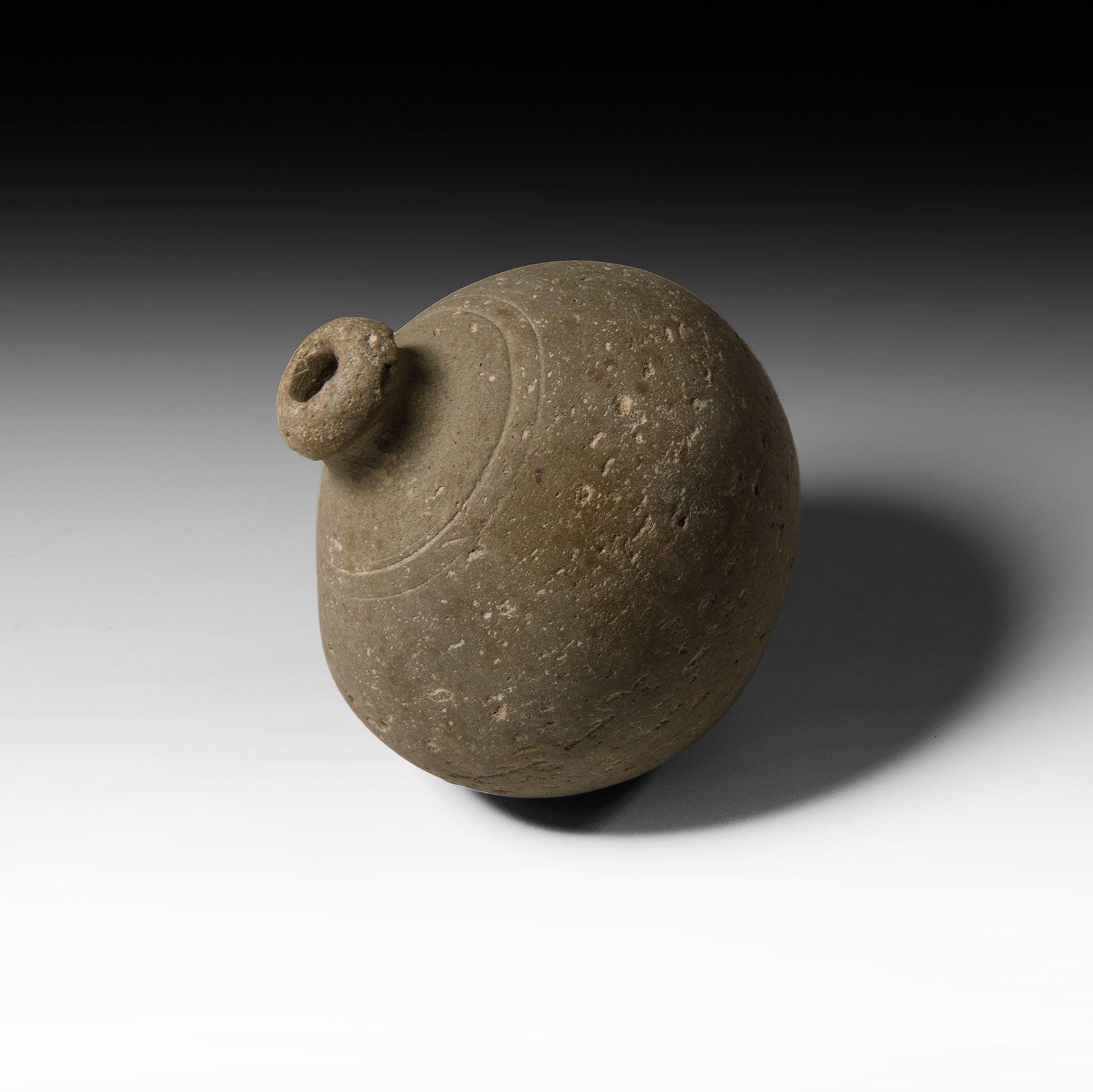
Byzantine 'Greek Fire' Fire Bomb or Hand Grenade
9TH-11TH CENTURY A.D.
4 in. (470 grams, 10.2 cm).
A ceramic vessel with a piriform body and domed mouth, two incised rings to the shoulder; intended to be filled with explosive liquid and wick, used as a hand grenade. [No Reserve]
ProvenancePreviously in a private collection since the 1990s.
Property of a Sussex, UK, teacher.
Accompanied by an academic paper by military specialist Dr Raffaele D'Amato, dated 15 July 2019 and titled 'Eastern Roman Empire - Greek Fire Bomb or Hand Grenade (μεσαίον kακάβιον) 9th-11th century AD'.
Cf. Arendt, W. I., Granaten des 13-14. Jahrhunderts, die an der Wolga gefunden sind, Zeitschrift fur Historische Waffen-und Kostumkunde, 11 (1926-8), p.42; cf. Arendt, W., Die Spharisch-konischen Gefasse aus Gebranntem Ton, ibid; cf. Ayalon, D., Gunpowder and Firearms in the Mamluk Kingdom, London, 1956, p.16.
FootnotesApart from the use of siphons or manual flame-throwers called cheirosiphona, special corps of Roman soldiers employed terracotta grenades, in the form of small jars, abundantly evidenced in archaeological excavations. Such were the γανωτα, vessels (sometimes also of bronze) used for Greek fire. They were called μεσαία kακαβιά or κυτροκακάβια where the former had a bulbous shape and the latter a more cylindrical form.
CONDITIONTimeLine Auctions follows a vetting process to ensure the authenticity and legality of all items, reinforcing our commitment to integrity and responsible trading. Each antiquity, antique, and coin lot undergoes thorough examination by a vetting committee of at least ten external specialists, professional trade association members, scientists, and archaeologists: Our Vetting Process
AUCTIONS:
TimeLine is a leading auction house specialising in antiquities, ancient art, collectables, natural history, coins, medals, and books. Our auctions offer museums, collectors, historians, and enthusiasts the opportunity to acquire unique and historically significant pieces.
-
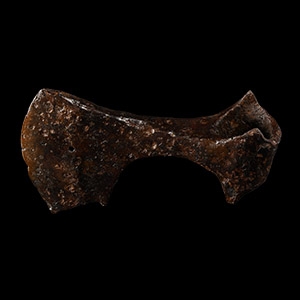
Viking Period Bearded Axehead
Circa 9th-11th century A.D.Sold for (Inc. bp): £169
A hand-forged iron axehead with triangular-section narrow blade widening to a broad bevelled edge with square chin, socket with lateral flanges and rectangular panel to the rear. 422 grams, 15.2 cm
Acquired 1971-1972. From the collection of the vendor's father. Property of a London, UK, collector.
The axe appears to belong to the typology of Viking side axes of Wheeler type B (Wheeler III / Rygh 559). Usually these bearded axeheads (skeggöks) had a longer edge, designed to split tree trunks into planks and beams, or heads during the battle. Some of the bearded axes were known as halfÞynna öx, the neck on such 'half thin axe' was thinly forged, to make it lighter. -
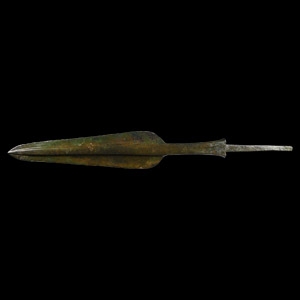
Amlash Type Spearhead
13th-11th century B.C.Sold for (Inc. bp): £234
A bronze tanged spearhead with heavily ridged and tapered blade with short collared shaft and square section tapered tang of recangular section. 436 grams, 40 cm
Acquired 1980-2015. Ex Abelita family collection.
The weapon belongs to the type 1 of the spearhead classification by Khorasani, mainly from Marlik or Amlash areas. Similar pieces have been dated by Stutzinger to 1200-1100 B.C. -
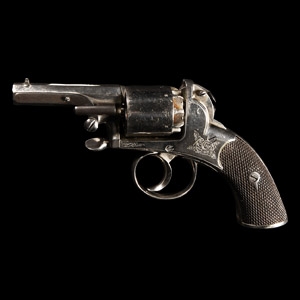
London Proofed Percussion Revolver
19th century A.D.Sold for (Inc. bp): £442
A double action nickel plated 5-shot percussion revolver with numbered chambers, the chambers and barrel bearing London proof marks and the barrel numbered 2; the frame with foliate engraving and fitted with chequered wood grip scales with hinged steel loading lever; action in working order. 480 grams, 18 cm
Acquired Peter Wilson Auction, 2020, lot 10. Property of a Kent collector. Accompanied by lot ticket.
Sold as an exempt item under Section 58 (2) of the Firearms Act, 1968, to be held as a curiosity or ornament. No license required but buyer must be over 18 years of age.
