
Loading, please wait...


LOT 1451
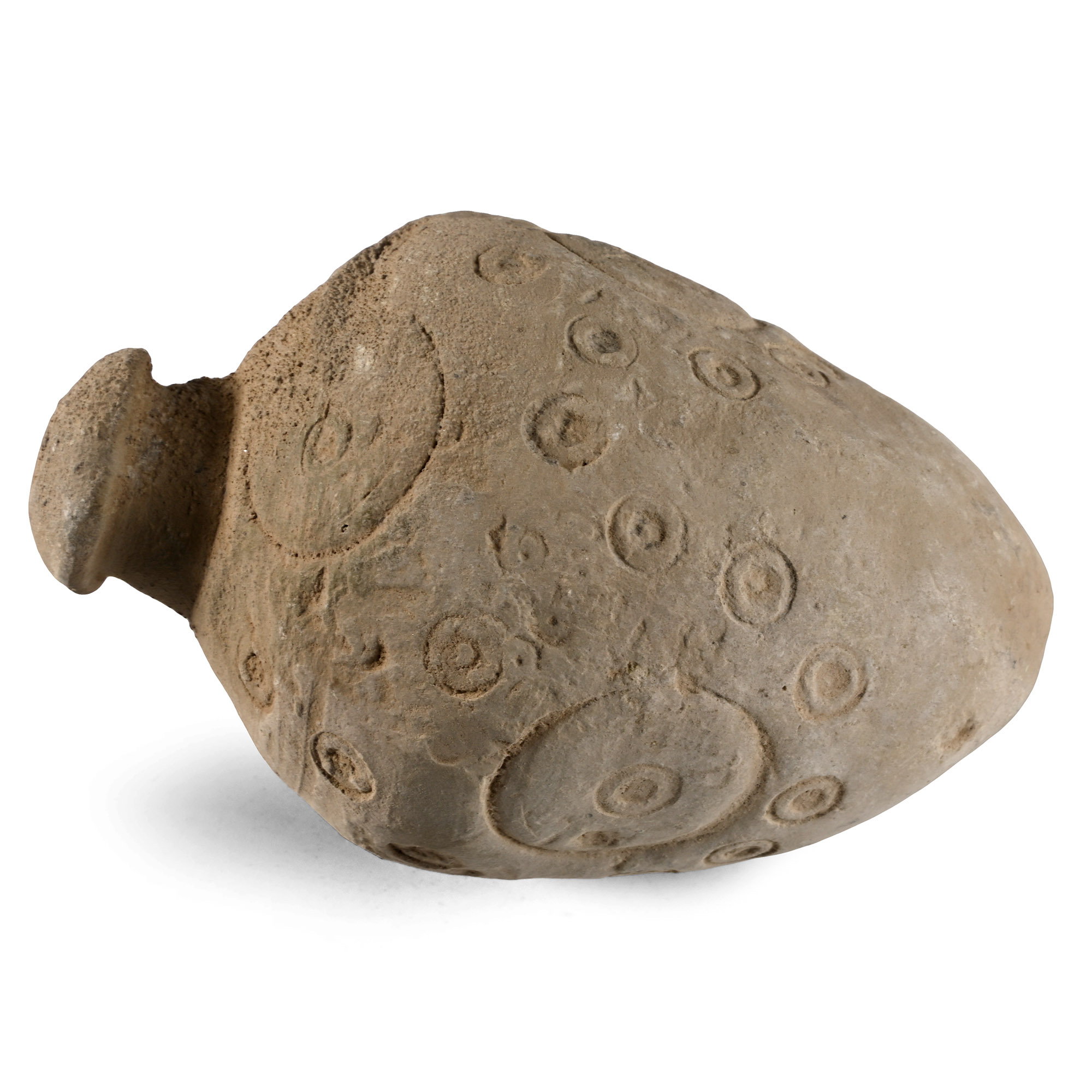
Byzantine 'Greek Fire' Ceramic Fire Bomb or Hand Grenade
9TH-11TH CENTURY A.D.
4 1/2 in. (376 grams, 11.6 cm).
Bulbous body with rounded base and domed filler hole, the body decorated with impressed ring-and-dot motifs; intended to be filled with explosive liquid and a wick, and used as a hand grenade. [No Reserve]
ProvenanceEx important collection of weaponry, London, UK, 1980-1990s.
Accompanied by an academic paper by military specialist Dr Raffaele D'Amato, dated 15 July 2019 and titled 'Eastern Roman Empire - Greek Fire Bomb or Hand Grenade (μεσαίον kακάβιον) 9th-11th century AD'.
Cf. Arendt, W. I., Granaten des 13-14. Jahrhunderts, die an der Wolga gefunden sind, Zeitschrift fur Historische Waffen-und Kostumkunde, 11 (1926-8), p.42; cf. Arendt, W., Die Spharisch-konischen Gefäße aus Gebranntem Ton, ibid; cf. Ayalon, D., Gunpowder and Firearms in the Mamluk Kingdom, London, 1956, p.16. v
FootnotesApart from the use of siphons or manual flame-throwers called cheirosiphona, special corps of Roman soldiers employed terracotta grenades, in the form of small jars, abundantly evidenced in archaeological excavations. They were called μεσαία kακαβιά or κυτροκακάβια, where the former had a bulbous shape and the latter a more cylindrical form.
CONDITIONTimeLine Auctions follows a vetting process to ensure the authenticity and legality of all items, reinforcing our commitment to integrity and responsible trading. Each antiquity, antique, and coin lot undergoes thorough examination by a vetting committee of at least ten external specialists, professional trade association members, scientists, and archaeologists: Our Vetting Process
AUCTIONS:
TimeLine is a leading auction house specialising in antiquities, ancient art, collectables, natural history, coins, medals, and books. Our auctions offer museums, collectors, historians, and enthusiasts the opportunity to acquire unique and historically significant pieces.
LOT 1451
Byzantine 'Greek Fire' Ceramic Fire Bomb or Hand Grenade
Estimate £70 - 90€81 - 104 (for guidance only)$95 - 122 (for guidance only)
Opening Bid
£5 (EUR 6; USD 7) +BP*
-
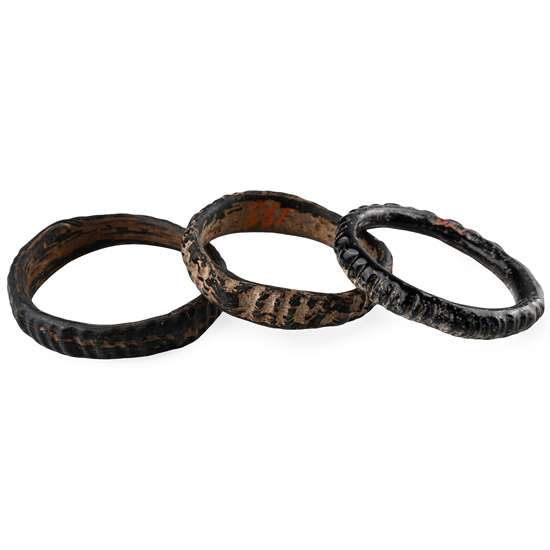
Byzantine Decorated Glass Bracelet Group
Circa 6th-10th century A.D.Estimate: £60 - 80 (+bp*)
Opening Bid: £5
D-shaped in section with corrugations to the outer face. 41 grams total, 52 - 56 mm
Acquired on the UK art market since the 1990s. From the property of a late Lincolnshire, UK, gentleman; thence by descent. -
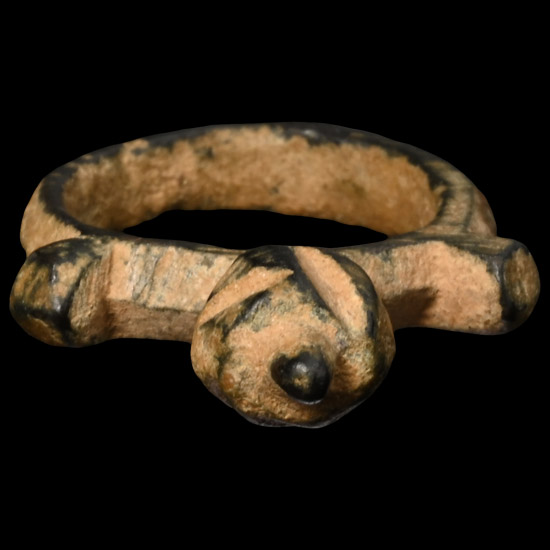
Byzantine Bronze Architectural Ring
6th century A.D.Estimate: £40 - 60 (+bp*)
Opening Bid: £5
Hoop with carinated profile and spur to each shoulder, cup and lobe projection with barleytwist detailing, mandrel to the upper face. 5.74 grams, 31.20 mm overall, 14.40 mm internal diameter (approximate size British G, USA 3 1/4, Europe 4.92, Japan 4)
From the private collection of a European gentleman (1942-2024), formed since the 1970s. -
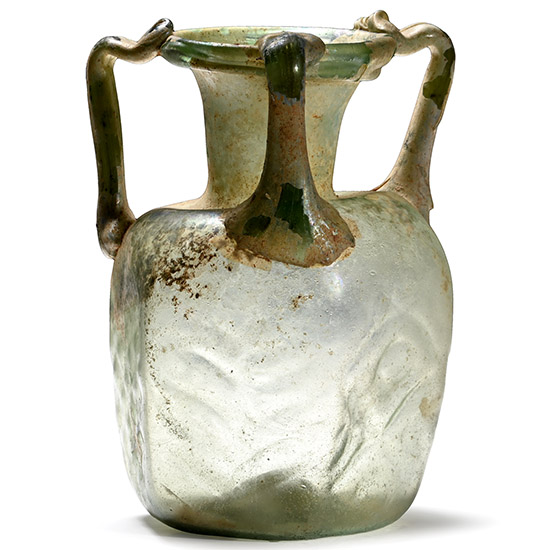
Byzantine Mould-Blown Translucent Pale Green Glass Three-Handled Jug
5th-8th century A.D.Estimate: £1,000 - 1,400 (+bp*)
Opening Bid: £550
Hexagonal body with a short cylindrical neck and a flaring rim, three applied handles extending from the rim to the shoulders, geometric decoration on the panels. 58 grams, 93 mm high
Roman glass from an important London collection, acquired from the early 1980s. From an important London glass collection, 1990s. Accompanied by a typed previous catalogue information page with provenance.
These octagonal or hexagonal jugs or jars were possibly made as tokens for pilgrims visiting the holy sites in Jerusalem or for use in burial rites. In the late 6th and early 7th century A.D., they were mass-produced in moulds for the pilgrim trade in the Holy Land, in the vicinity of the holy city, but they were found all around the Mediterranean, especially in islands like Cyprus, an important place on the sea route that brought pilgrims to Jerusalem. Such vessels were probably filled with oil from holy sites and sold to pilgrims.
