Loading, please wait...
Details
LOT 1510
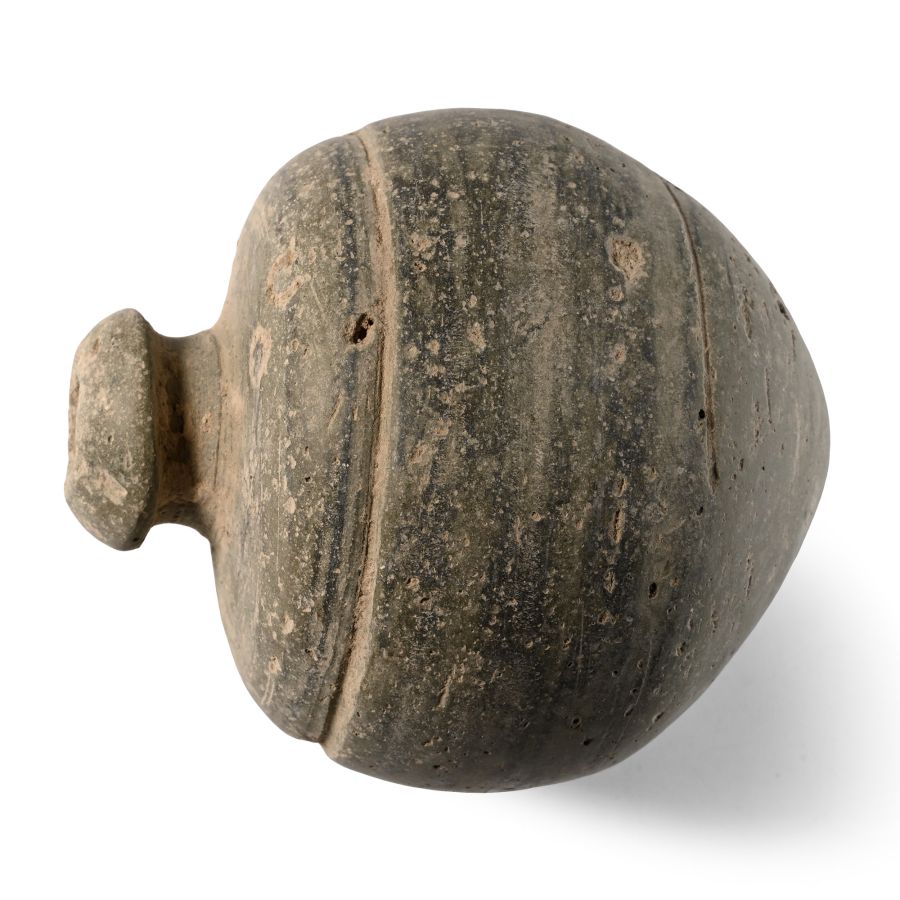
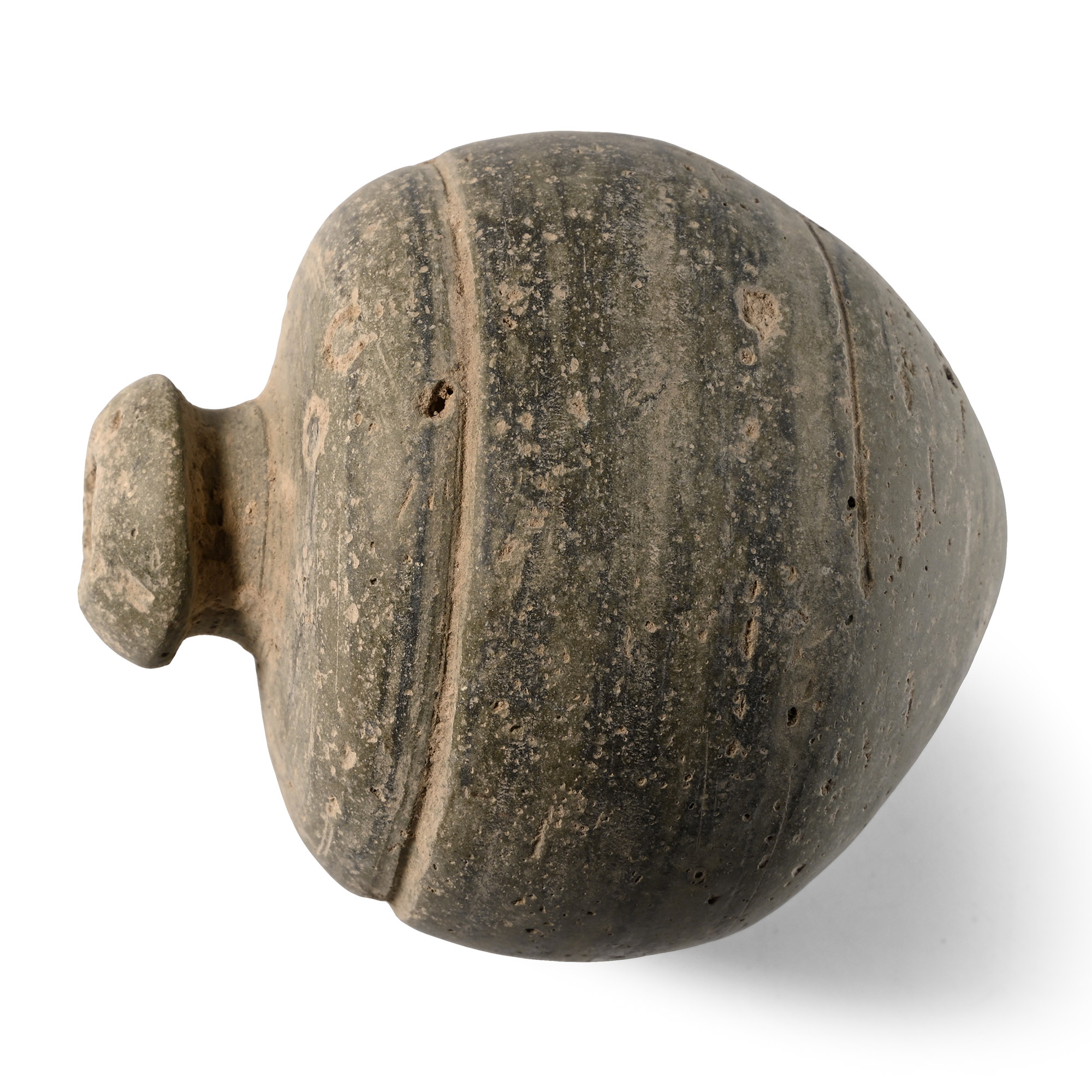
Byzantine 'Greek Fire' Ceramic Fire Bomb or Hand Grenade
9TH-11TH CENTURY A.D.
3 1/4 in. (251 grams, 84 mm).
Ovoid body with impressed ring to the shoulder, domed filler-hole; intended to be filled with explosive liquid and a wick, and used as a hand grenade. [No Reserve]
Provenance
From an important specialist collection, London, UK, 1990s onwards.
Accompanied by an academic paper by military specialist Dr Raffaele D'Amato, dated 15 July 2019 and titled 'Eastern Roman Empire - Greek Fire Bomb or Hand Grenade (μεσαίον kακάβιον) 9th-11th century AD'.
Literature
Cf. Arendt, W. I., Granaten des 13-14. Jahrhunderts, die an der Wolga gefunden sind, Zeitschrift fur Historische Waffen-und Kostumkunde, 11 (1926-8), p.42; cf. Arendt, W., Die Spharisch-konischen Gefäße aus Gebranntem Ton, ibid; cf. Ayalon, D., Gunpowder and Firearms in the Mamluk Kingdom, London, 1956, p.16.
Footnotes
Apart from the use of siphons or manual flame-throwers called cheirosiphona, special corps of Roman soldiers employed terracotta grenades, in the form of small jars, abundantly evidenced in archaeological excavations. They were called μεσαία kακαβιά or κυτροκακάβια where the former had a bulbous shape and the latter a more cylindrical form.
CONDITIONVETTING:
TimeLine Auctions follows a vetting process to ensure the authenticity and legality of all items, reinforcing our commitment to integrity and responsible trading. Each antiquity, antique, and coin lot undergoes thorough examination by a vetting committee of at least ten external specialists, professional trade association members, scientists, and archaeologists: Our Vetting Process
AUCTIONS:
TimeLine is a leading auction house specialising in antiquities, ancient art, collectables, natural history, coins, medals, and books. Our auctions offer museums, collectors, historians, and enthusiasts the opportunity to acquire unique and historically significant pieces.
LOT 1510
Byzantine 'Greek Fire' Ceramic Fire Bomb or Hand Grenade
Sold for (Inc. bp): £91
RELATED LOTS
-
Medieval Knight's Iron Hand-and-a-Half Sword with Inscribed Bronze Pommel
Germany, 14th century A.D.Sold for (Inc. bp): £14,300
Longsword of Oakeshott's Type XVa, cross style 8, bronze pommel style J (recessed); strongly tapering, pointed blade of ‘flattened diamond’ section, cross style tapering gradually outward to sharply downturned tips; long grip with slight taper, disc pommel with chamfered edges and a potent cross in the centre surrounded by an inscription (on both sides) '+ IH SU + AAWM'. 1.25 kg, 113 cm
From the private family collection of a lady, UK; acquired in Germany mid 20th century. Accompanied by an academic report by Dr Raffaele D’Amato. This lot has been checked against the Interpol Database of stolen works of art and is accompanied by search certificate number no.13034-24799.
Some wheel pommels of this date have engraved, or inset roundels with armorial or devotional emblems, and a number of sword blades of this date bear religious inscriptions in the form of a prayer. The inscription on the pommel between the two potent crosses is intriguing. The letters 'IH SU' are a clear reference to the name of the Saviour, and can be translated as Ihesu-Jesus, or also Ihesu Merci (Jesus have mercy), a simple prayer for the person carrying the sword. The letters 'A.A. W.M.' could refer to the name of the owner of the sword (WM = Wilhelm) or the maker of the weapon. It is difficult to consider the letters as an abbreviation of the prayer ‘Ave Maria’, usually shortened in the German medieval inscriptions as A.M. -
Frankish Warrior's Iron Byrnie Chain Mail Armour
Northern Europe, circa 6th-10th century A.D.Sold for (Inc. bp): £4,680
A nearly complete short-sleeved ring armour composed of interlocking links in the four-through-one formation with alternating rivetted rings. 4.71 kg, 65 x 75 cm
From the private collection of a London gentleman, from his grandfather's collection formed before the early 1970s. Accompanied by an academic report by Dr Raffaele D’Amato. This lot has been checked against the Interpol Database of stolen works of art and is accompanied by a search certificate number no.13041-248010.
The rings are arranged in rows, and the links within the same row do not join. Instead, each ring connects to two rings in the row above and two in the row beneath. A great majority of all-rivetted mail comes from Southern Scandinavia and Northern Europe, notably Sweden, northern Germany and Poland. All-rivetted mail already occurs there during the Roman Iron Age, and continues into the Migration, the Vendel, and then the Viking periods. Rivetted rings were usually fabricated by shaping metal wire into a circle with the ends overlapping several mm. Here, the riveted rings seem to be of reshaped oval form. -
Medieval Warrior's Iron Chain Mail Armour Shirt
Circa 15th century A.D.Sold for (Inc. bp): £1,820
A butted short-sleeved chainmail shirt made of thick oval rings assembled in the usual system of one-to-four; in an excellent state of preservation, with over 95% of the rings intact, very few broken or corroded, with no later additions. 9.93 kg, 87 x 56 cm
Acquired on the German art market before 2000. Private collection, South Germany. Accompanied by an academic report by Dr Raffaele D'Amato. This lot has been checked against the Interpol Database of stolen works of art and is accompanied by search certificate no.13066-249665.
In the German-manufactured ring mail armours, in the 15th century A.D., the rings protecting the breast were very thick, whereas the sleeved mail armours were thinner. Master armourers from Nuremberg were famous for this production across Europe.