
Loading, please wait...
LOT 1579
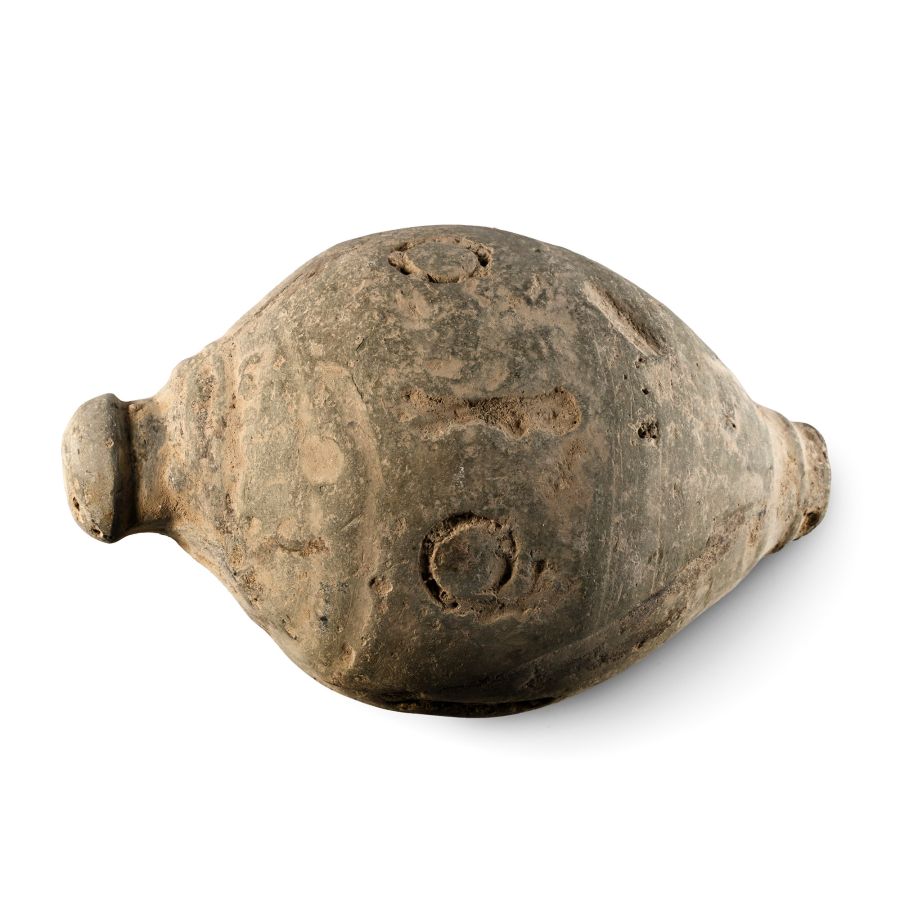
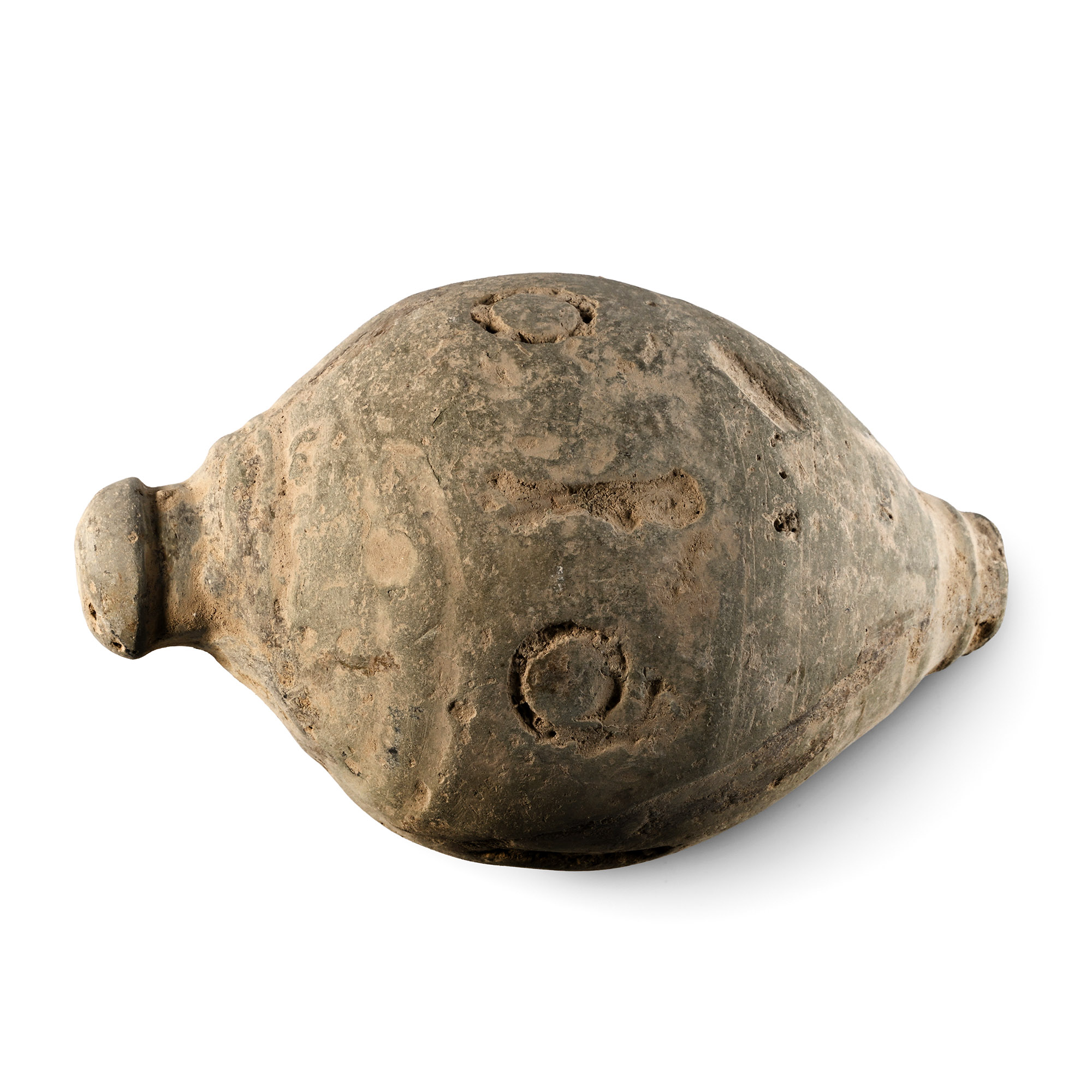
Byzantine 'Greek Fire' Ceramic Fire Bomb or Hand Grenade
9TH-11TH CENTURY A.D.
5 3/4 in. (691 grams, 14.6 cm).
Ovoid in profile with a rounded base, a band of annulets and vertical lines on the upper body; intended to be filled with explosive liquid and a wick, and used as a hand grenade. [No Reserve]
ProvenanceFrom a specialist collection, London, UK, 1990-2000s.
Accompanied by an academic paper by military specialist Dr Raffaele D'Amato, dated 15 July 2019 and titled 'Eastern Roman Empire - Greek Fire Bomb or Hand Grenade (μεσαίον kακάβιον) 9th-11th century AD'.
Cf. Arendt, W. I., Granaten des 13-14. Jahrhunderts, die an der Wolga gefunden sind, Zeitschrift fur Historische Waffen-und Kostumkunde, 11 (1926-8), p.42; cf. Arendt, W., Die Spharisch-konischen Gefäße aus Gebranntem Ton, ibid; cf. Ayalon, D., Gunpowder and Firearms in the Mamluk Kingdom, London, 1956, p.16.
FootnotesApart from the use of siphons or manual flame-throwers called cheirosiphona, special corps of Roman soldiers employed terracotta grenades, in the form of small jars, abundantly evidenced in archaeological excavations. They were called μεσαία kακαβιά or κυτροκακάβια, where the former had a bulbous shape and the latter a more cylindrical form.
CONDITIONTimeLine Auctions follows a vetting process to ensure the authenticity and legality of all items, reinforcing our commitment to integrity and responsible trading. Each antiquity, antique, and coin lot undergoes thorough examination by a vetting committee of at least ten external specialists, professional trade association members, scientists, and archaeologists: Our Vetting Process
AUCTIONS:
TimeLine is a leading auction house specialising in antiquities, ancient art, collectables, natural history, coins, medals, and books. Our auctions offer museums, collectors, historians, and enthusiasts the opportunity to acquire unique and historically significant pieces.
LOT 1579
Byzantine 'Greek Fire' Ceramic Fire Bomb or Hand Grenade
Sold for (Inc. bp): £91
-
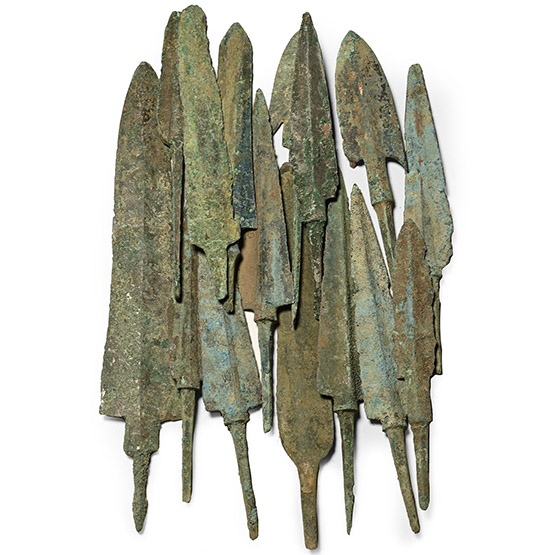
Luristan Bronze Arrowhead Group
13th-6th century B.C.Sold for (Inc. bp): £234
Including barbed, triangular, heater-shaped and other tanged types. 442 grams total, 11.3-19.5 cm
Acquired 1980-2015. Ex Abelita family collection. -
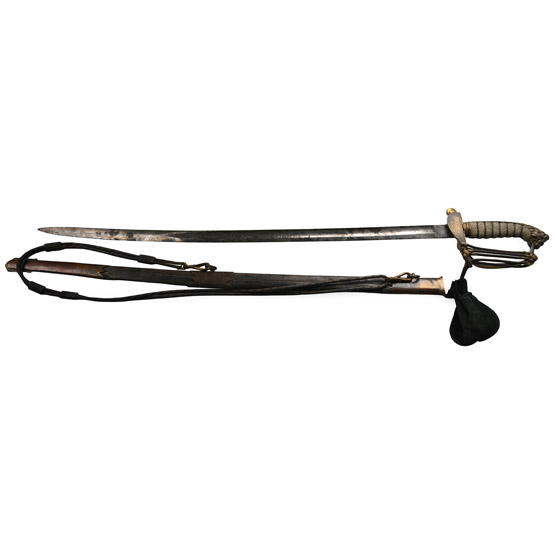
Royal Navy Officer’s Sword for Battle of Trafalgar Midshipman (Later Commander) James Eaton
1827 PatternSold for (Inc. bp): £4,680
A solid half-basket-hilt with folding guard, engraved 'J.S. Eaton, R.N.' in copperplate; lion-head pommel with knuckle-bow entering through the lion's mouth, 'ray-skin' grip and retaining wires; sword-knot tied through slot in the knuckle-bow (now in protective velvet pouch); pipe-backed single-edged blade with etched crown-and-anchor design to one face and heraldic helm to the other, ricasso with reserved six-pointed star and inset gold disc with blackletter 'D'; black leather scabbard with three brass fittings (locket, middle and chape) and two suspension rings; suspension cord with decorative braided banded keepers. 1.31 kg, 95 cm
Believed to have been owned by James Eaton, famed for serving at the battle of Trafalgar, and in later life, Commander. Ex Newbury antique emporium. Property of a Berkshire, UK, gentleman collector. Accompanied by copies of various online biographical research information. This lot has been checked against the Interpol Database of stolen works of art and is accompanied by search certificate number no.13157-246979.
The sword is believed to have belonged to Eaton in later life, when he had been promoted to the rank of Commander. The Trafalgar Roll (p.53) and other sources record his career in some detail. James Eaton was born in London in 1783 and entered service in the Royal Navy in 1799, aged 16, aboard the Quebec stationed in the West Indies, and in 1800 he was appointed Midshipman to the vessel La Prompte. He was in the mizentop of the Hannibal in the action off Algeciras, Spain, in 1801 when she was obliged to surrender, having sustained losses of 81 men killed and 62 wounded; he was then in an exchange of prisoners and returned to Britain aboard the San Antonio which had been captured from the Spanish in battle at Cadiz. As a midshipman in 1803, he served on the Atalante intercepting enemy smuggling and supply vessels near St. Gildas in the bay of Quiberon, Brittany. Eaton was the Signal Midshipman of the Téméraire at the battle of Trafalgar in 1805 and was the first signal officer to repeat Nelson's famous message 'England expects that every man will do his duty' to the rest of the fleet, an illustrious and important achievement: J.M.W. Turner created a magnificent painting of the Téméraire which is now featured on United Kingdom £20 notes. This ship took part in the thick of the action at Trafalgar - she came alongside and was lashed to the French ships Fougeux and Redoutable, the crew of which was about to board Nelson's flagship, HMS Victory until a broadside was delivered which caused a huge loss of life and saved Nelson's vessel from the hands of the French. He was promoted to lieutenant the following year and appointed to the Lion where he served for six years. He sustained wounds in an action aboard the Lion while escorting a convoy to China and took part in 1811 in the invasion of Java mounted against the Dutch East India Company. In 1813, he was aboard the Beaver when she rescued the crew of a Swedish merchant vessel and received a distinction for his part in the action. He retired in 1842 with the rank of Commander with the Naval General Service Medal and two clasps in recognition of his distinguished career. He finally settled in West Bromwich; he died fifteen years later. Less glorious, perhaps, is his nickname 'Snotty' Eaton - the normal term in those days used to describe any midshipman. The vendor has been told by Will Heppa, curator at the Royal Navy Museum, that there appears to be only one 'J Eaton' in the records of the appropriate period; there is thus every reason to accept that the sword did belong to the Eaton of Trafalgar fame. -
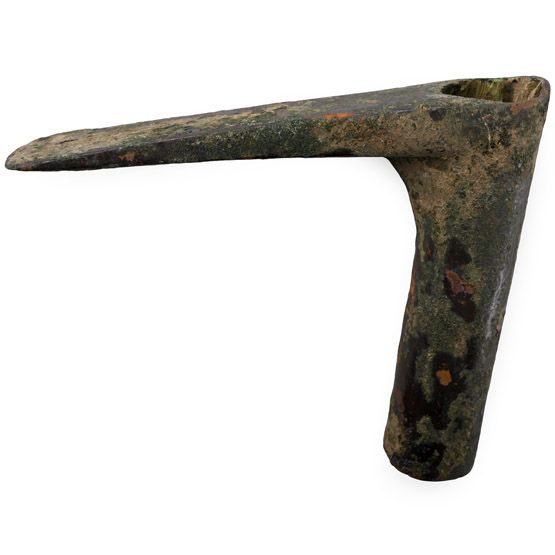
Luristan Bronze Socketted Adze
2nd-1st millennium B.C.Estimate: £100 - 140 (+bp*)
Opening Bid: £50
Long tubular socket, rectangular-section tapering blade with convex cutting edge. 355 grams, 14.2 cm
Ex Abelita family collection, 1980s-2000s.
