
Loading, please wait...
LOT 1534
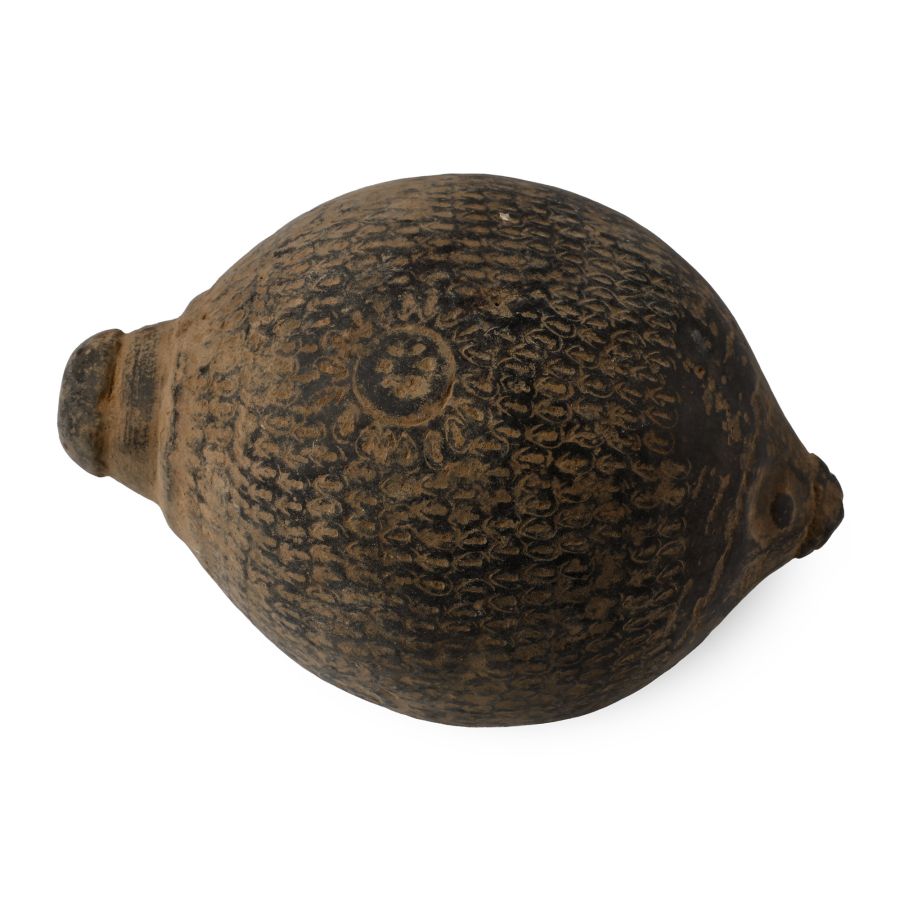
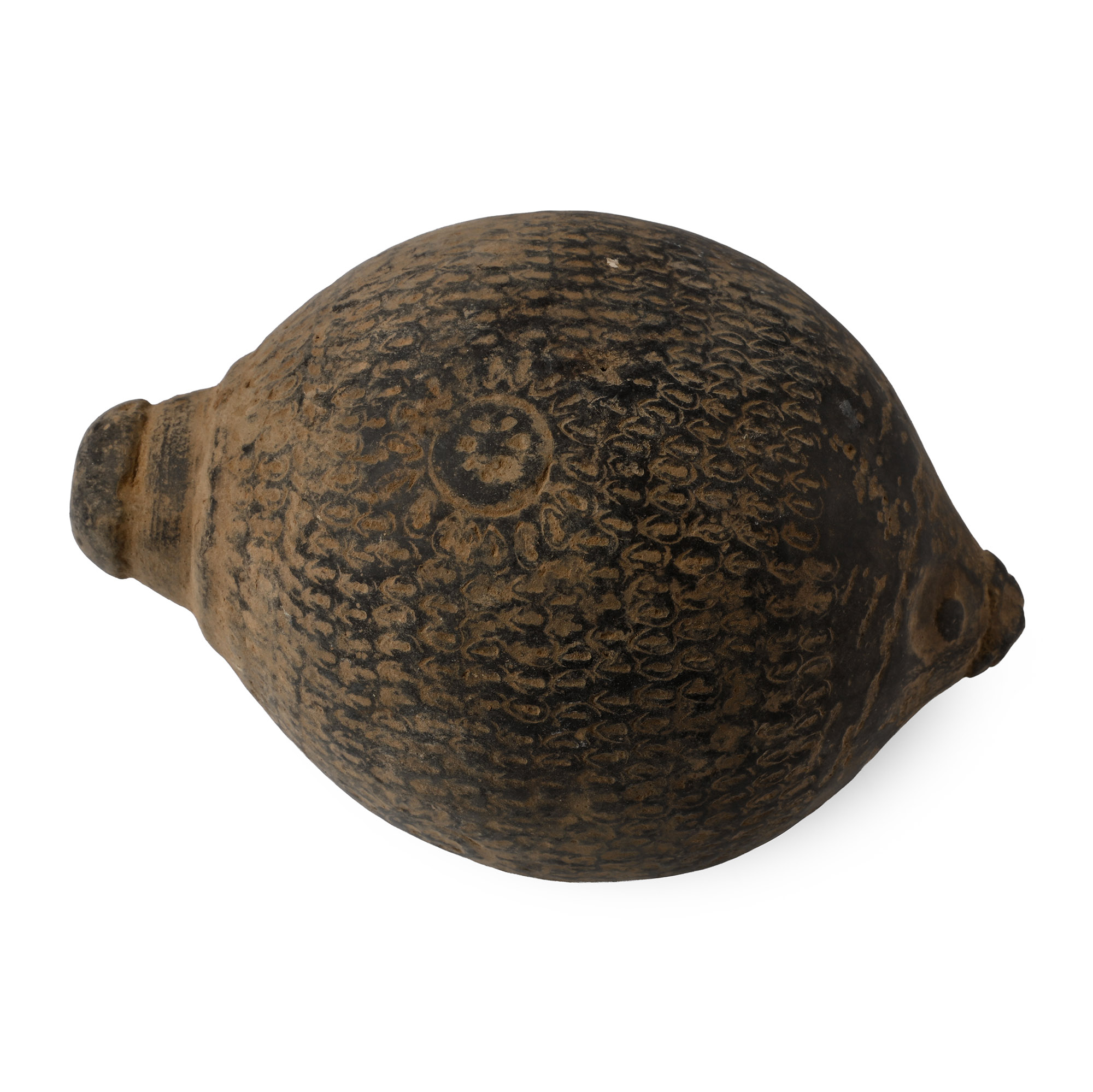
Byzantine 'Greek Fire' Ceramic Fire Bomb or Hand Grenade
9TH-11TH CENTURY A.D.
5 1/2 in. (757 grams, 14.1 cm).
Rounded body with tiered neck and domed mouth, body decorated with tightly arranged teardrop-shaped motifs with large rosettes on the shoulder; intended to be filled with explosive liquid and a wick, and used as a hand grenade. [No Reserve]
ProvenanceFrom an important specialist collection, London, UK, 1990s onwards.
Accompanied by an academic paper by military specialist Dr Raffaele D'Amato, dated 15 July 2019 and titled 'Eastern Roman Empire - Greek Fire Bomb or Hand Grenade (μεσαίον kακάβιον) 9th-11th century AD'.
This lot is accompanied by an illustrated lot declaration signed by the Head of the Antiquities Department, Dr Raffaele D'Amato.
Cf. Arendt, W. I., Granaten des 13-14. Jahrhunderts, die an der Wolga gefunden sind, Zeitschrift fur Historische Waffen-und Kostumkunde, 11 (1926-8), p.42; cf. Arendt, W., Die Spharisch-konischen Gefäße aus Gebranntem Ton, ibid; cf. Ayalon, D., Gunpowder and Firearms in the Mamluk Kingdom, London, 1956, p.16.
FootnotesApart from the use of siphons or manual flame-throwers called cheirosiphona, special corps of Roman soldiers employed terracotta grenades, in the form of small jars, abundantly evidenced in archaeological excavations. They were called μεσαία kακαβιά or κυτροκακάβια where the former had a bulbous shape and the latter a more cylindrical form.
CONDITIONTimeLine Auctions follows a vetting process to ensure the authenticity and legality of all items, reinforcing our commitment to integrity and responsible trading. Each antiquity, antique, and coin lot undergoes thorough examination by a vetting committee of at least ten external specialists, professional trade association members, scientists, and archaeologists: Our Vetting Process
AUCTIONS:
TimeLine is a leading auction house specialising in antiquities, ancient art, collectables, natural history, coins, medals, and books. Our auctions offer museums, collectors, historians, and enthusiasts the opportunity to acquire unique and historically significant pieces.
LOT 1534
Byzantine 'Greek Fire' Ceramic Fire Bomb or Hand Grenade
Sold for (Inc. bp): £182
-
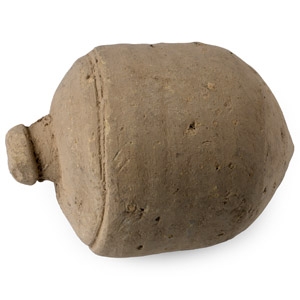
Byzantine 'Greek Fire' Ceramic Fire Bomb or Hand Grenade
9th-11th century A.D.Sold for (Inc. bp): £111
Cylindrical body with pointed tip and domed mouth; intended to be filled with explosive liquid and a wick, and used as a hand grenade. 820 grams, 14 cm
From an important specialist collection, London, UK, 1990s onwards. Accompanied by an academic paper by military specialist Dr Raffaele D'Amato, dated 15 July 2019 and titled 'Eastern Roman Empire - Greek Fire Bomb or Hand Grenade (μεσαίον kακάβιον) 9th-11th century AD'. This lot is accompanied by an illustrated lot declaration signed by the Head of the Antiquities Department, Dr Raffaele D'Amato.
Apart from the use of siphons or manual flame-throwers called cheirosiphona, special corps of Roman soldiers employed terracotta grenades, in the form of small jars, abundantly evidenced in archaeological excavations. They were called μεσαία kακαβιά or κυτροκακάβια where the former had a bulbous shape and the latter a more cylindrical form. -
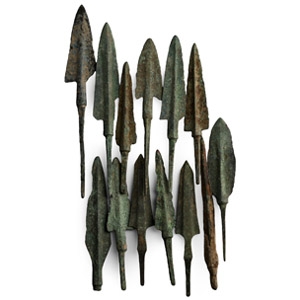
Luristan Bronze Arrowhead Collection
2nd-1st millennium B.C.Sold for (Inc. bp): £143
Comprising mainly barbed-and-tanged and leaf-shaped types. 315 grams total, 11-16.5 cm
From a London collection, 1990s-2000. This lot is accompanied by an illustrated lot declaration signed by the Head of the Antiquities Department, Dr Raffaele D'Amato. -
.jpg)
Caucasian Axehead with Engraved Dragon Heads
Koban Culture, 12th-8th century B.C.Sold for (Inc. bp): £11,050
Comprising a swept curved edge, slender neck with faceting, bulb socket and small striking face to the butt; frieze of hatched serpentine necks and heads to each face of the blade, with reserved triangles; band of hatched chevrons to the neck, horizontal fluting to the socket; mounted on a custom-made stand. 806 grams total including stand, axehead: 18.8 cm
Franz Heger (1853-1931), Austrian traveller and ethnographer, acquired in the Caucasus during his 1890 expedition. Believed to have been gifted circa 1930 to Franz Hancar (1893-1968), noted scholar and expert in ancient Caucasian cultures. Thence by descent, acquired in the 1950s by Mr R.D., Vienna, Austria. Acquired from the above in 1998 by N.M., former Israeli Ambassador to Austria (1998-2000). Accompanied by an academic report by Dr Raffaele D'Amato. This lot has been checked against the Interpol Database of stolen works of art and is accompanied by a search certificate number no.12840-240720. This lot has been cleared against the Art Loss Register database, and is accompanied by an illustrated lot declaration signed by the Head of the Antiquities Department, Dr Raffaele D'Amato.
During the latter half of the 2nd millennium B.C., one type of axe head dominated in the region of the Eastern European steppes. It had a narrow horizontal blade, a short blade and a tube-shaped handle. Examples have been found across the steppes of Eastern Europe from Transcaucasia. From the middle of the second millennium B.C., the spread of the type in the Eastern Steppes was connected with the movement of Iranian-speaking nomads, maybe the Tocharo-speaking tribes, who used two-wheeled horse-drawn war chariots.
