
Loading, please wait...
LOT 1057
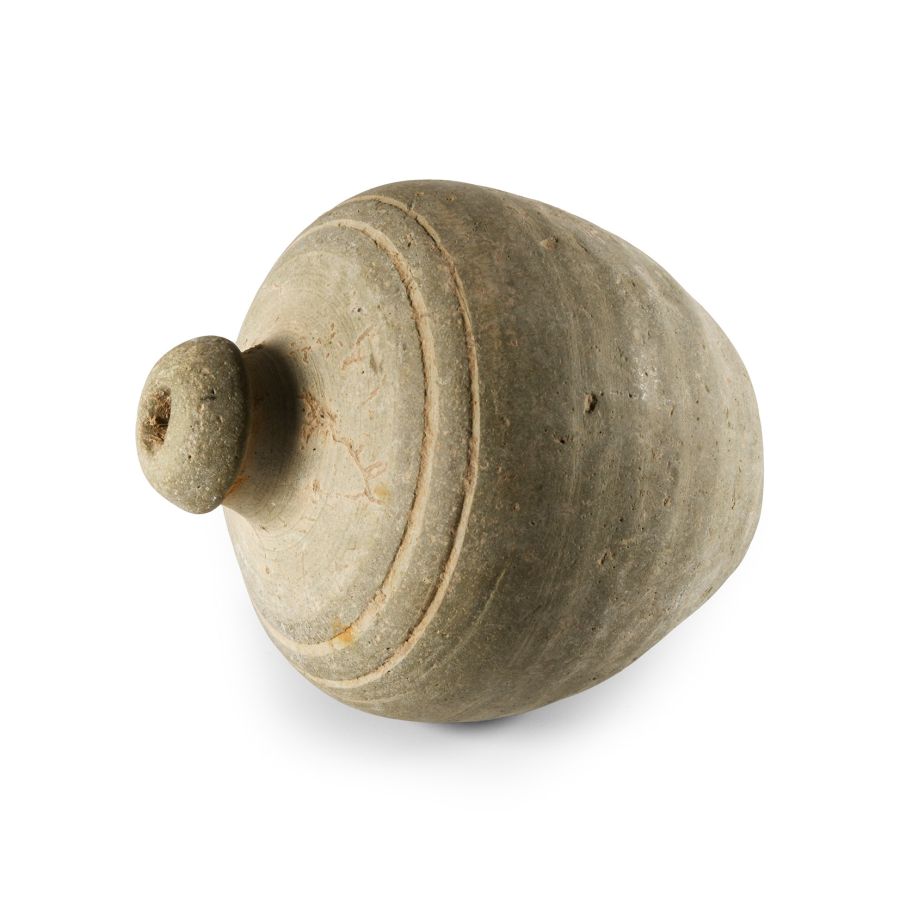
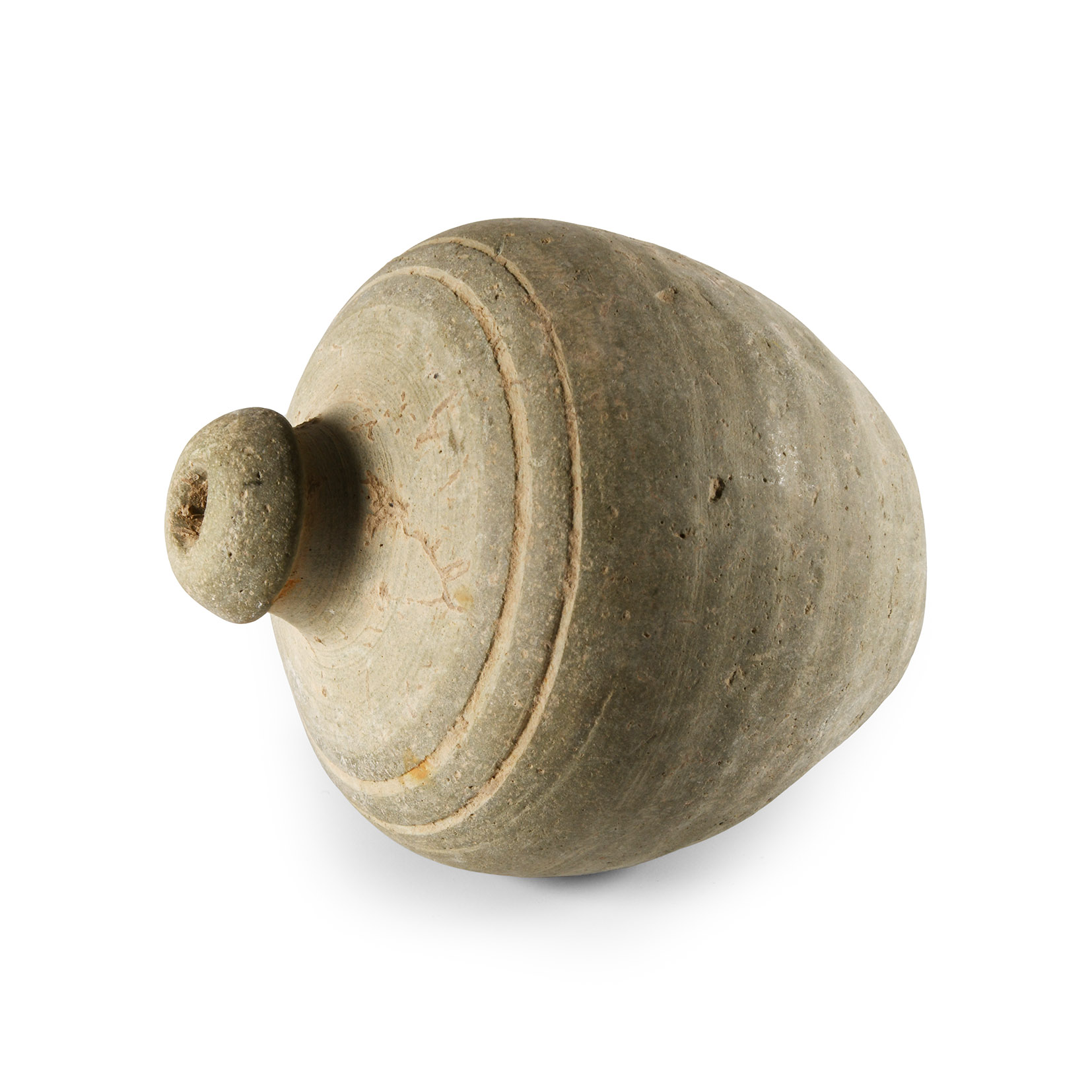
Byzantine 'Greek Fire' Ceramic Fire Bomb or Hand Grenade
9TH-11TH CENTURY A.D.
4 in. (355 grams, 10.3 cm).
Piriform body with domed filler-hole, marked by horizontal lines to the shoulder; intended to be filled with explosive liquid and wick, used as a hand grenade. [No Reserve]
ProvenanceAcquired 1980-2015.
Ex Abelita family collection.
Accompanied by an academic paper by military specialist Dr Raffaele D'Amato, dated 15 July 2019 and titled 'Eastern Roman Empire - Greek Fire Bomb or Hand Grenade (μεσαίον kακάβιον) 9th-11th century AD'.
Cf. Arendt, W. I., Granaten des 13-14. Jahrhunderts, die an der Wolga gefunden sind, Zeitschrift fur Historische Waffen-und Kostumkunde, 11 (1926-8), p.42; cf. Arendt, W., Die Spharisch-konischen Gefasse aus Gebranntem Ton, ibid; cf. Ayalon, D., Gunpowder and Firearms in the Mamluk Kingdom, London, 1956, p.16.
FootnotesApart from the use of siphons or manual flame-throwers called cheirosiphona, special corps of Roman soldiers employed terracotta grenades, in the form of small jars, abundantly evidenced in archaeological excavations. Such were the γανωτα, vessels (sometimes also of bronze) used for Greek fire. They were called μεσαία kακαβιά or κυτροκακάβια where the former had a bulbous shape and the latter a more cylindrical form.
CONDITIONTimeLine Auctions follows a vetting process to ensure the authenticity and legality of all items, reinforcing our commitment to integrity and responsible trading. Each antiquity, antique, and coin lot undergoes thorough examination by a vetting committee of at least ten external specialists, professional trade association members, scientists, and archaeologists: Our Vetting Process
AUCTIONS:
TimeLine is a leading auction house specialising in antiquities, ancient art, collectables, natural history, coins, medals, and books. Our auctions offer museums, collectors, historians, and enthusiasts the opportunity to acquire unique and historically significant pieces.
LOT 1057
Byzantine 'Greek Fire' Ceramic Fire Bomb or Hand Grenade
Sold for (Inc. bp): £416
-
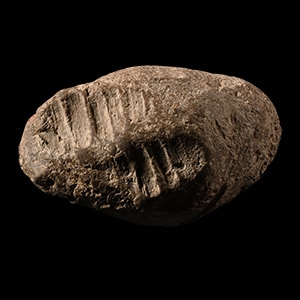
Roman Praetorian Guard Terracotta Sling Shot with Scorpion
1st century A.D.Sold for (Inc. bp): £286
Lentoid section with a raised 'keel' to one end, depicting a stylised scorpion. 25.75 grams, 43 mm
Ex Simmons Gallery, London E11, UK, in the 1990s. From a North London collection.
The sling (funda) with its lead (plumbea pondera) and stone missiles was used by special funditores, illustrated on Trajan’s Column where they are dressed in broad tunics with no armour, but carry a shield. Interestingly, this glans has the emblem usually associated with the Praetorian Guard - the scorpion. It was an emblem also used in Ptolemaic Egypt, and it is not impossible that this bullet could be Ptolemaic or Romano-Egyptian. We believe this bullet could be associated with the Praetorian regiments which means this could be one of the first pieces of evidence for their use. -
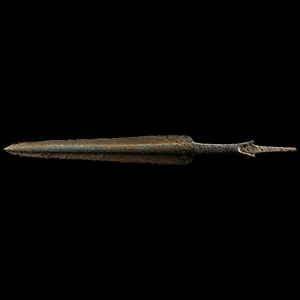
Amlash Type Bronze Spearhead
13th-12th century B.C.Sold for (Inc. bp): £117
Showing a long tapering blade with rounded shoulders and prominent mid-rib, the tang straight and rectangular in section. 411 grams, 40.5 cm
Acquired 1980-2015. Ex Abelita family collection.
The weapon belongs to the type 1 of the Khorasani spearhead classification, mainly from the Marlik or Amlash areas. Similar pieces have been dated by Stutzinger to 1200-1100 B.C., but the period of use is attested to at least until 1000 B.C. -
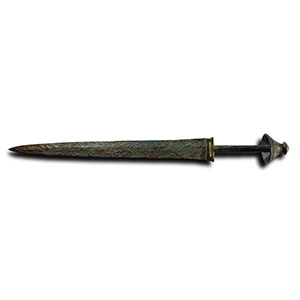
Amarlu Bronze Dagger with Bell-shaped Pommel
Late 2nd millennium B.C.Sold for (Inc. bp): £715
With solid cast hilt, straight horizontal guard with turquoise inlay; plain narrow grip with conical hollow cast mushroom pommel decorated with dots and lines; wide shallow midrib on the blade tapering to a sharp tip. 505 grams, 52 cm
Ex old English collection. London art market, pre 2000. Property of a London, UK, gentleman.
Moorey and Khorasani dated swords with mushroom pommels to the end of the second millennium B.C. The weapon belongs to Category IX of the Khorasani classification, the ones with a mushroom or bell-shaped pommel. A similar example is in the National Museum of Iran, Tehran.
