
Loading, please wait...
LOT 1065
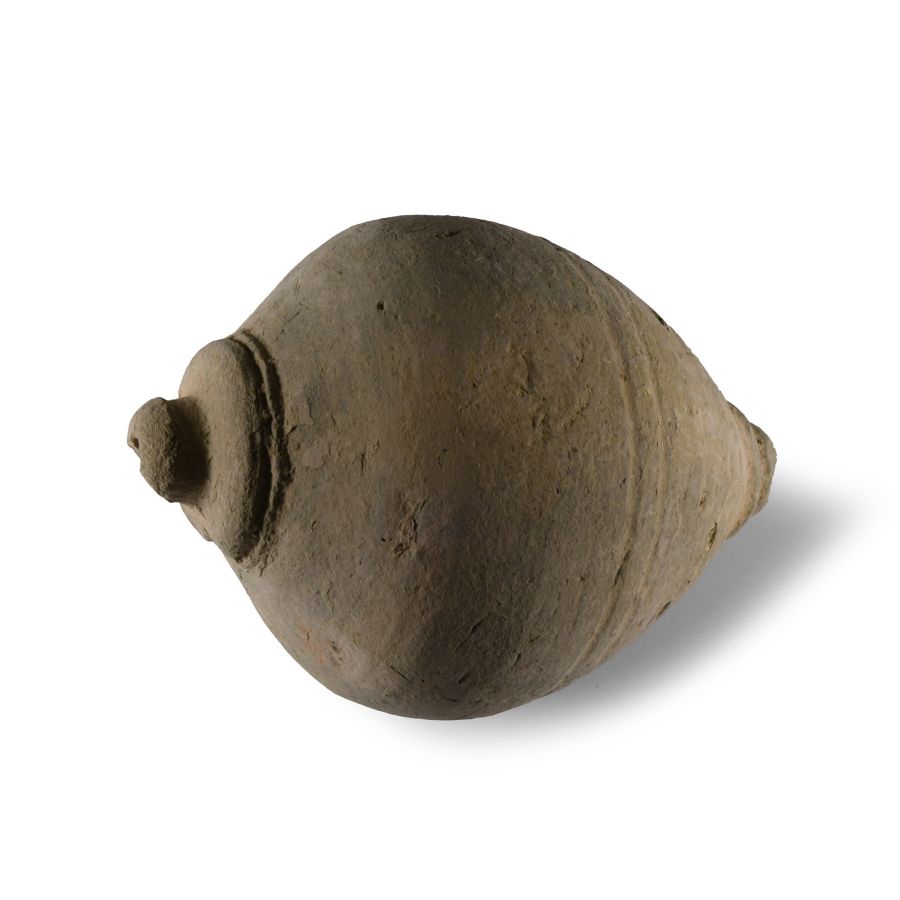
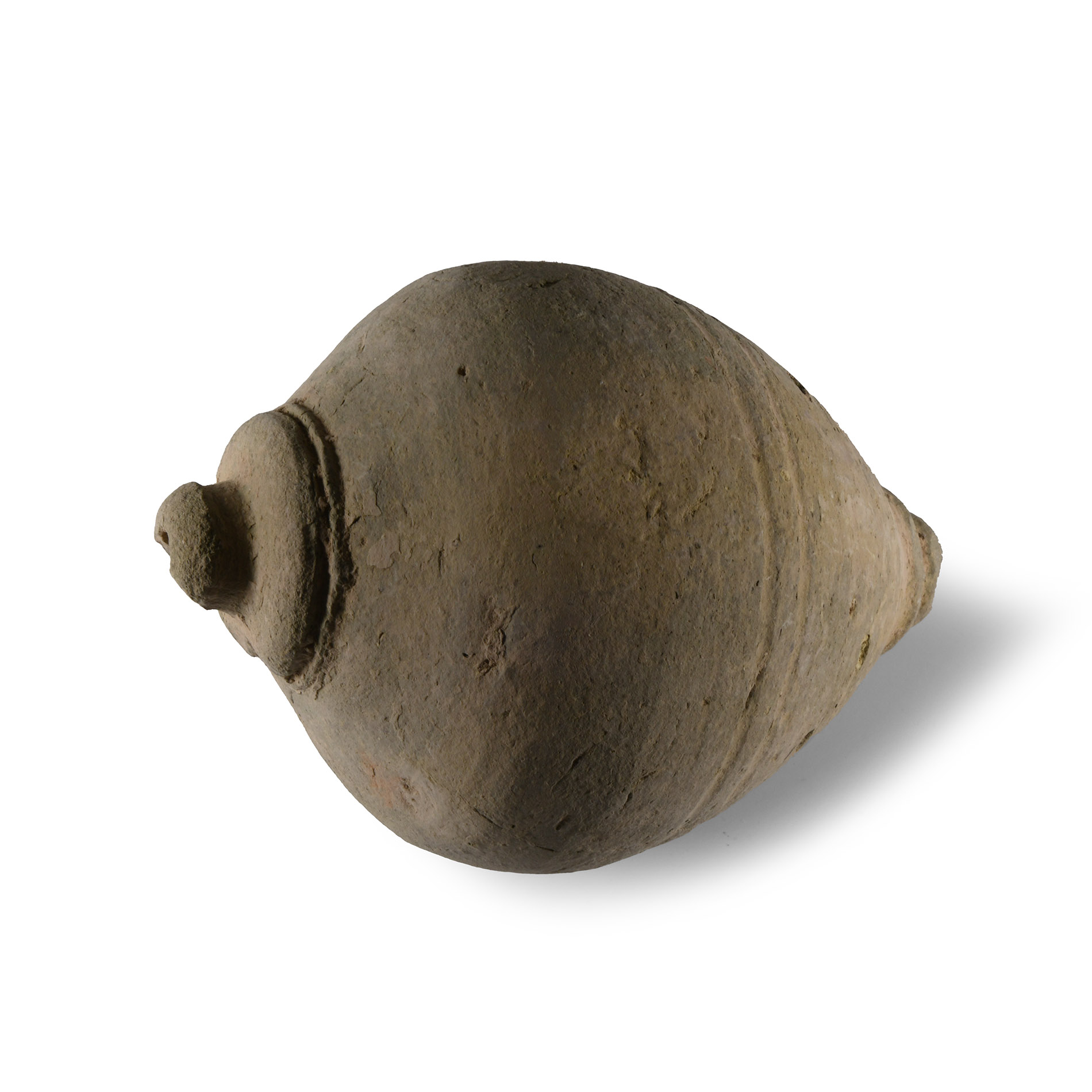
Byzantine 'Greek Fire' Ceramic Fire Bomb or Hand Grenade
CIRCA 11TH-14TH CENTURY A.D.
6 1/8 in. (964 grams, 15.5 cm high).
With a piriform body and domed mouth with two indented lines decorating the mid section; intended to be filled with explosive liquid and wick, used as a hand grenade. [No Reserve]
ProvenanceAcquired 1980-2015.
Ex Abelita family collection.
Accompanied by an academic paper by military specialist Dr Raffaele D'Amato, dated 15 July 2019 and titled 'Eastern Roman Empire - Greek Fire Bomb or Hand Grenade (μεσαίον kακάβιον) 9th-11th century AD'.
Cf. Arendt, W. I., Granaten des 13-14. Jahrhunderts, die an der Wolga gefunden sind, Zeitschrift fur Historische Waffen-und Kostumkunde, 11 (1926-8), p.42; cf. Arendt, W., Die Spharisch-konischen Gefasse aus Gebranntem Ton, ibid; cf. Ayalon, D., Gunpowder and Firearms in the Mamluk Kingdom, London, 1956, p.16; for the way of employment see D'Amato, R., Byzantine Naval Forces 1261-1461, The Roman Empire's Last Marines, Oxford, 2016, plate B, p.41.
FootnotesApart from the use of siphons or manual flame-throwers called cheirosiphona, special Roman soldiers employed terracotta grenades, in the form of small jars, abundantly evidenced in archaeological excavations. Such were the γανωτα, vessels (sometimes also in bronze) used for Greek fire. They were called μεσαία kακαβιά or κυτροκακάβια where the former had a bulbous shape and the latter a more cylindrical form.
CONDITIONTimeLine Auctions follows a vetting process to ensure the authenticity and legality of all items, reinforcing our commitment to integrity and responsible trading. Each antiquity, antique, and coin lot undergoes thorough examination by a vetting committee of at least ten external specialists, professional trade association members, scientists, and archaeologists: Our Vetting Process
AUCTIONS:
TimeLine is a leading auction house specialising in antiquities, ancient art, collectables, natural history, coins, medals, and books. Our auctions offer museums, collectors, historians, and enthusiasts the opportunity to acquire unique and historically significant pieces.
LOT 1065
Byzantine 'Greek Fire' Ceramic Fire Bomb or Hand Grenade
Sold for (Inc. bp): £144
-
Byzantine 'Greek Fire' Ceramic Fire Bomb or Hand Grenade
Circa 11th-14th century A.D.Sold for (Inc. bp): £144
With a piriform body and domed mouth with two indented lines decorating the mid section; intended to be filled with explosive liquid and wick, used as a hand grenade. 964 grams, 15.5 cm high
Acquired 1980-2015. Ex Abelita family collection. Accompanied by an academic paper by military specialist Dr Raffaele D'Amato, dated 15 July 2019 and titled 'Eastern Roman Empire - Greek Fire Bomb or Hand Grenade (μεσαίον kακάβιον) 9th-11th century AD'.
Apart from the use of siphons or manual flame-throwers called cheirosiphona, special Roman soldiers employed terracotta grenades, in the form of small jars, abundantly evidenced in archaeological excavations. Such were the γανωτα, vessels (sometimes also in bronze) used for Greek fire. They were called μεσαία kακαβιά or κυτροκακάβια where the former had a bulbous shape and the latter a more cylindrical form. -
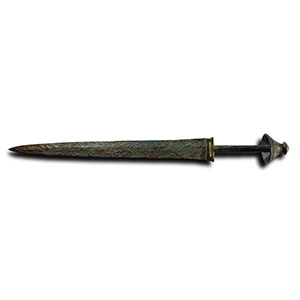
Amarlu Bronze Dagger with Bell-shaped Pommel
Late 2nd millennium B.C.Sold for (Inc. bp): £715
With solid cast hilt, straight horizontal guard with turquoise inlay; plain narrow grip with conical hollow cast mushroom pommel decorated with dots and lines; wide shallow midrib on the blade tapering to a sharp tip. 505 grams, 52 cm
Ex old English collection. London art market, pre 2000. Property of a London, UK, gentleman.
Moorey and Khorasani dated swords with mushroom pommels to the end of the second millennium B.C. The weapon belongs to Category IX of the Khorasani classification, the ones with a mushroom or bell-shaped pommel. A similar example is in the National Museum of Iran, Tehran. -
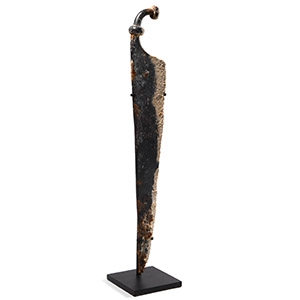
Iron Age Celtic La Tene Dagger
1st century B.C.-1st century A.D.Sold for (Inc. bp): £975
Featuring a gently curved single-edged iron blade and one-sided fuller, curved handle with knot pommel; mounted on a custom-made display stand. 525 grams total, 35 cm high including stand
Dutch art market. Private collection of K.S., Cologne, Germany, acquired 1996.
One of the military insignia of a Celtic warrior was the war-knife, usually between 33 and 35 cm long. For example, in the collection of Celtic military equipment from Galish-Lovachka, the archaeologists have found a short sword with an X-shaped handle (l = 41 cm), two middle La Tène swords (72.5 and 75 cm long), 12 large curved knives, 27 spearheads, two javelin heads, 14 arrowheads, and nine iron chain belts for hanging a sword. The war-knife was also used for hunting, as a spare weapon, or to cut the throat of an enemy in a surprise attack.
