
Loading, please wait...


LOT 0185
Byzantine Gold Solidus in Gold Ring
6TH CENTURY A.D.
1 in. (21.14 grams, 24.51 mm overall, 17.47 x 16.14 mm internal diameter (approximate size British J 1/2, USA 5, Europe 9.32, Japan 9)).
The coin showing a facing bust of a pearl-diademed emperor, cuirassed and holding a cross; set in a thick frame with a double rectangular-section hoop below; the solidus a cast or barbarised version.
ProvenanceAcquired on the European art market.
This lot has been checked against the Interpol Database of stolen works of art and is accompanied by search certificate number no.13338-257893.
Cf. similar solidus in the Dumbarton Oaks Collections, inv.no.DOC 1:173, no. (319).
FootnotesThe coin represents a frontal bust of Justinian I in a helmet (kamelaukion) with a plume, a diadem with trefoil ornament on the front, and a cuirass decorated with four pellets. Globus cruciger in right hand, shield with horseman device on left shoulder. Inscription: DNIVSTINIANVSPPAVC (Dominus Noster Justinianus Semper Augustus). Probably Mint of Rome 537-542.
CONDITIONTimeLine Auctions follows a vetting process to ensure the authenticity and legality of all items, reinforcing our commitment to integrity and responsible trading. Each antiquity, antique, and coin lot undergoes thorough examination by a vetting committee of at least ten external specialists, professional trade association members, scientists, and archaeologists: Our Vetting Process
AUCTIONS:
TimeLine is a leading auction house specialising in antiquities, ancient art, collectables, natural history, coins, medals, and books. Our auctions offer museums, collectors, historians, and enthusiasts the opportunity to acquire unique and historically significant pieces.
LOT 0185
Byzantine Gold Solidus in Gold Ring
Estimate £2,500 - 3,500€2,900 - 4,060 (for guidance only)$3,380 - 4,730 (for guidance only)
-
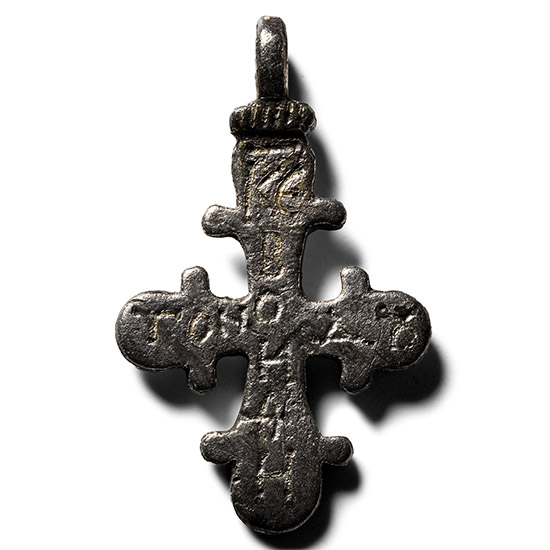
Byzantine Silver-Gilt Cross Pendant
Circa 9th-12th century A.D.Sold for (Inc. bp): £140
Bifacial cross with lobed finials, gilt Greek inscription on both sides, one side with 'KE BOHΘΗ' placed vertically and 'TON ΔOY[...]' horizontally; the other side with 'ΛON COY CTYΛY' placed vertically, and 'ANON' horizontally; the whole inscription reading: 'KγριΕ BOHΘH TON ΔOYΛON COY CTYΛYANON' = Lord helps your servant Stylianos. 4.52 grams, 34 mm
Ex German art market, 2000s. Acquired from an EU collector living in London. From the collection of a Surrey, UK, gentleman. -
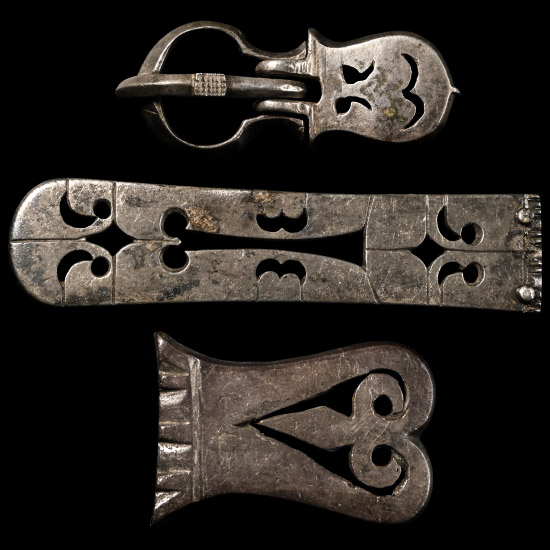
Early Byzantine Silver Belt Fittings with Openwork Decoration
6th-7th century A.D.Estimate: £300 - 400 (+bp*)
Opening Bid: £150
Comprising: two strap ends with openwork decoration of bifurcated scrolls and volutes; a buckle with an arched loop and cast tongue mounted on a shield-shaped plate decorated in a similarly abstract vegetal scheme. 51.5 grams total, 47-89 mm
Acquired on the European art market.
The high quality of execution, formal consistency, and use of silver suggest these fittings once adorned the belt of a military or aristocratic figure within a frontier or provincial context. Their design is representative of the transitional material culture of the early Byzantine world, in which classical motifs were abstracted and reinterpreted through regional aesthetic idioms. This ensemble belongs to the broader category of Early Byzantine personal dress fittings, and is closely related to the Martynivka Hoard—a group of silver artefacts discovered near Kanev (modern Cherkasy Oblast, Ukraine) before 1909. Now divided between the British Museum and the National Museum of the History of Ukraine, the hoard includes strap ends and buckles of closely comparable design and manufacture. While their precise cultural attribution remains debated, the prevailing scholarly consensus situates them within the orbit of Byzantine provincial production, possibly influenced by or intended for Slavic, nomadic, or client populations in the Pontic steppe region. Similar artefacts have been recovered from Kerch in Crimea, further supporting the view that such belt fittings were widely disseminated in Byzantine-controlled or influenced regions along the northern Black Sea during the 6th and 7th centuries. Their function was not merely practical; richly decorated belts of this kind were important signifiers of rank, allegiance, and imperial favour. -
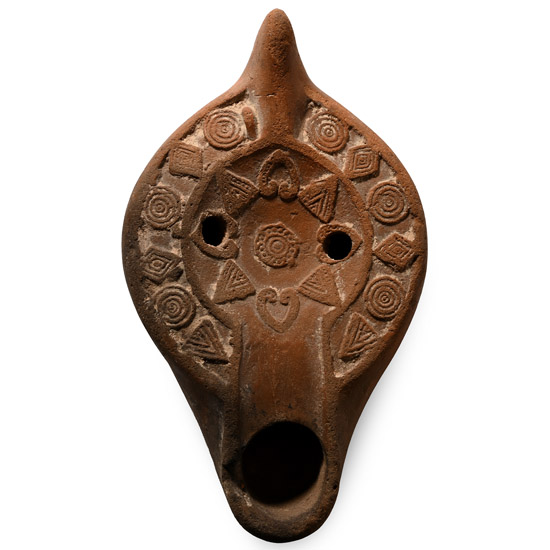
Byzantine Terracotta Oil Lamp with Concentric Motifs
Circa 5th-6th century A.D.Sold for (Inc. bp): £143
Large oil lamp with stub handle to the rear, wide rim with concentric rings and lozenges, the discus with concentric triangles and volutes, a low basal ring. 213 grams, 14 cm
From an important collection of lamps, Germany, 1970s.
