
Loading, please wait...
_900x900.jpg "Byzantine Gold Ring with Square Carnelian Bezel")
_200x200.jpg "Byzantine Gold Ring with Square Carnelian Bezel")
.jpg "Byzantine Gold Ring with Square Carnelian Bezel")
LOT 0923
Byzantine Gold Ring with Square Carnelian Bezel
8TH-10TH CENTURY A.D.
1 in. (9.34 grams, 23.69 mm overall, 16.86 mm internal diameter (approximate size British J 1/2, USA 5, Europe 9.32, Japan 9)).
With frond detailing to the shoulders, square bezel with hatched ornament, inset carnelian gemstone.
ProvenanceEx private collection, acquired in the 1980s.
with Christie's, New York, 'Ancient Jewellery', 11 December 2003, no.455.
Private European collection.
Accompanied by a copy of the relevant Christie's pages.
TimeLine Auctions follows a vetting process to ensure the authenticity and legality of all items, reinforcing our commitment to integrity and responsible trading. Each antiquity, antique, and coin lot undergoes thorough examination by a vetting committee of at least ten external specialists, professional trade association members, scientists, and archaeologists: Our Vetting Process
AUCTIONS:
TimeLine is a leading auction house specialising in antiquities, ancient art, collectables, natural history, coins, medals, and books. Our auctions offer museums, collectors, historians, and enthusiasts the opportunity to acquire unique and historically significant pieces.
LOT 0923
Byzantine Gold Ring with Square Carnelian Bezel
Estimate £800 - 1,000€930 - 1,160 (for guidance only)$1,080 - 1,350 (for guidance only)
-
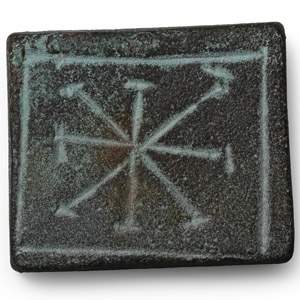
Byzantine Bronze Inscribed Weight
5th-6th century A.D.Sold for (Inc. bp): £46
Tabular in form, obverse with eight-rayed starburst in a frame, reverse with incised text. 25.8 grams, 25 mm
From the collection of a gentleman, acquired on the London art market in the 1990s. -
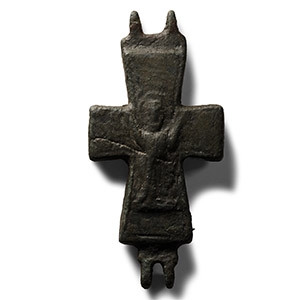
Byzantine Reliquary Cross Pendant Plate
10th-12th century A.D.Sold for (Inc. bp): £72
Obverse plate from an enkolpion with low-relief nimbate figure in orans posture. 13 grams, 54 mm
Ex property of a North London, UK, gentleman, 1990s. -
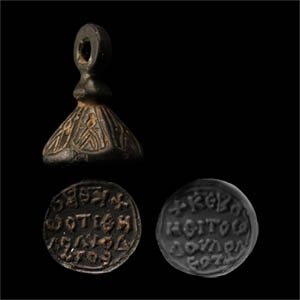
Byzantine Bronze 'Lord Help Leon the Servant' Stamp Seal
5th-7th century A.D.Sold for (Inc. bp): £358
Comprising a conical body with segmented outer face and loop motifs, biconvex baluster, thick loop; retrograde legend to the underside: '+KE BO / HΘITOV / ΔΟΥΛΟ / ΛΕΟΤΑ (Lord help Leon the servant). 15.6 grams, 25 mm
From the private collection of Mr K.A., acquired in the 1990s-early 2000s.
