
Loading, please wait...
_900x900.jpg "Byzantine Gold Marriage Ring")
_200x200.jpg "Byzantine Gold Marriage Ring")
_900x900.jpg "Byzantine Gold Marriage Ring")
_200x200.jpg "Byzantine Gold Marriage Ring")
.jpg "Byzantine Gold Marriage Ring")
.jpg "Byzantine Gold Marriage Ring")
LOT 0184
Byzantine Gold Marriage Ring
CIRCA 6TH-7TH CENTURY A.D.
1 in. (9.62 grams, 23.93 mm overall, 18.92 mm internal diameter (approximate size British R 1/2, USA 8 3/4, Europe 19.38, Japan 18)).
D-section hoop with expanding shoulders, trumpet-shaped bezel with two facing busts and a cross between and a nimbate bearded bust above, legend 'OMONOIA' (harmony) below.
ProvenanceFrom an important Byzantine collection, formed in the 1970s, Surrey, UK.
This lot has been checked against the Interpol Database of stolen works of art and is accompanied by search certificate number no.13347-258734.
Cf. similar subject in a ring from Museum of Fine Arts, Boston, accession no.63.1555; see also The Museum of Fine Arts, Boston, Romans and Barbarians, Boston, 1976, p.179, no.202; Chadour, A.B., Rings. The Alice and Louis Koch Collection, volume I, Leeds, 1994, item 489, for type.
FootnotesThe marriage ring is one of the typologies in which figural decorations are frequently found. Generally speaking, marriage rings are engraved with a representation of a husband and wife, sometimes accompanied by Christ, and usually engraved with wishes for 'harmony, health and the grace of God'. Rings of this type had been used since the late 4th century A.D. and remained extremely popular in Byzantium in the 6th and 7th centuries.
CONDITIONTimeLine Auctions follows a vetting process to ensure the authenticity and legality of all items, reinforcing our commitment to integrity and responsible trading. Each antiquity, antique, and coin lot undergoes thorough examination by a vetting committee of at least ten external specialists, professional trade association members, scientists, and archaeologists: Our Vetting Process
AUCTIONS:
TimeLine is a leading auction house specialising in antiquities, ancient art, collectables, natural history, coins, medals, and books. Our auctions offer museums, collectors, historians, and enthusiasts the opportunity to acquire unique and historically significant pieces.
-
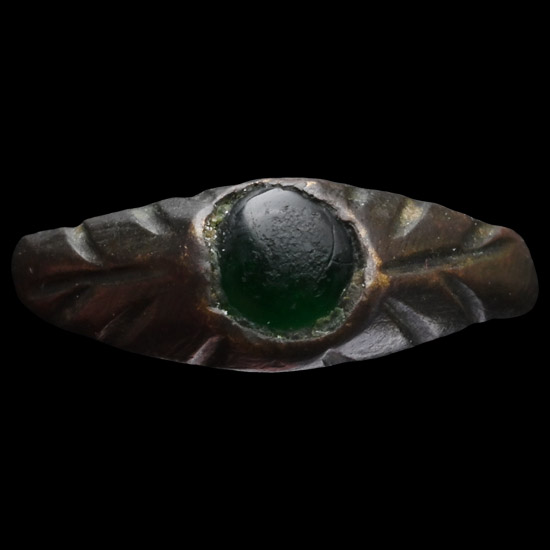
Byzantine Bronze Stirrup Ring with Green Gem
Circa 14th-15th century A.D.Sold for (Inc. bp): £91
With a slender hoop and thickened underside, conical bezel set with incuse foliage detailing, inset cabochon. 2.96 grams, 23.50 mm overall, 16.02 x 15.43 mm internal diameter (approximate size British J, USA 4 3/4, Europe 8.69, Japan 8)
From the private collection of Mr Brian Edwards, New Malden, Surrey, UK, formed from the late 1970s-early 1980s; thence by descent. Accompanied by the original collector's data sheet(s) with reference no.A45. -
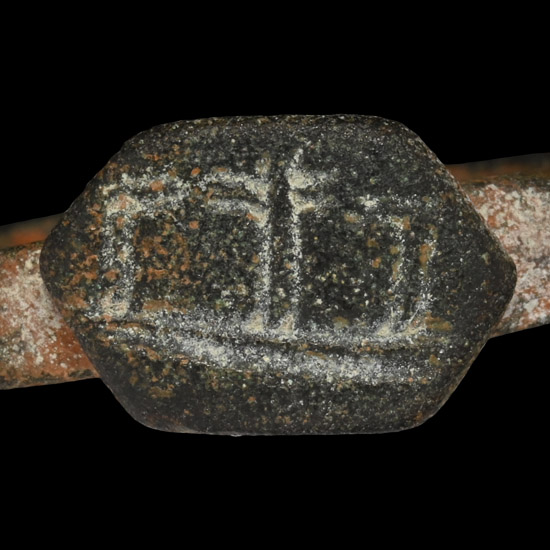
Byzantine Bronze Ring with Three Crosses of the Crucifixion
Circa 5th century A.D.Sold for (Inc. bp): £98
Comprising a D-section hoop and a hexagonal bezel with three crosses on a baseline. 4.23 grams, 23.24 mm overall, 19.00 x 17.01 mm internal diameter (approximate size British N 1/2, USA 6 3/4, Europe 14.35, Japan 13)
From the private collection of a European gentleman (1942-2024), formed since the 1970s. -
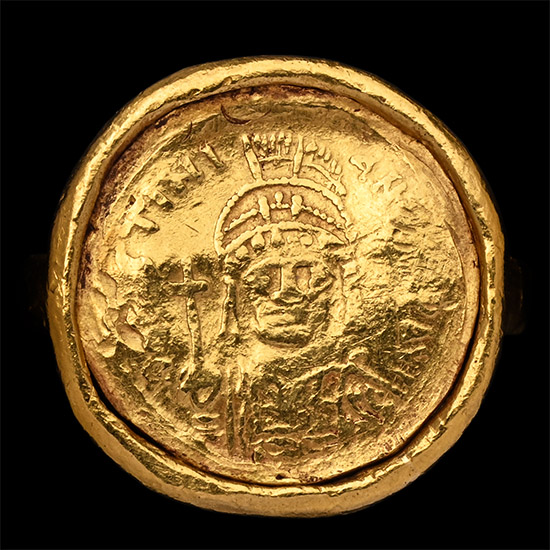
Byzantine Gold Solidus in Gold Ring
6th century A.D.Estimate: £2,500 - 3,500 (+bp*)
Opening Bid: £1,300
The coin showing a facing bust of a pearl-diademed emperor, cuirassed and holding a cross; set in a thick frame with a double rectangular-section hoop below; the solidus a cast or barbarised version. 21.14 grams, 24.51 mm overall, 17.47 x 16.14 mm internal diameter (approximate size British J 1/2, USA 5, Europe 9.32, Japan 9)
Acquired on the European art market. This lot has been checked against the Interpol Database of stolen works of art and is accompanied by search certificate number no.13338-257893.
The coin represents a frontal bust of Justinian I in a helmet (kamelaukion) with a plume, a diadem with trefoil ornament on the front, and a cuirass decorated with four pellets. Globus cruciger in right hand, shield with horseman device on left shoulder. Inscription: DNIVSTINIANVSPPAVC (Dominus Noster Justinianus Semper Augustus). Probably Mint of Rome 537-542.
