
Loading, please wait...
_900x900.jpg "Byzantine Gold Marriage Ring with Busts")
_200x200.jpg "Byzantine Gold Marriage Ring with Busts")
.jpg "Byzantine Gold Marriage Ring with Busts")
LOT 0208
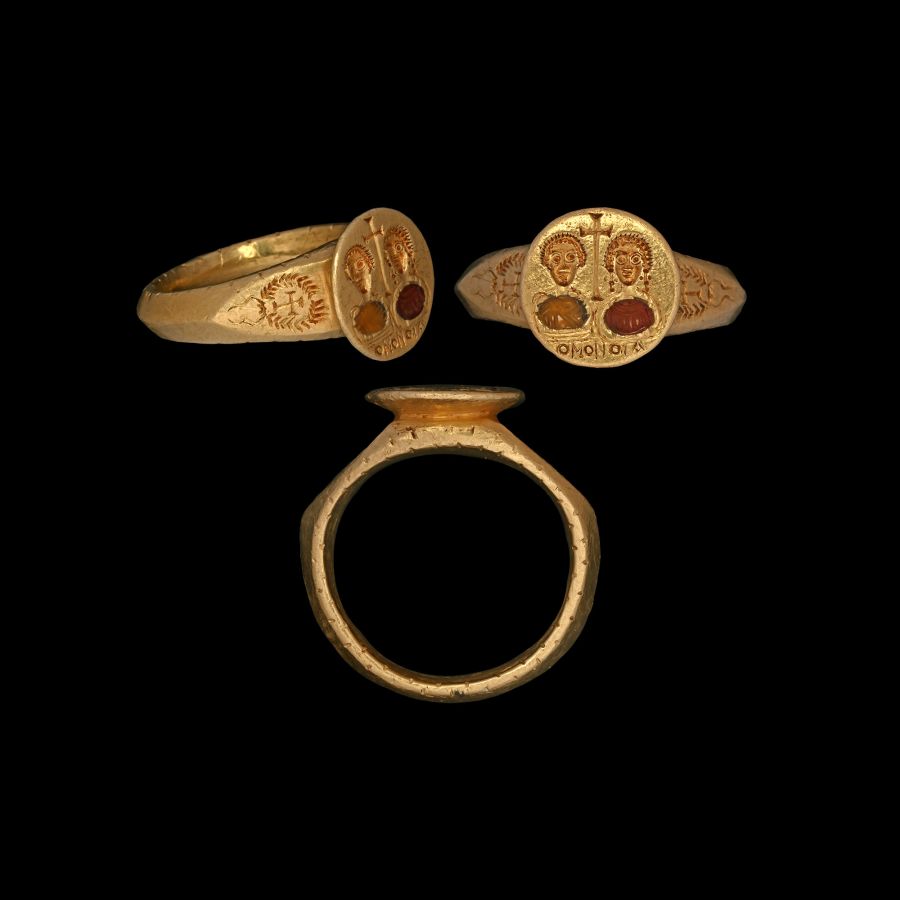
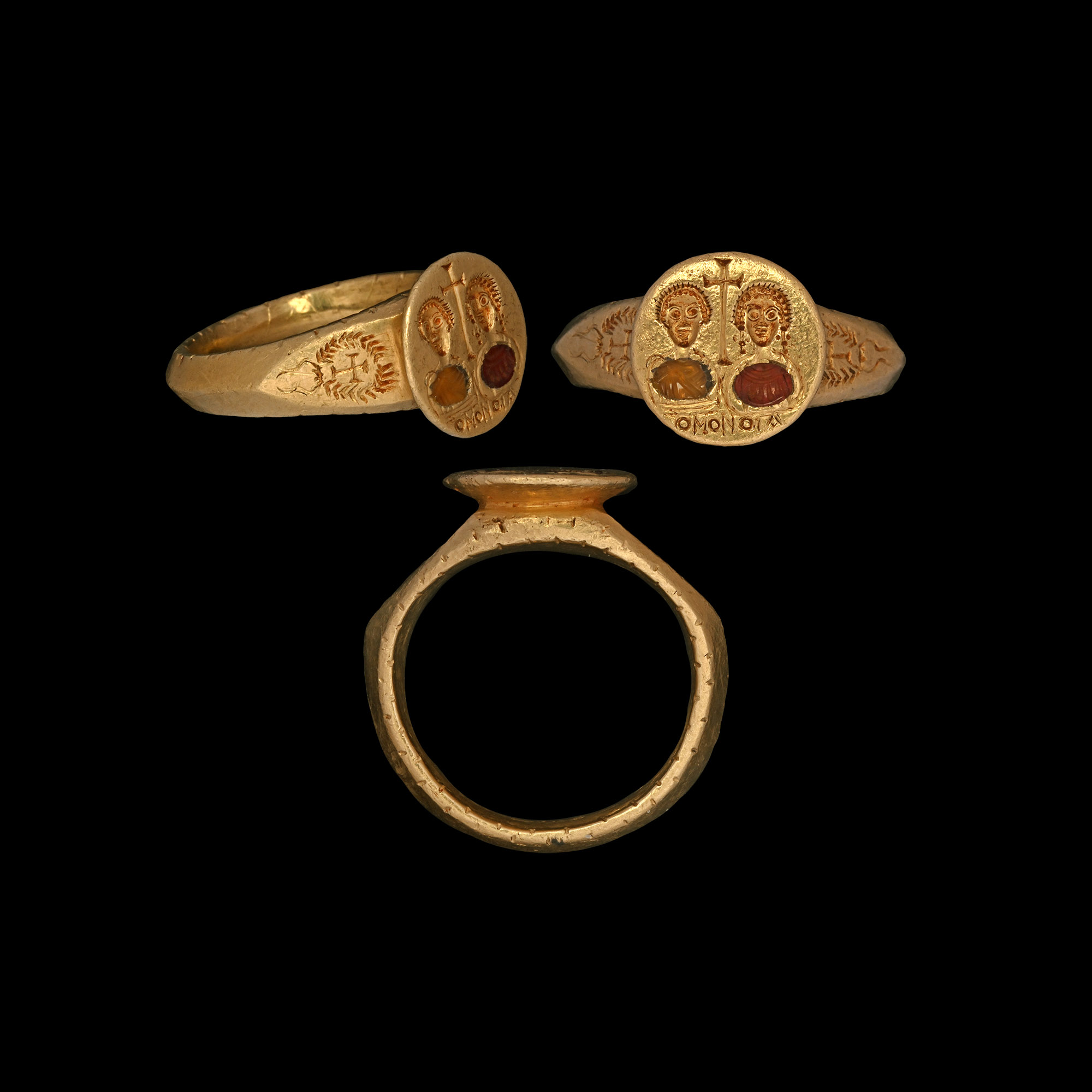
Byzantine Gold Marriage Ring with Busts
CIRCA 6TH-7TH CENTURY A.D.
1 in. (13.76 grams, 25.37 mm overall, 18.77 mm internal diameter (approximate size British Q, USA 8, Europe 17.49, Japan 16)).
D-section hoop with carination, flat chamfered shoulders each with an engraved cross moline within a wreath; trumpet-shaped bezel with two facing busts and processional cross between, the bodies with inset carnelian studs; legend 'OMONOIA' (harmony) below.
ProvenanceFrom the collection of a late English gentleman, 1990s.
This lot has been checked against the Interpol Database of stolen works of art and is accompanied by a search certificate number no.13047-248619.
Cf. similar subject in a ring from Museum of Fine Arts, Boston, accession no.63.1555; see also The Museum of Fine Arts, Boston, Romans and Barbarians, Boston, 1976, p.179, no.202; Chadour, A.B., Rings. The Alice and Louis Koch Collection, volume I, Leeds, 1994, item 489, for type.
FootnotesThe marriage ring is one of the typologies in which figural decorations are frequently found. Generally speaking, marriage rings are engraved with a representation of a husband and wife, sometimes accompanied by Christ, and usually engraved with wishes for 'harmony, health and the grace of God'. Rings of this type had been used since the late 4th century A.D. and remained extremely popular in Byzantium in the 6th and 7th centuries.
CONDITIONTimeLine Auctions follows a vetting process to ensure the authenticity and legality of all items, reinforcing our commitment to integrity and responsible trading. Each antiquity, antique, and coin lot undergoes thorough examination by a vetting committee of at least ten external specialists, professional trade association members, scientists, and archaeologists: Our Vetting Process
AUCTIONS:
TimeLine is a leading auction house specialising in antiquities, ancient art, collectables, natural history, coins, medals, and books. Our auctions offer museums, collectors, historians, and enthusiasts the opportunity to acquire unique and historically significant pieces.
-
Byzantine Bronze Ring with Warrior Saint
12th-13th century A.D.Sold for (Inc. bp): £59
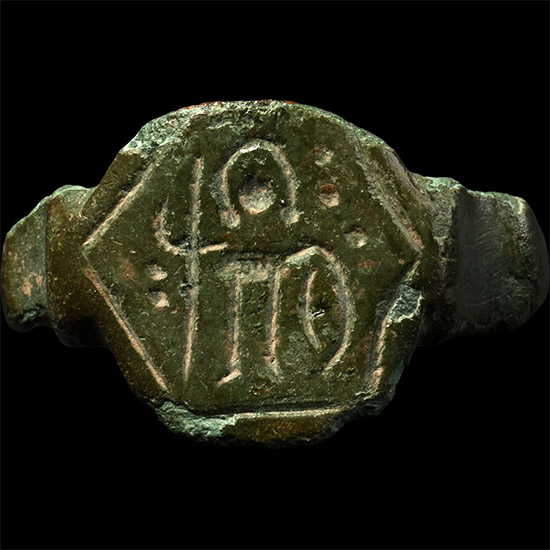
Hoop with angled shoulders, hexagonal bezel with a stylised nimbate warrior holding a long spear and a shield. 3.24 grams, 21.62 mm overall, 18.18 mm internal diameter (approximate size British Q, USA 8, Europe 17.49, Japan 16)
Acquired on the UK and EU art market before 2000. From the private collection of a Surrey, UK, gentleman.
The bronze ring is compactly worked from a single bar. The hoop, hemispherical in section, broadens at the top, where the hexagonal ring bezel was hammered. The decoration inscribed in the hexagon shows a military saint in the upper field, surrounded by lines running parallel to the hexagon, which form a further decorative element. The bezel of these rings was decorated with stylised images, very often military saints, who were asked for protection and blessing. They are usually represented as one or two human figures, schematically depicted, inscribed in a circle, decorating the bezel. -
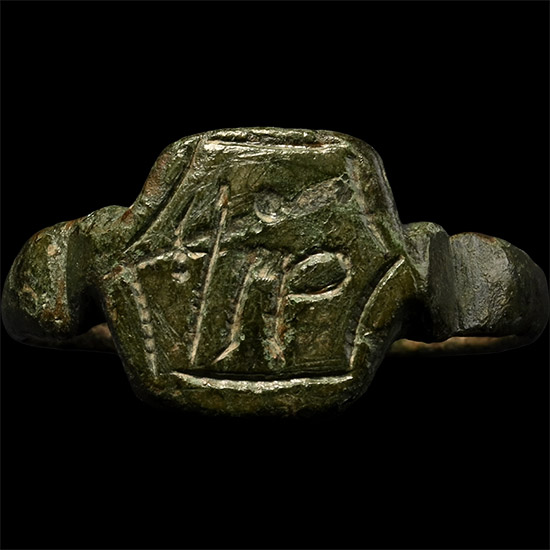
Byzantine Bronze Ring with Warrior Saint
12th-13th century A.D.Sold for (Inc. bp): £195
D-section hoop with angled shoulders, hexagonal bezel with a stylised warrior holding a long spear and a shield. 3.78 grams, 22.01 mm overall, 18.76 mm internal diameter (approximate size British Q 1/2, USA 8 1/4, Europe 18.12, Japan 17)
Acquired on the UK and EU art market before 2000. From the private collection of a Surrey, UK, gentleman.
This category of rings had a hexagonal-rounded chaton raised above the link. Conforming to the iconography of the Orthodox countries under the influence of Byzantium, the possible decoration was related to the military saints. -
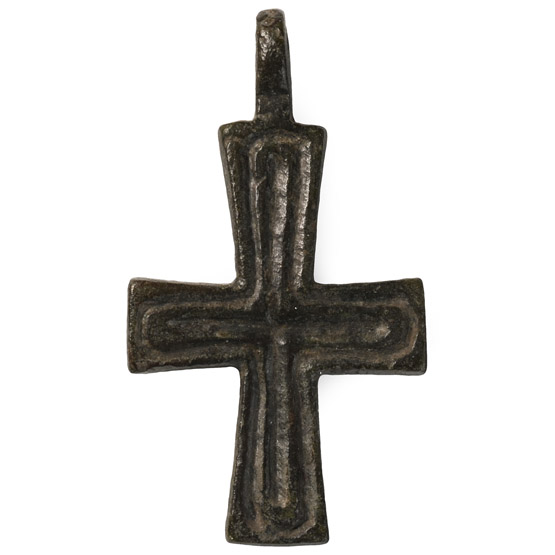
Byzantine Bronze Pendant Cross
10th-12th century A.D.Sold for (Inc. bp): £130
Expanding-arm type with a low-relief Maltese cross at the centre. 4.99 grams, 39 mm
Ex German art market, 2000s. Acquired from an EU collector living in London. From the collection of a Surrey, UK, gentleman.
