
Loading, please wait...
LOT 1077
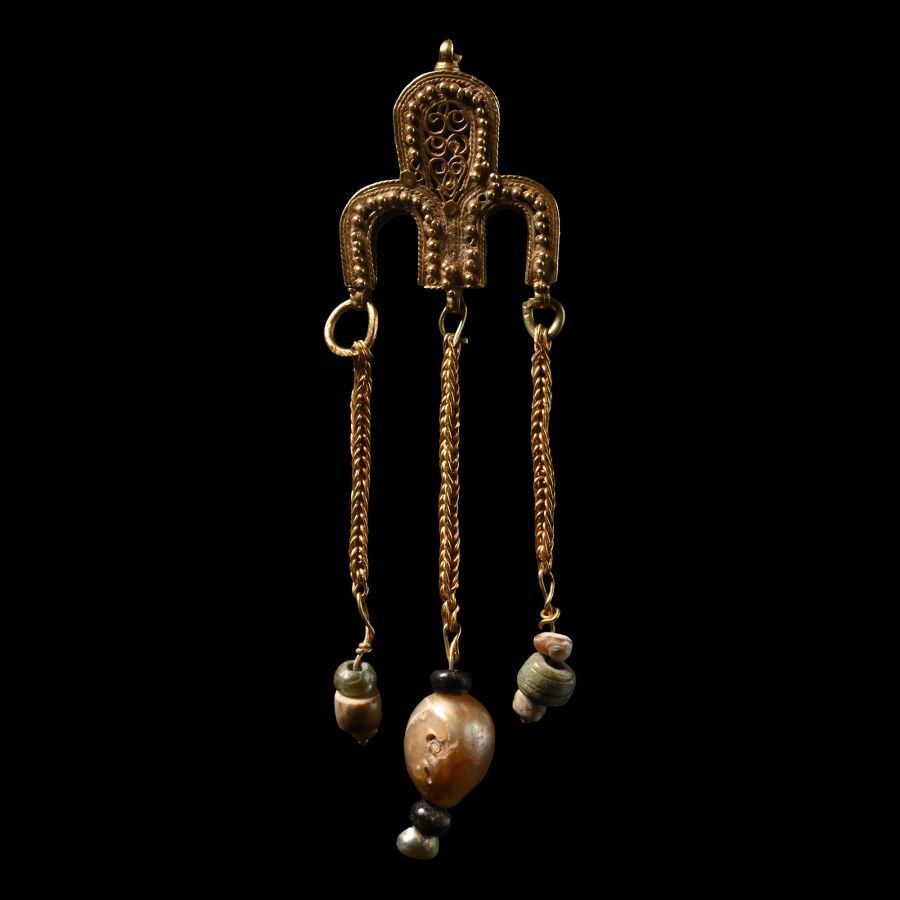
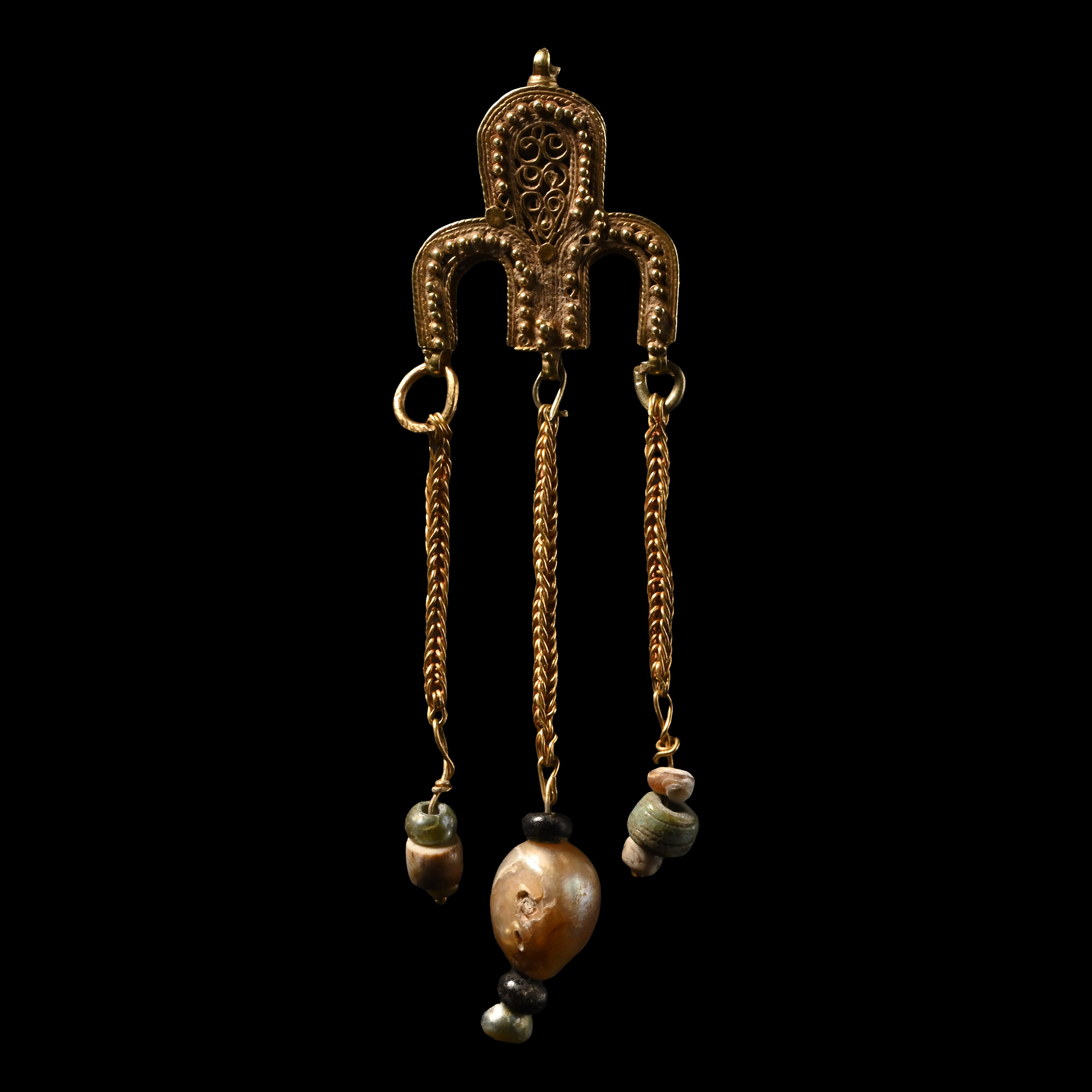
Byzantine Gold Filigree Pendant with Pearl Bead Drops
6TH-7TH CENTURY A.D. AND LATER
2 7/8 in. (4.92 grams, 73 mm).
Hollow-formed gold earring shaped like the letter 'psi' (Ψ) with filigree detailing; attached chain drops with pearls, garnets, and other beads; a marriage.
ProvenanceFrom a European collection, 1960s.
Ex North London, UK, gentleman.
TimeLine Auctions follows a vetting process to ensure the authenticity and legality of all items, reinforcing our commitment to integrity and responsible trading. Each antiquity, antique, and coin lot undergoes thorough examination by a vetting committee of at least ten external specialists, professional trade association members, scientists, and archaeologists: Our Vetting Process
AUCTIONS:
TimeLine is a leading auction house specialising in antiquities, ancient art, collectables, natural history, coins, medals, and books. Our auctions offer museums, collectors, historians, and enthusiasts the opportunity to acquire unique and historically significant pieces.
-
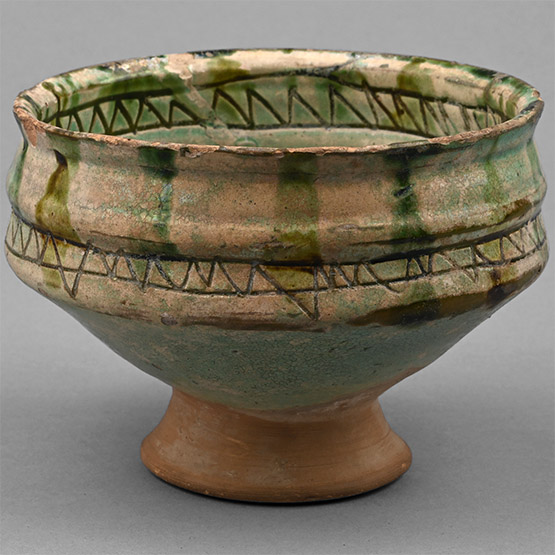
Byzantine Green Glazed Sgraffito Footed Bowl
13th century A.D.Sold for (Inc. bp): £780
Carinated in profile with narrow flared base, green-glazed upper body; to the inner face a central roundel with zigzag fill and a zigzag band above the gallery, to the outer face horizontal zigzag band to the shoulder; old Christie's label with '144/2 5540'. 372 grams, 13 cm
Ex Charles Gillot (1853-1903). with Christie's, Paris, 2008. European private collection. -
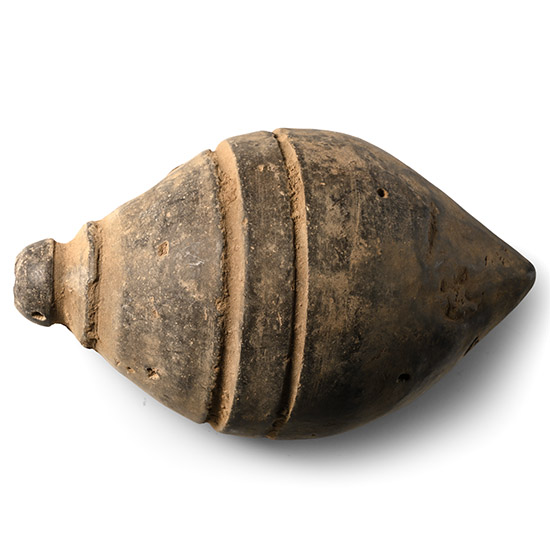
Byzantine 'Greek Fire' Ceramic Fire Bomb or Hand Grenade
9th-11th century A.D.Sold for (Inc. bp): £195
Ovoid in profile with rounded base, two deep circumeferential grooves on the body; intended to be filled with explosive liquid and a wick, and used as a hand grenade. 604 grams, 14.3 cm
From a specialist collection, London, UK, 1990-2000s. Accompanied by an academic paper by military specialist Dr Raffaele D'Amato, dated 15 July 2019 and titled 'Eastern Roman Empire - Greek Fire Bomb or Hand Grenade (μεσαίον kακάβιον) 9th-11th century AD'.
Apart from the use of siphons or manual flame-throwers called cheirosiphona, special corps of Roman soldiers employed terracotta grenades, in the form of small jars, abundantly evidenced in archaeological excavations. They were called μεσαία kακαβιά or κυτροκακάβια, where the former had a bulbous shape and the latter a more cylindrical form. -
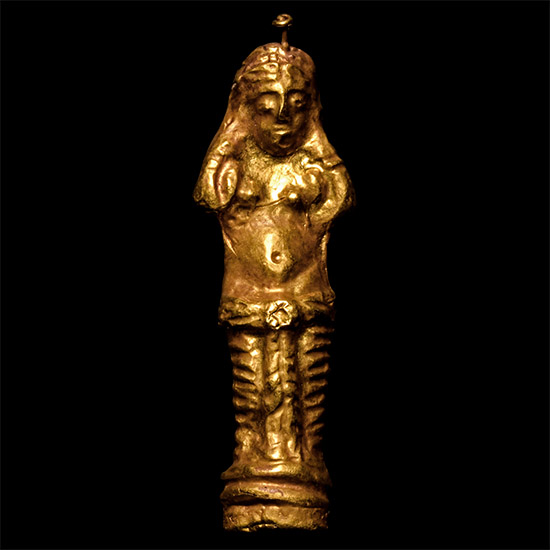
Byzantine Gold Standing Female Pendant
7th-9th century A.D.Estimate: £2,500 - 3,500 (+bp*)
Opening Bid: £1,250
Hollow-formed and modelled in the round, standing female wearing a palla around her hips, hands raised to her hair; applied mounting strip to reverse and wire stud to brow to mount a bead. 3.44 grams, 39 mm
UK private collection before 2000. Acquired on the UK art market. Private collection, London, UK. This lot has been checked against the Interpol Database of stolen works of art and is accompanied by search certificate number no.13138-248306.
The stance is based on the famous Venus Anadyomene image of the goddess emerging from the sea, as shown in the mosaic at Casa del Principe di Napoli in Pompeii.
