
Loading, please wait...
LOT 0854
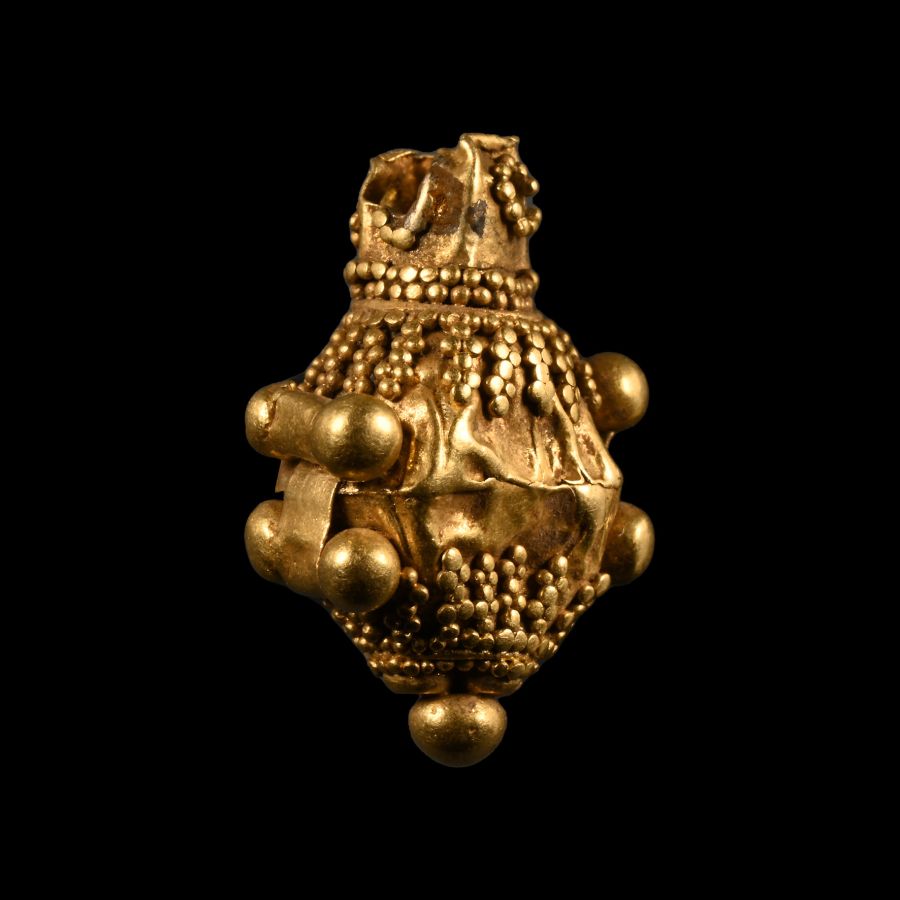
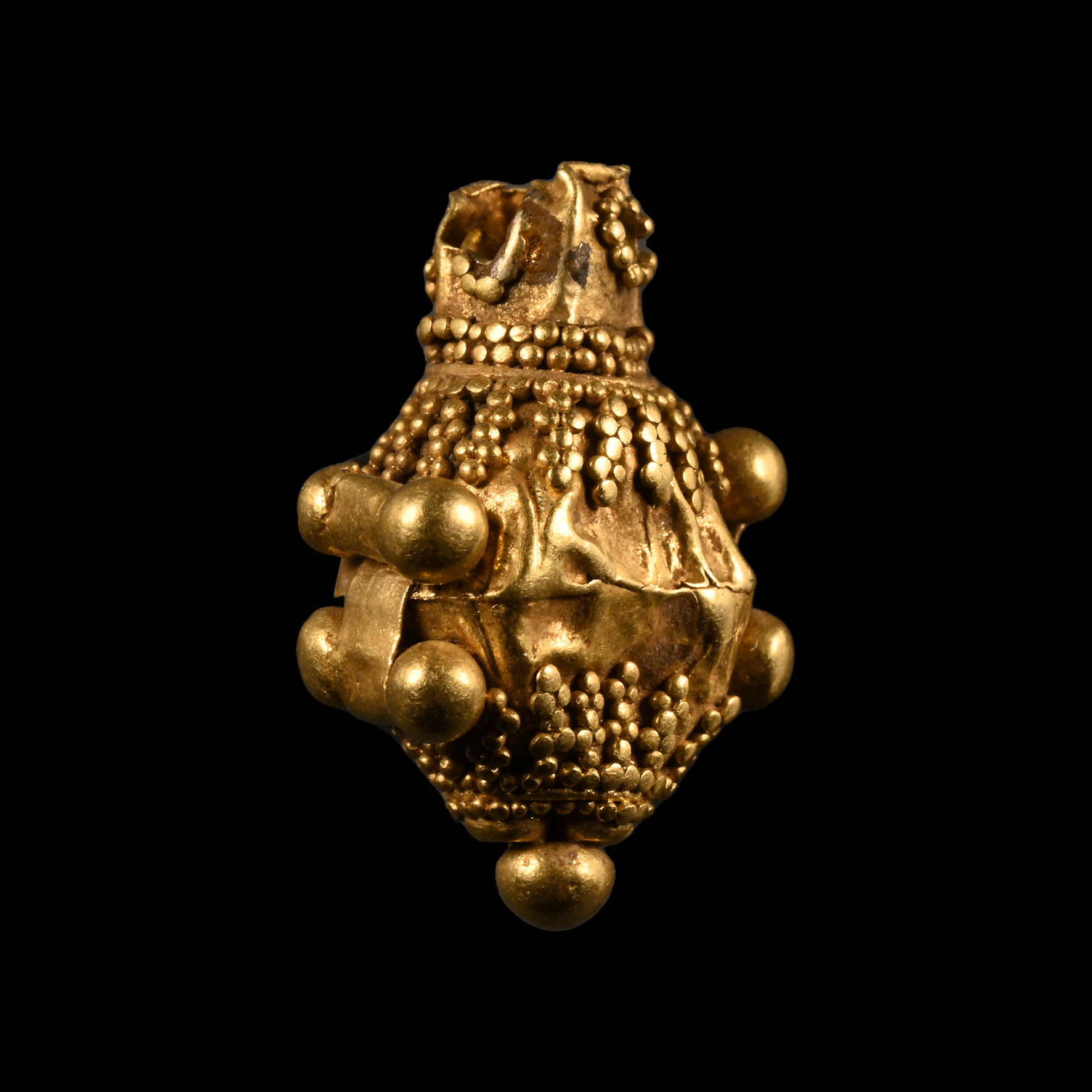
Byzantine Gold Filigree Finial
6TH-14TH CENTURY A.D.
3/4 in. (2.47 grams, 17 mm).
Of hollow, bulbous form, now slightly squashed, four pellets to each side and an apex pellet, granule clusters to both hemispheres, socket to base with roughly square-shaped cross-section, three circular attachment piercings with granulated borders.
ProvenanceFrom a late Japanese specialist collector, 1970-2000s.
CONDITIONTimeLine Auctions follows a vetting process to ensure the authenticity and legality of all items, reinforcing our commitment to integrity and responsible trading. Each antiquity, antique, and coin lot undergoes thorough examination by a vetting committee of at least ten external specialists, professional trade association members, scientists, and archaeologists: Our Vetting Process
AUCTIONS:
TimeLine is a leading auction house specialising in antiquities, ancient art, collectables, natural history, coins, medals, and books. Our auctions offer museums, collectors, historians, and enthusiasts the opportunity to acquire unique and historically significant pieces.
LOT 0854
Byzantine Gold Filigree Finial
Estimate £250 - 350€290 - 410 (for guidance only)$340 - 470 (for guidance only)
-
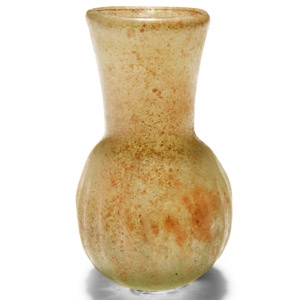
Byzantine Ribbed Glass Cosmetic Bottle
Circa 5th-6th century A.D.Sold for (Inc. bp): £78
The translucent globular body with raised ribs running vertically around the equator, with everted neck and mouth. 29 grams, 72 mm
Ex Coincraft, London WC1. Ex private Merseyside, UK, collection. Accompanied by a Coincraft certificate of authenticity. -
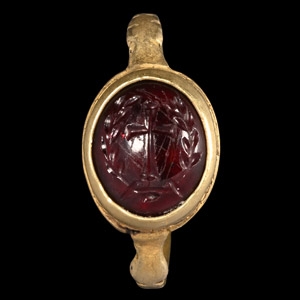
Byzantine Gold Ring with Engraved Cross Gemstone
6th-8th century A.D.Estimate: £2,000 - 3,000 (+bp*)
Opening Bid: £1,111
With baluster detailing to the shoulders, ellipsoid bezel with decorative band to the cell wall, inset garnet cabochon with intaglio design of a cross beneath a wreath and dish below. 3.35 grams, 21.60 mm overall, 19.51 mm internal diameter (approximate size British M, USA 6, Europe 12.46, Japan 12)
From a late Japanese specialist collector, 1970-2000s. This lot has been checked against the Interpol Database of stolen works of art and is accompanied by search certificate number no.11865-206975. -
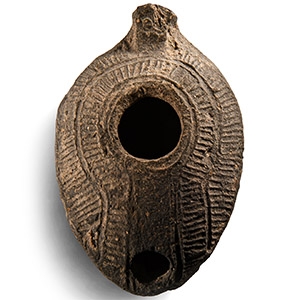
Byzantine Terracotta Oil Lamp
7th century A.D.Sold for (Inc. bp): £65
Carinated with a domed upper face, circular filling hole and spout, remains of handle, raised linear motifs. 65 grams, 90 mm
Acquired 1970s onwards. Private collection of Michael O'Hara, Cambridgeshire, UK. Ex private collection of Benjamin Hyde-Smith, Hertfordshire, UK.
