
Loading, please wait...
LOT 0160
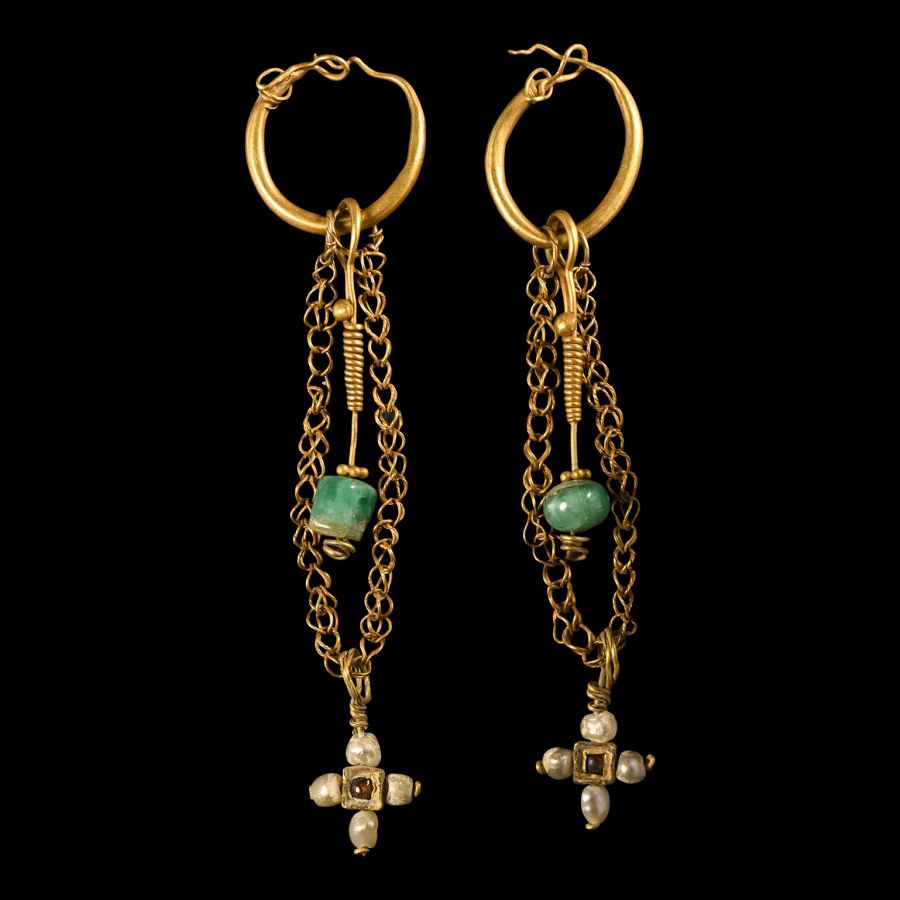
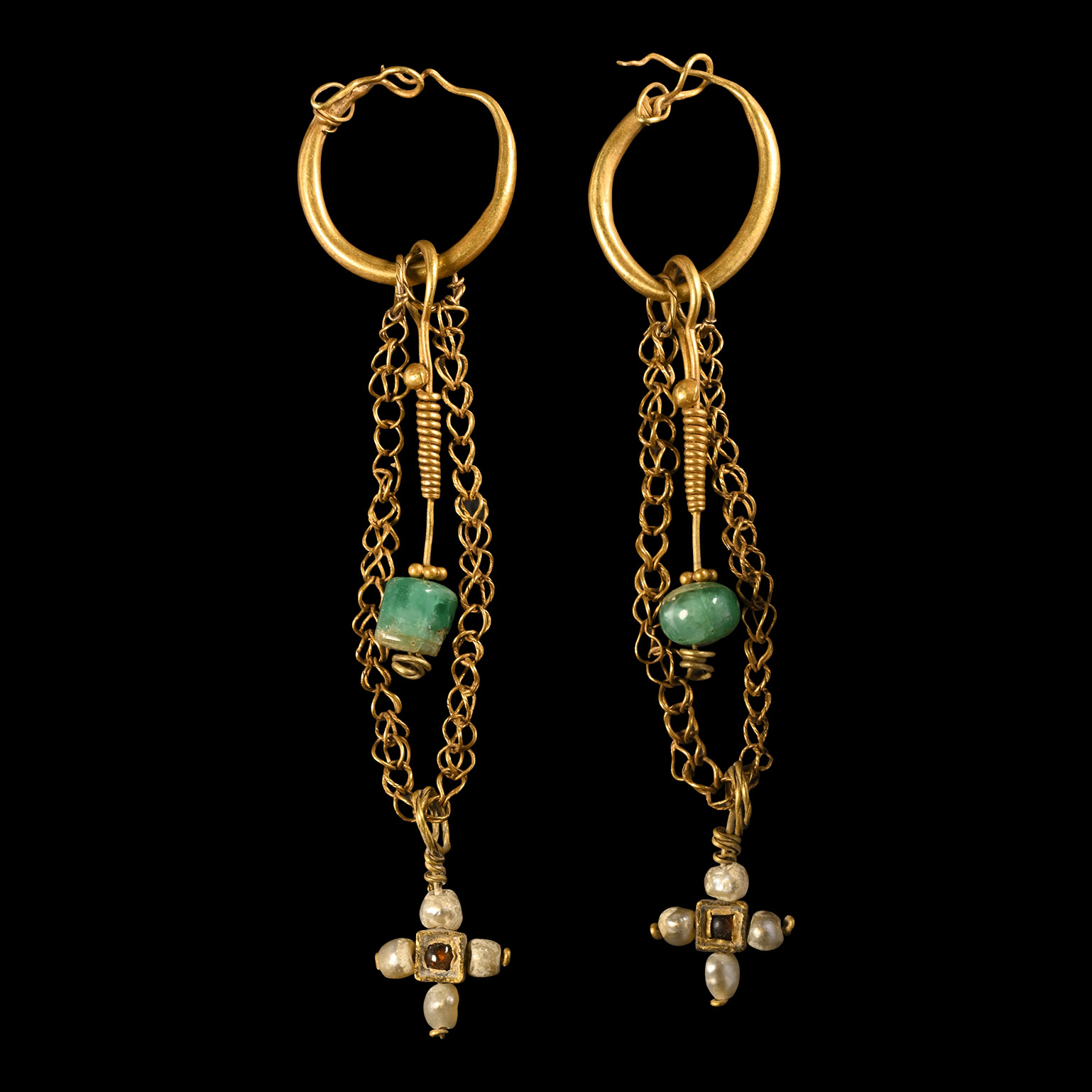
Byzantine Gold Earrings with Gemstone Drops
6TH-7TH CENTURY A.D.
3 1/2 - 3 3/4 in. (13.6 grams total, 90-96 mm).
A pair of gold earrings, each with a tapering hoop and chain suspending a cross set with polished garnet at the centre and a pearl bead to each arm, drop positioned at the centre of the chain composed of a gold stem with coiled wire sleeve, granulated bead and emerald bead below. [2]
ProvenanceAcquired 1980-2015.
Ex Abelita family collection.
This lot has been checked against the Interpol Database of stolen works of art and is accompanied by search certificate no.11635-198428.
Cf. for similarly complex drop earrings see Ross, M.C., Catalogue of the Byzantine and Early Mediaeval Antiquities in the Dumbarton Oaks Collection, Volume 2: Jewelry, Enamels and Art of the Migration Period, Washington, 2005, pl.LXXXII, item 166, pl.LXV, item 132, and similar crosses on a necklace in the Metropolitan Museum of Art, New York under reference 17.190.1667.
CONDITIONTimeLine Auctions follows a vetting process to ensure the authenticity and legality of all items, reinforcing our commitment to integrity and responsible trading. Each antiquity, antique, and coin lot undergoes thorough examination by a vetting committee of at least ten external specialists, professional trade association members, scientists, and archaeologists: Our Vetting Process
AUCTIONS:
TimeLine is a leading auction house specialising in antiquities, ancient art, collectables, natural history, coins, medals, and books. Our auctions offer museums, collectors, historians, and enthusiasts the opportunity to acquire unique and historically significant pieces.
LOT 0160
Byzantine Gold Earrings with Gemstone Drops
Estimate £2,000 - 3,000€2,320 - 3,480 (for guidance only)$2,700 - 4,050 (for guidance only)
-
Byzantine Gold Turret Ring
6th-7th century A.D.Sold for (Inc. bp): £260
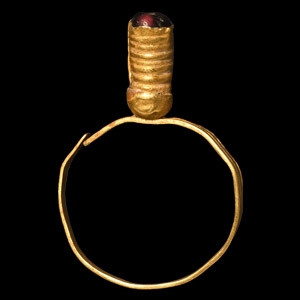
A gold finger ring with tall columnar ribbed bezel, inset garnet cabochon from a re-used bead; hoop split. 2.05 grams, 34.61 mm overall, 22.30 mm internal diameter (approximate size British V 1/2, USA 10 3/4, Europe 24.4, Japan 23)
Hoop broken.
Acquired 1970-2010. Collection of a late Japanese gentleman. -
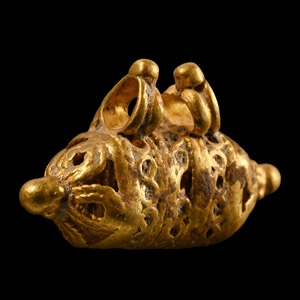
Byzantine Gold Openwork Pendant
Circa 12th-14th century A.D.Sold for (Inc. bp): £364
A capsule-shaped openwork gold pendant decorated with vertical columns of filigree figures of eight between beaded tracks, domed cap to each terminal formed as four-petalled flowers with central pellet; two ribbed suspension loops with apex granules. 2.25 grams, 18 mm
Acquired 1969-1999. London collection of the late Mr S.M., thence by descent. -
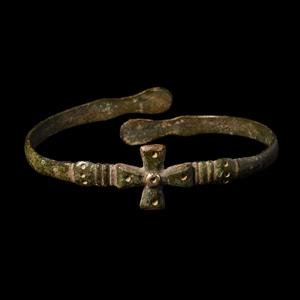
Byzantine Bracelet with Cross
9th-12th century A.D.Sold for (Inc. bp): £203
A slender bracelet with D-section hoop and overlapping terminals, central cross with the five wounds of Christ represented as a shallow dimple to each arm and central silver circular boss, vertical ribs and dimples to the shoulders, waisted terminals decorated with vertical grooves and dot-in-ring motifs. 15.07 grams, 66 mm
Fine condition.
Acquired Munich, Germany, late 1990s. Property of an East London gentleman.
