
Loading, please wait...
LOT 0350
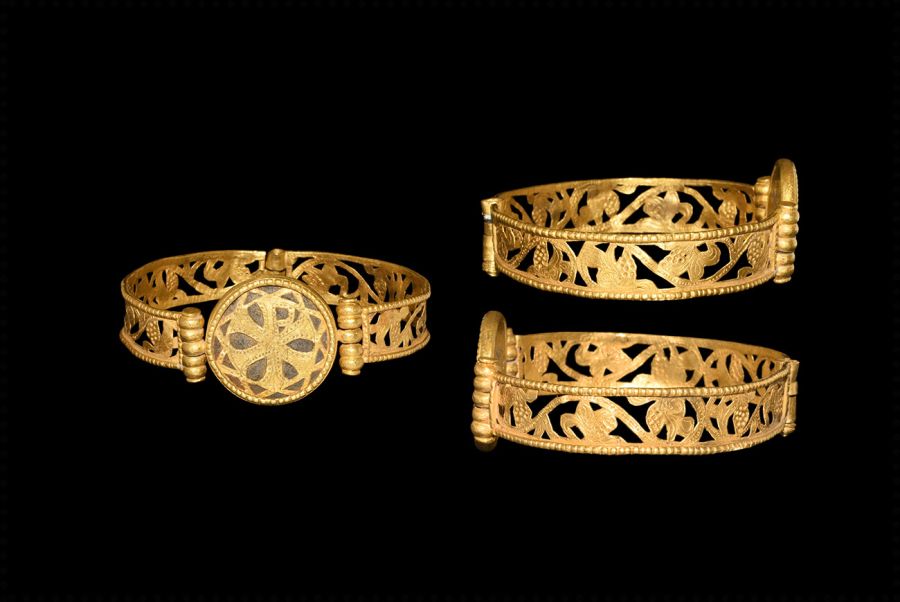
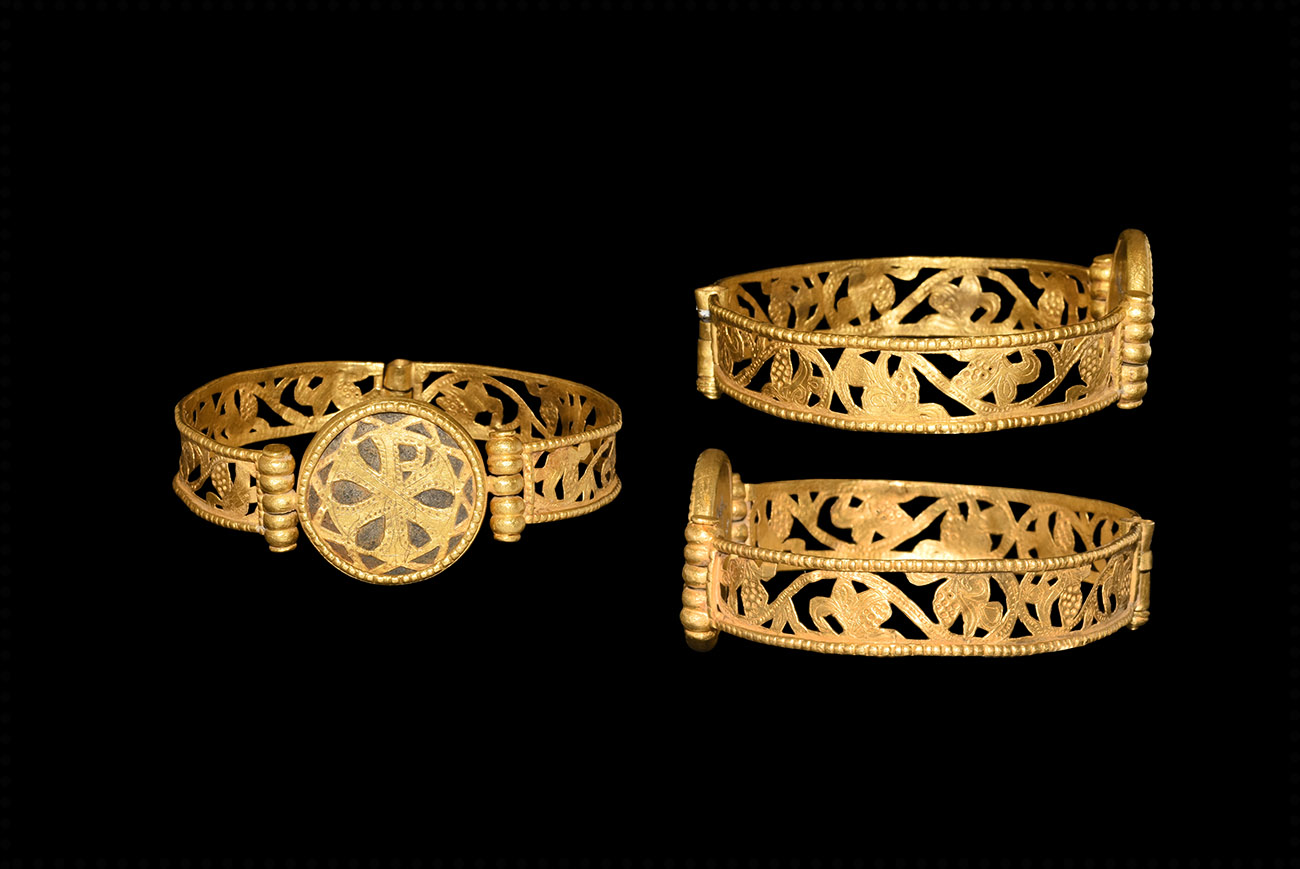
Byzantine Gold Chi-Rho Hinged Bracelet
6TH CENTURY AD
2 3/4" (45 grams, 71mm).
A gold hinged bracelet comprising a flat-section hoop with openwork scrolled vegetation, beaded borders; hinged junction with pin; ribbed hinges flanking the discoid cell with beaded rim, inset silver disc overlaid by an openwork panel with christogram within intersecting squares; the christogram and tendrils with pecked detailing, the scrolled tendrils punched pellet detailing to the fruit.
ProvenanceProperty of a New York collector; acquired 1980s. Accompanied by a positive X-Ray Fluorescence metal analysis certificate.
PublishedAccompanied by an Art Loss Register certificate.
LiteratureSee Yeroulanou, A. Important Bracelets in Early Christian and Byzantine Art in Entwistle, C. & Adams, N. Intelligible Beauty, Recent Research into Byzantine Jewellery, London, 2010 for discussion.
FootnotesThe chi-rho is an ancient Christian symbol that consists of the intersection of the capital Greek letters chi (Χ) and rho (Ρ), which are the first two letters of "Christ" in Greek. The chi-rho can represent either Christ or Christianity and is also known as a Christogram. The chi-rho is also known as the labarum, which is based on the Latin word laureum, "military standard." This is based on Constantine's application of the chi-rho symbol to his military standard after receiving his famous vision before the Battle of the Milvian Bridge in 312 AD. The symbol, along many others such as the fish, was also used by early Christians as a means of identifying each other without drawing the attention of hostile authorities. Its popularity as a symbol under the recognised Christian faith was mostly during the Late Roman period and the early to middle Byzantine periods, until it was eventually superseded by the symbol of the cross itself.
This style of bracelet became popular from the sixth century onward and they are noted for the technical skill of the goldsmiths in producing the depicate decoration on the band and head. As well as the Chi-Rho motif images of the Virgin Mary in the orans prayer posture were also popular decoration.
TimeLine Auctions follows a vetting process to ensure the authenticity and legality of all items, reinforcing our commitment to integrity and responsible trading. Each antiquity, antique, and coin lot undergoes thorough examination by a vetting committee of at least ten external specialists, professional trade association members, scientists, and archaeologists: Our Vetting Process
AUCTIONS:
TimeLine is a leading auction house specialising in antiquities, ancient art, collectables, natural history, coins, medals, and books. Our auctions offer museums, collectors, historians, and enthusiasts the opportunity to acquire unique and historically significant pieces.
8th-10th century AD
Lot No. 0371
Sold for (Inc. premium): £5,625
8th-12th century AD
Lot No. 1948 Opening bid: £30
6th-8th century AD
Lot No. 1972 Opening bid: £108
