
Loading, please wait...
LOT 0862
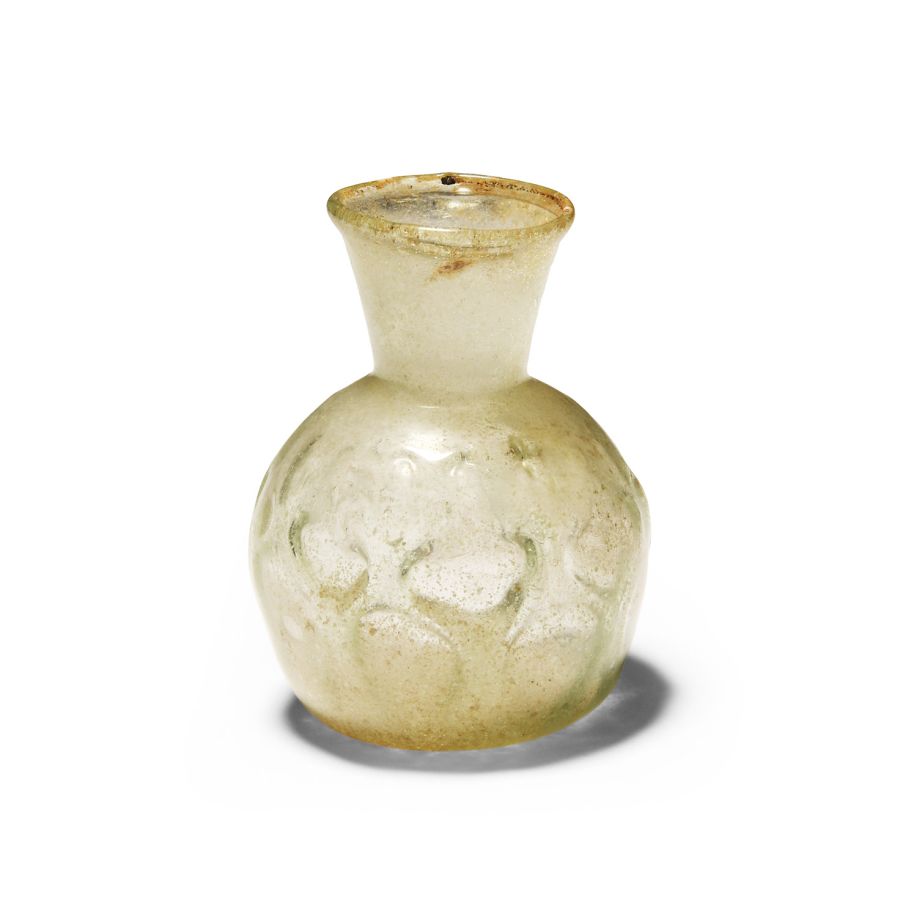
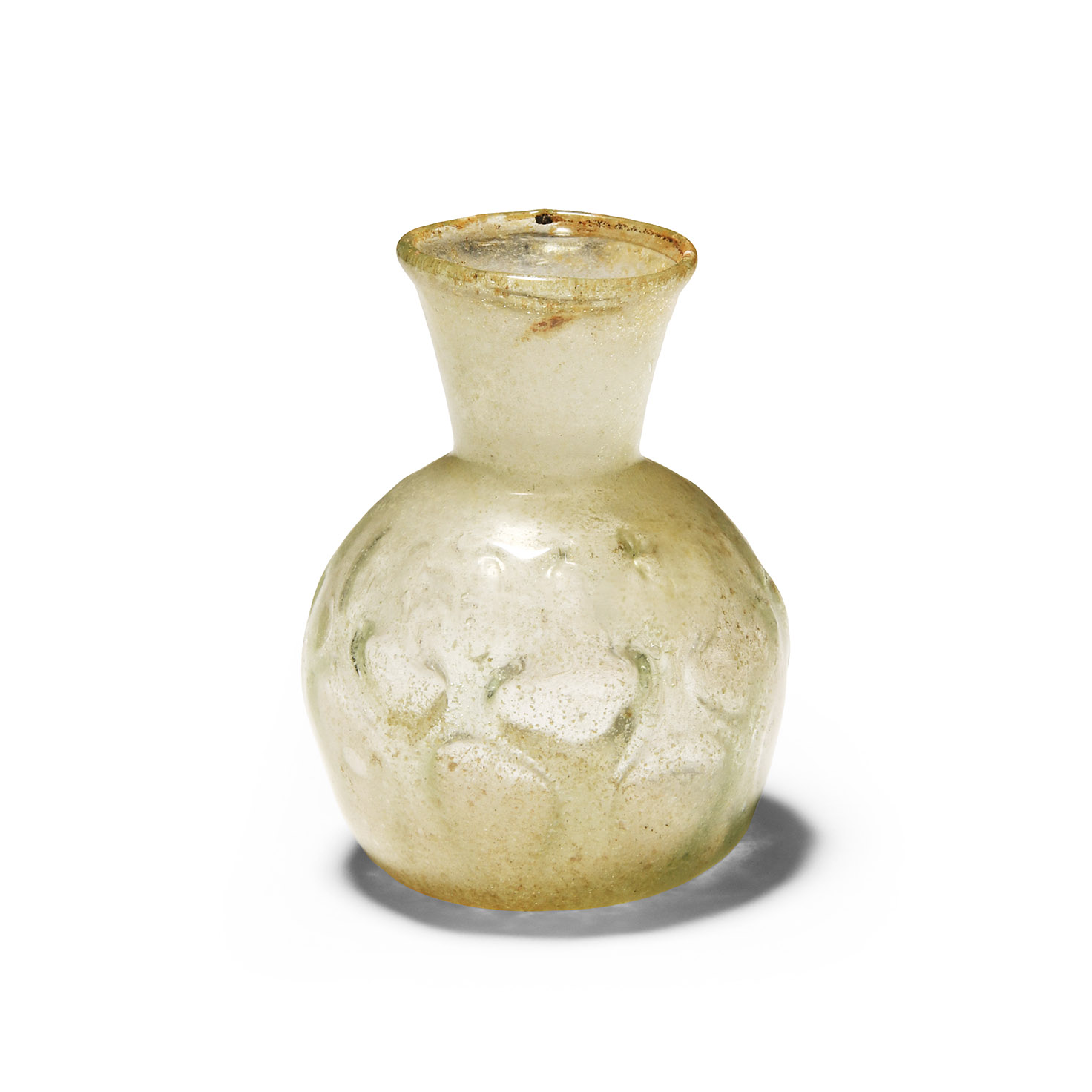
Byzantine Glass Cosmetic Bottle
CIRCA 5TH-6TH CENTURY A.D.
3 in. (35 grams, 77 mm).
The molded body of broadly globular form and displaying a 'net' pattern, with everted neck and mouth. [No Reserve]
ProvenanceEx Coincraft, London WC1.
Ex private Merseyside, UK, collection.
Accompanied by a Coincraft certificate of authenticity.
TimeLine Auctions follows a vetting process to ensure the authenticity and legality of all items, reinforcing our commitment to integrity and responsible trading. Each antiquity, antique, and coin lot undergoes thorough examination by a vetting committee of at least ten external specialists, professional trade association members, scientists, and archaeologists: Our Vetting Process
AUCTIONS:
TimeLine is a leading auction house specialising in antiquities, ancient art, collectables, natural history, coins, medals, and books. Our auctions offer museums, collectors, historians, and enthusiasts the opportunity to acquire unique and historically significant pieces.
-
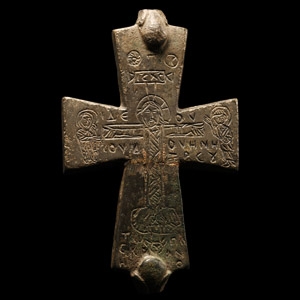
Byzantine Bronze Reliquary Cross Pendant Plate
10th-12th century A.D.Sold for (Inc. bp): £260
The frontal section of an enkolpion, with the representation of crucified Jesus among Saint Mary and Saint John; Christ dressed in a long tunic (colobium) decorated with parallel stripes (clavi) and patterned hatches, his head turned to the right; his wounds on the cross are marked by nails; the cross standing upon a small hill, identified by rare inscription 'Ο ΤΟΠΟС КРАΝΙΟΥ' (a place of a skull, Matthew 27:33), indicating Golgota; the titulum with inscription 'Ι(ΗСΟΥ)С X(ΡΙ СΤΟ)C' (Jesus Christ), and the sun (left) with the moon (right); the central inscription corresponds to the words of the Gospel of John 19:26: 'here is your son, (ΙΔΕ Ο Υ {ΙΟ} С {C}ΟΥ ) here is your Mother (ΙΔΟΥ Η ΜΗΤ{Η}Ρ CΟΥ)'. 56.5 grams, 86 mm
Formerly in a 1980s collection. Acquired on the UK art market. Previously the property of an Essex gentleman.
Usually the reliquary crosses or enkolpia, were composed of two separate halves, inside of which a relic of a saint was contained; this could have been a piece of cloth or a bone. This extraordinary piece is very rare due to containing part of the Gospel of John about the Crucifixion. -
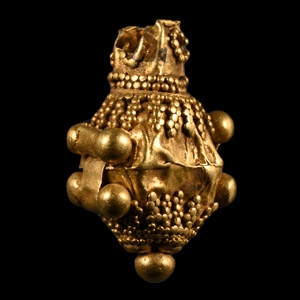
Byzantine Gold Filigree Finial
6th-14th century A.D.Estimate: £250 - 350 (+bp*)
Opening Bid: £125
Of hollow, bulbous form, now slightly squashed, four pellets to each side and an apex pellet, granule clusters to both hemispheres, socket to base with roughly square-shaped cross-section, three circular attachment piercings with granulated borders. 2.47 grams, 17 mm
From a late Japanese specialist collector, 1970-2000s. -
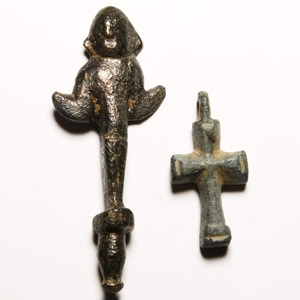
Byzantine Bronze Cross Pendant and Angel Finial Group
6th-8th century A.D.Sold for (Inc. bp): £59
Comprising: a cruciform pendant with notching to each arm and integral suspension loop; a finial crowned with an angel or seraphim. 21.83 grams total, 31-57 mm
Ex old English collection. London art market, 1980s.
