
Loading, please wait...
_900x900.jpg "Byzantine Gilt Bronze Horse Harness Decoration Set")
_200x200.jpg "Byzantine Gilt Bronze Horse Harness Decoration Set")
.jpg "Byzantine Gilt Bronze Horse Harness Decoration Set")
LOT 0183
Byzantine Gilt Bronze Horse Harness Decoration Set
8TH-10TH CENTURY A.D.
3/8 - 3 5/8 in. (556 grams total, 11-92 mm).
Comprising: a large octofoil harness frontal plate with beaded rim and granulation; studs with quatrefoil plates; bell-shaped dangles. [304]
ProvenanceFrom the private collection of a London gentleman, from his grandfather's collection formed before the early 1970s.
This lot has been checked against the Interpol Database of stolen works of art and is accompanied by a search certificate number no.12687-234699.
Cf. for similar harness decoration in Khazar graves Gorelik, M., 'Arms and Armour in South-Eastern Europe in the Second Half of the First Millennium AD' in Nicolle, D., Companion to Medieval Arms and Armour, Woodbridge, 2012, pp.127-148, pl.XI-9 figs.27,32.
FootnotesThe military technology of Byzantium and Khazar Kingdom were interconnected in the 8th-10th centuries A.D. Many military items, like horse harnesses, were produced in both countries and object of interchange between the two military cultures.
CONDITIONTimeLine Auctions follows a vetting process to ensure the authenticity and legality of all items, reinforcing our commitment to integrity and responsible trading. Each antiquity, antique, and coin lot undergoes thorough examination by a vetting committee of at least ten external specialists, professional trade association members, scientists, and archaeologists: Our Vetting Process
AUCTIONS:
TimeLine is a leading auction house specialising in antiquities, ancient art, collectables, natural history, coins, medals, and books. Our auctions offer museums, collectors, historians, and enthusiasts the opportunity to acquire unique and historically significant pieces.
-
.jpg)
Byzantine Bronze Ring with Monogram
13th-14th century A.D.Sold for (Inc. bp): £78
An expanding hoop with decorated shoulders, an octagonal bezel with a monogram, composed of the Greek letters 'Χ [ΑΙΡΕ] ΔΥωΝ[Υ]C (?)' = Be glad Dyoniys. 5.76 grams, 24.25 mm overall, 20.14 mm internal diameter (approximate size British S, USA 9, Europe 20, Japan 19)
Acquired on the UK and EU art market before 2000. From the private collection of a Surrey, UK, gentleman.
The plate and hoop of these rings were soldered together. This system probably originated only in the late period of the Eastern Roman Empire, as evidenced by the faceting of the sides and the irregularity in the letters forming the name. -
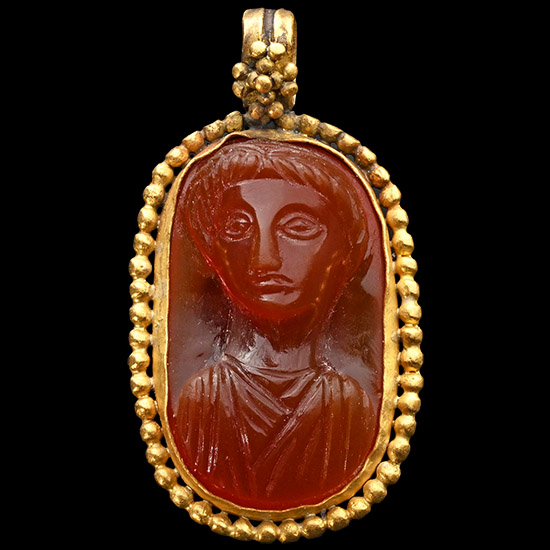
Byzantine Gold Pendant with Carnelian Cameo Bust
Circa 3rd-6th century A.D.Estimate: £3,000 - 4,000 (+bp*)
Opening Bid: £1,500
Carved bust modelled in the half-round with large lentoid eyes and braided hair to the brow, depicting a disciple, an apostle, or a portrait; gold cell with band of granules to the outer edge, ribbed suspension loop with granule detailing. 8.97 grams, 39 mm
From a North American gentleman's collection, 1990s. This lot has been checked against the Interpol Database of stolen works of art and is accompanied by search certificate number no.13367-259037.
Towards the end of the 3rd century, the Roman production of gemstones decreased quickly. At the same time, early Christian motifs appeared on the gemstones. Rare motifs like the one in the current gemstone show portraits of noblewomen or men. -
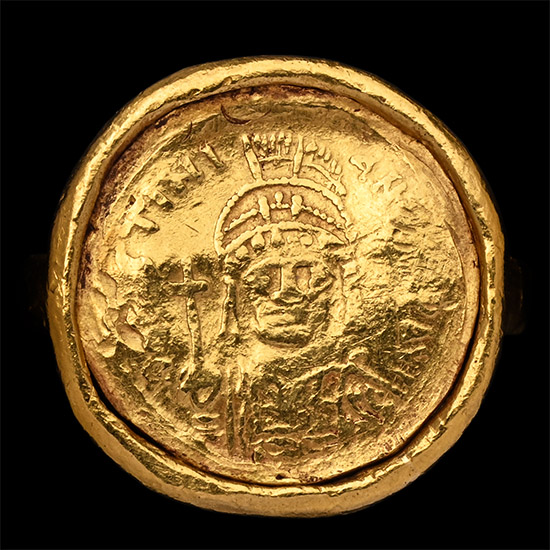
Byzantine Gold Solidus in Gold Ring
6th century A.D.Estimate: £2,500 - 3,500 (+bp*)
Opening Bid: £1,300
The coin showing a facing bust of a pearl-diademed emperor, cuirassed and holding a cross; set in a thick frame with a double rectangular-section hoop below; the solidus a cast or barbarised version. 21.14 grams, 24.51 mm overall, 17.47 x 16.14 mm internal diameter (approximate size British J 1/2, USA 5, Europe 9.32, Japan 9)
Acquired on the European art market. This lot has been checked against the Interpol Database of stolen works of art and is accompanied by search certificate number no.13338-257893.
The coin represents a frontal bust of Justinian I in a helmet (kamelaukion) with a plume, a diadem with trefoil ornament on the front, and a cuirass decorated with four pellets. Globus cruciger in right hand, shield with horseman device on left shoulder. Inscription: DNIVSTINIANVSPPAVC (Dominus Noster Justinianus Semper Augustus). Probably Mint of Rome 537-542.
