
Loading, please wait...
LOT 0195
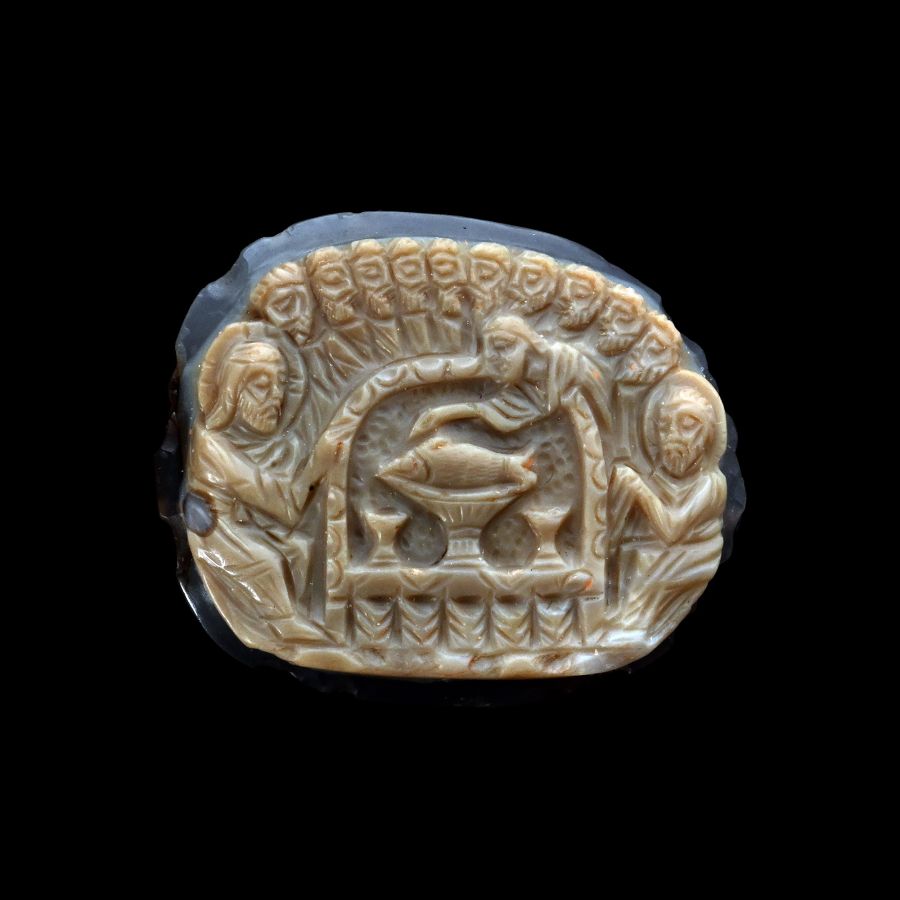
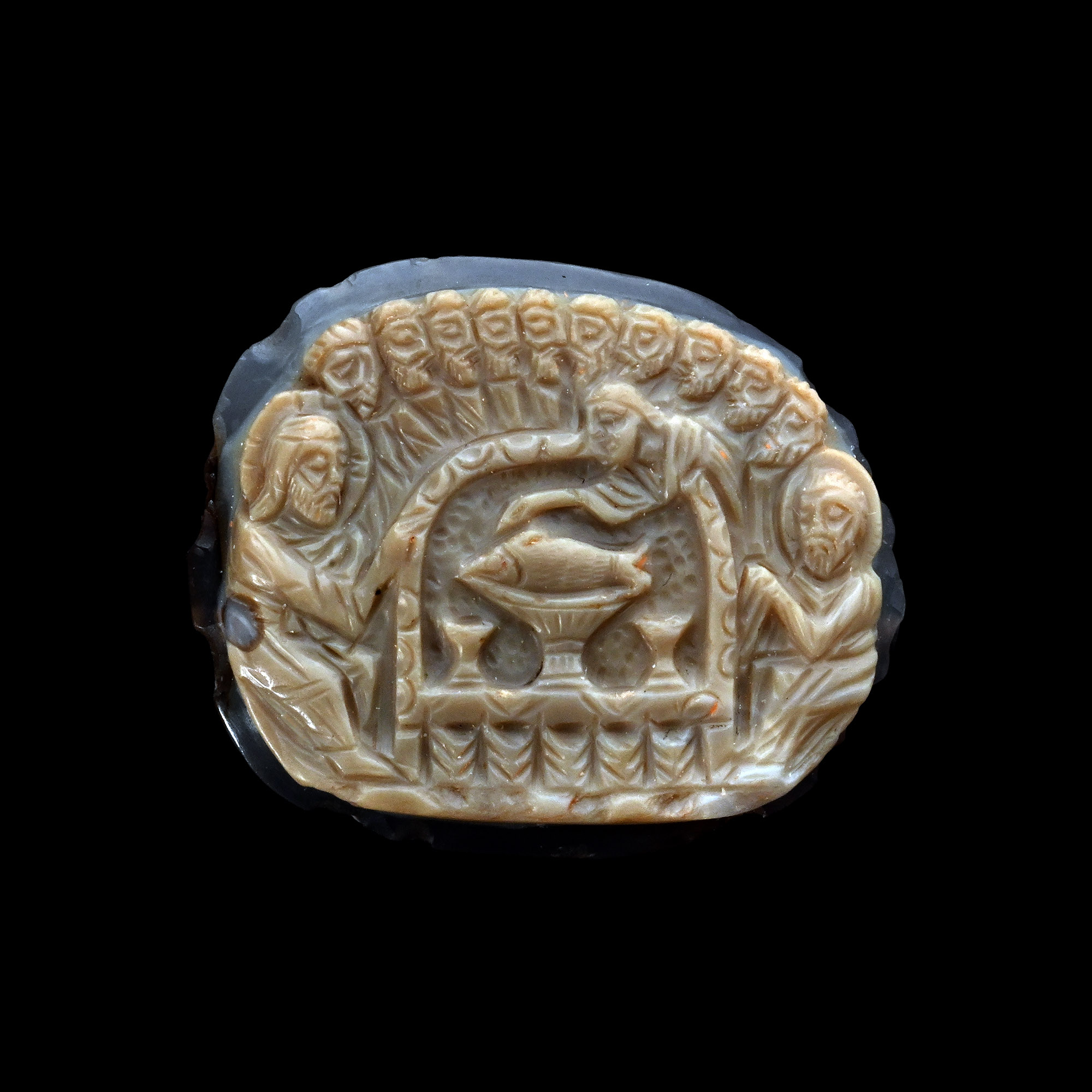
Byzantine Carved Agate Cameo of The Holy Banquet
6TH-8TH CENTURY A.D.
1 1/4 in. (9.95 grams, 32 mm).
Plano-convex in section with low-relief carving: scene with a meal at a so-called sigma table surrounded by Christ, Peter, John and the other disciples; Christ and Peter attending and beardless Saint John the Evangelist preparing the fish.
ProvenanceFrom a North American gentleman's collection, 1990s.
This lot has been checked against the Interpol Database of stolen works of art and is accompanied by search certificate number no.13368-259040.
Cf. Giugea, G.D. Representations of the Last Supper Scene in Romanian Medieval and Western Renaissance Mural Painting in Proceedings of 11th International Conference on Education & Social Sciences. 22-24 January 2024- Istanbul, Turkey especially fig.1, The Last Supper at Sant’ Apollinare Nuovo, Ravenna.
FootnotesIn early Byzantine art, Saint Peter is often depicted as the only figure apart from Christ to be shown with a nimbus, to emphasise his pre-eminent position as a church father and the 'rock' of the church.
CONDITIONTimeLine Auctions follows a vetting process to ensure the authenticity and legality of all items, reinforcing our commitment to integrity and responsible trading. Each antiquity, antique, and coin lot undergoes thorough examination by a vetting committee of at least ten external specialists, professional trade association members, scientists, and archaeologists: Our Vetting Process
AUCTIONS:
TimeLine is a leading auction house specialising in antiquities, ancient art, collectables, natural history, coins, medals, and books. Our auctions offer museums, collectors, historians, and enthusiasts the opportunity to acquire unique and historically significant pieces.
-
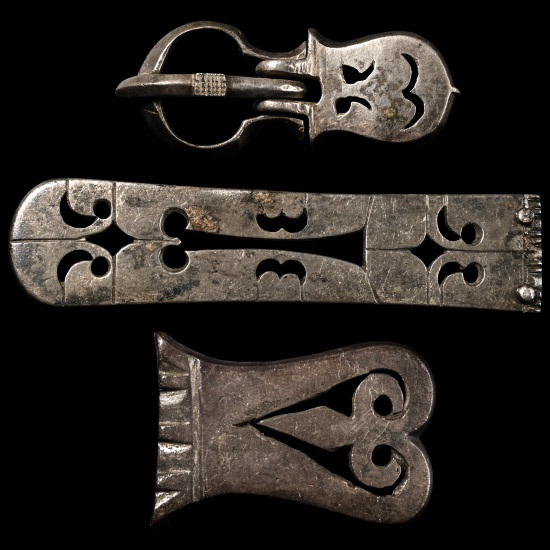
Early Byzantine Silver Belt Fittings with Openwork Decoration
6th-7th century A.D.Estimate: £300 - 400 (+bp*)
Opening Bid: £150
Comprising: two strap ends with openwork decoration of bifurcated scrolls and volutes; a buckle with an arched loop and cast tongue mounted on a shield-shaped plate decorated in a similarly abstract vegetal scheme. 51.5 grams total, 47-89 mm
Acquired on the European art market.
The high quality of execution, formal consistency, and use of silver suggest these fittings once adorned the belt of a military or aristocratic figure within a frontier or provincial context. Their design is representative of the transitional material culture of the early Byzantine world, in which classical motifs were abstracted and reinterpreted through regional aesthetic idioms. This ensemble belongs to the broader category of Early Byzantine personal dress fittings, and is closely related to the Martynivka Hoard—a group of silver artefacts discovered near Kanev (modern Cherkasy Oblast, Ukraine) before 1909. Now divided between the British Museum and the National Museum of the History of Ukraine, the hoard includes strap ends and buckles of closely comparable design and manufacture. While their precise cultural attribution remains debated, the prevailing scholarly consensus situates them within the orbit of Byzantine provincial production, possibly influenced by or intended for Slavic, nomadic, or client populations in the Pontic steppe region. Similar artefacts have been recovered from Kerch in Crimea, further supporting the view that such belt fittings were widely disseminated in Byzantine-controlled or influenced regions along the northern Black Sea during the 6th and 7th centuries. Their function was not merely practical; richly decorated belts of this kind were important signifiers of rank, allegiance, and imperial favour. -
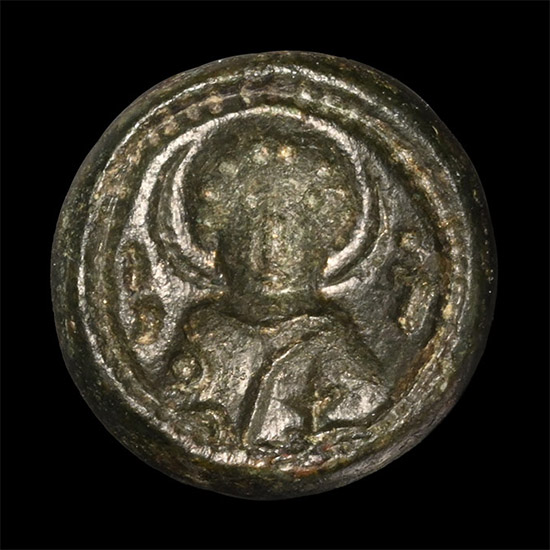
Byzantine Bronze Seal with Saint
8th-10th century A.D.Sold for (Inc. bp): £78
Collared loop above, underside with facing bust of a nimbate saint holding a cross. 6.34 grams, 18 mm
Ex German art market, 2000s. Acquired from an EU collector living in London. From the collection of a Surrey, UK, gentleman. -
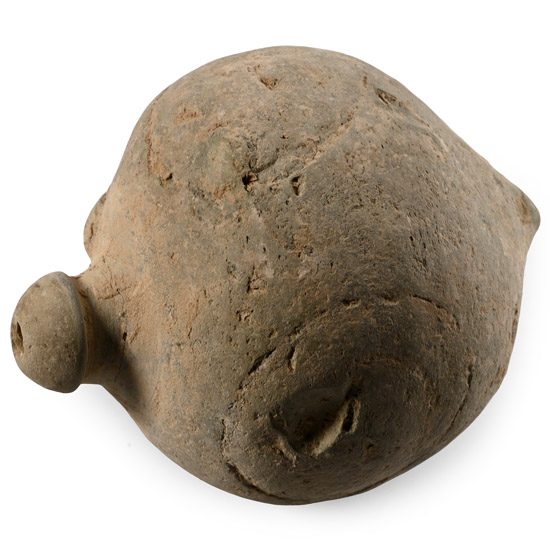
Byzantine 'Greek Fire' Ceramic Fire Bomb or Hand Grenade
9th-11th century A.D.Sold for (Inc. bp): £65
Bulbous body with pointed base and domed mouth; intended to be filled with explosive liquid and a wick, and used as a hand grenade. 598 grams, 12 cm
From an important specialist collection, London, UK, 1990s. Accompanied by an academic paper by military specialist Dr Raffaele D'Amato, dated 15 July 2019 and titled 'Eastern Roman Empire - Greek Fire Bomb or Hand Grenade (μεσαίον kακάβιον) 9th-11th century AD'.
Apart from the use of siphons or manual flame-throwers called cheirosiphona, special corps of Roman soldiers employed terracotta grenades, in the form of small jars, abundantly evidenced in archaeological excavations. They were called μεσαία kακαβιά or κυτροκακάβια, where the former had a bulbous shape and the latter a more cylindrical form.
