
Loading, please wait...
LOT 1094
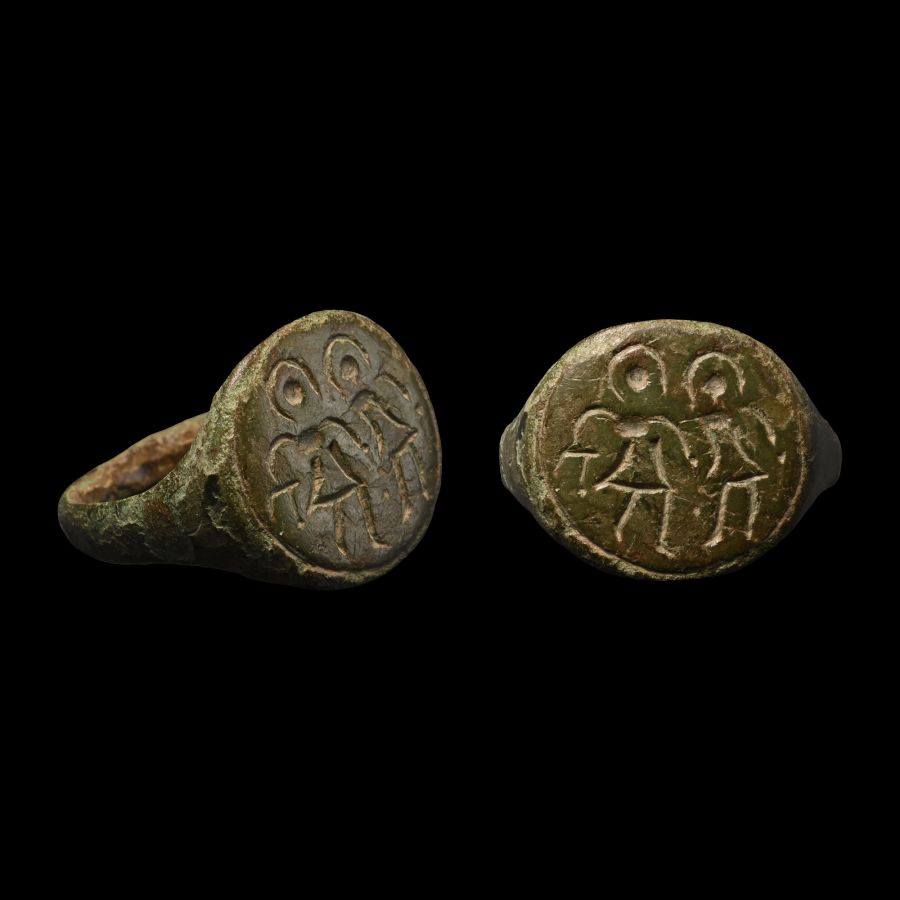
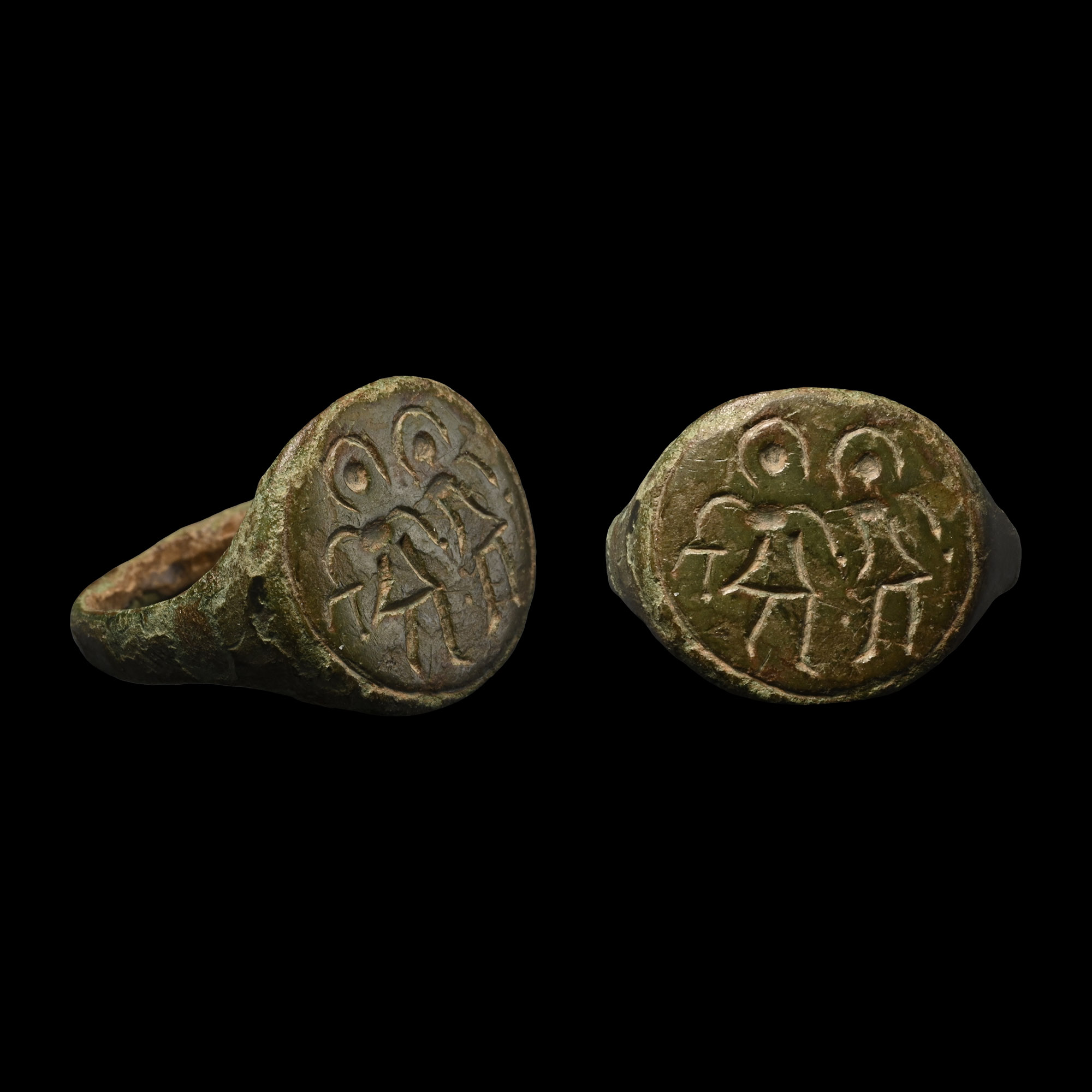
Byzantine Bronze Ring with Saints
11TH CENTURY A.D.
7/8 in. (6.46 grams, 22.33 mm overall, 19.15 mm internal diameter (approximate size British R 1/2, USA 8 3/4, Europe 19.38, Japan 18)).
Comprising a D-section hoop and a large discoid bezel with two stylised nimbate figures dressed in short tunics. [No Reserve]
ProvenanceAcquired on the UK and EU art market before 2000.
From the private collection of a Surrey, UK, gentleman.
Cf. Đurović, I., Средњовековни накит из збирки Народног музеја Крагујевац (Medieval jewelry from the collections of the National Museum Kragujevac, in Serbian), Крагујевац, 2012, fig.60, for the type.
FootnotesThe oval hoop, in this category of rings, gradually widens into a full shoulder and massive flattened head. The bezel is ellipsoidal, decorated with stylised images, most probably of military saints, invoking protection and blessing.
CONDITIONTimeLine Auctions follows a vetting process to ensure the authenticity and legality of all items, reinforcing our commitment to integrity and responsible trading. Each antiquity, antique, and coin lot undergoes thorough examination by a vetting committee of at least ten external specialists, professional trade association members, scientists, and archaeologists: Our Vetting Process
AUCTIONS:
TimeLine is a leading auction house specialising in antiquities, ancient art, collectables, natural history, coins, medals, and books. Our auctions offer museums, collectors, historians, and enthusiasts the opportunity to acquire unique and historically significant pieces.
-
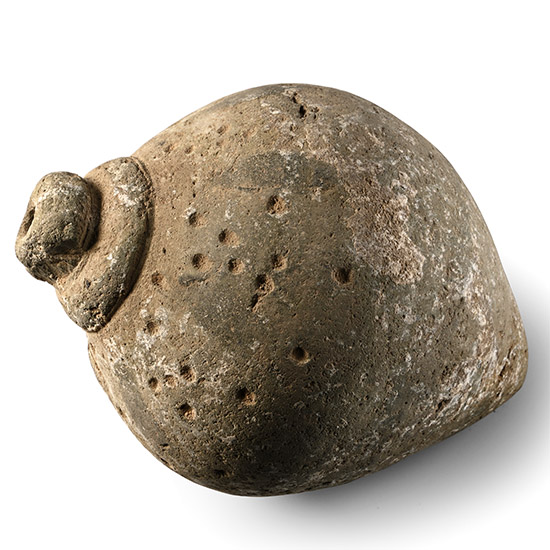
Byzantine 'Greek Fire' Ceramic Fire Bomb or Hand Grenade
9th-11th century A.D.Sold for (Inc. bp): £85
Ovoid in profile with incised dot decoration on the upper body; intended to be filled with explosive liquid and a wick, and used as a hand grenade. 912 grams, 15 cm
From a specialist collection, London, UK, 1990-2000s. Accompanied by an academic paper by military specialist Dr Raffaele D'Amato, dated 15 July 2019 and titled 'Eastern Roman Empire - Greek Fire Bomb or Hand Grenade (μεσαίον kακάβιον) 9th-11th century AD'.
Apart from the use of siphons or manual flame-throwers called cheirosiphona, special corps of Roman soldiers employed terracotta grenades, in the form of small jars, abundantly evidenced in archaeological excavations. They were called μεσαία kακαβιά or κυτροκακάβια, where the former had a bulbous shape and the latter a more cylindrical form. -
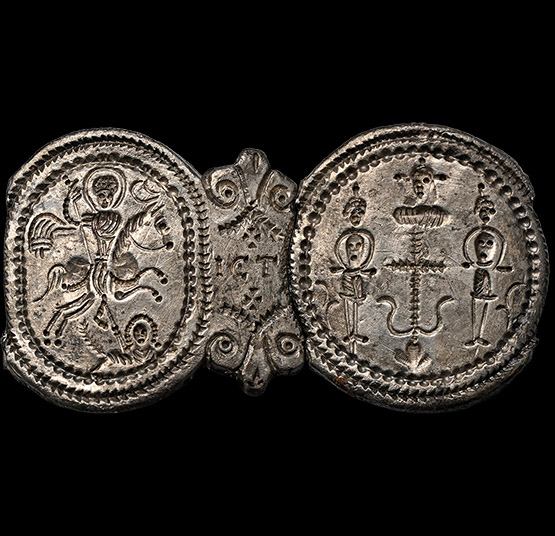
Byzantine Silver Bracelet Sections with Warrior Saint and Crucifixion
6th-7th century A.D.Sold for (Inc. bp): £936
Two fragments from a military bracelet (brachiolion) comprising: a disc with double border of pellets, at the centre two standing figures of the two robbers flanking a stylised Stavrosis (crucifixion), composed of a stylised cross surmounted by the nimbate head of Christ; the other an ellipsoid panel and portion of the shank with pelta-shaped motifs flanking 'ICT' (IesouC Theou = Jesus son of God) legend, the panel with double border of pellets enclosing image of nimbate Saint George on horseback with scale armour and spearing the dragon with a long spear (doru). 9.67 grams total, 26 mm each
Ex private Dorset, UK, collection circa 1980s. Property of a London, UK, antiquarian. Accompanied by an academic report by Dr Raffaele D’Amato. This lot has been checked against the Interpol Database of stolen works of art and is accompanied by a search certificate number no.13042-248494.
The importance of the depicted subject, the Stavrosis or Crucifixion, lies in its rarity. We know of very few representations of this subject in the early period of Christian art. Since the 6th-7th centuries, the iconographic type of military saints on horseback, Saint George, Saint Demetrios, Saint Theodore and Saint Sisinnios appear in the artistic milieu of the Middle East at the end of the 5th century-early 6th century AD. Among this iconography, the figure of Saint George, killer of the Dragon, stood out. The warrior saint was represented armed like a true Christian warrior of the Roman Empire, and the style of his armament here, also for comparison with similar images, points to a 6th-7th century dating, a period when the Eastern Roman Empire was still at the height of its power and exerted its influence over Eastern and Western Europe. -
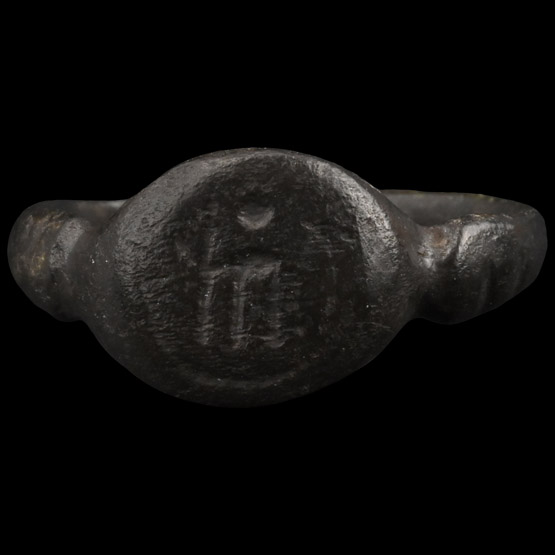
Byzantine Bronze Ring with Warrior Saint
14th-15th century A.D.Sold for (Inc. bp): £59
Comprising a slender hoop with gently expanding shoulders, an oval bezel with a stylised standing figure holding a spear. 3.23 grams, 20.48 mm overall, 18.01 mm internal diameter (approximate size British N 1/2, USA 6 3/4, Europe 14..35, Japan 13)
Acquired on the UK and EU art market before 2000. From the private collection of a Surrey, UK, gentleman.
These kind of rings, possibly signet rings, find their parallels with artefacts from Eastern Europe, especially in the area of Smederevo. Comparison elements allow us to propose a 14th-15th A.D. date. In the Orthodox world, military saints were common representations, although engraved simplistically.
