
Loading, please wait...
_900x900.jpg "Byzantine Bronze Ring with Monogram")
_200x200.jpg "Byzantine Bronze Ring with Monogram")
.jpg "Byzantine Bronze Ring with Monogram")
LOT 1113
Byzantine Bronze Ring with Monogram
13TH-14TH CENTURY A.D.
1 in. (5.76 grams, 24.25 mm overall, 20.14 mm internal diameter (approximate size British S, USA 9, Europe 20, Japan 19)).
An expanding hoop with decorated shoulders, an octagonal bezel with a monogram, composed of the Greek letters 'Χ [ΑΙΡΕ] ΔΥωΝ[Υ]C (?)' = Be glad Dyoniys. [No Reserve]
ProvenanceAcquired on the UK and EU art market before 2000.
From the private collection of a Surrey, UK, gentleman.
Cf. Wamser, L., Die Welt von Byzanz - Europas Östliches Erbe, München, 2004, item 682, for the type.
FootnotesThe plate and hoop of these rings were soldered together. This system probably originated only in the late period of the Eastern Roman Empire, as evidenced by the faceting of the sides and the irregularity in the letters forming the name.
CONDITIONTimeLine Auctions follows a vetting process to ensure the authenticity and legality of all items, reinforcing our commitment to integrity and responsible trading. Each antiquity, antique, and coin lot undergoes thorough examination by a vetting committee of at least ten external specialists, professional trade association members, scientists, and archaeologists: Our Vetting Process
AUCTIONS:
TimeLine is a leading auction house specialising in antiquities, ancient art, collectables, natural history, coins, medals, and books. Our auctions offer museums, collectors, historians, and enthusiasts the opportunity to acquire unique and historically significant pieces.
-
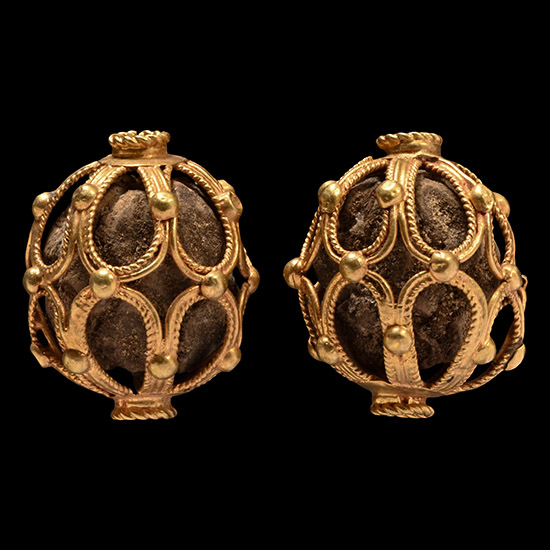
Byzantine Gold Openwork Beads from Earrings
10th-11th century A.D.Sold for (Inc. bp): £644
Each a spherical cage with ropework texturing, a granule at each node; oval glass bead within. 13.8 grams, 22 mm each
Acquired on the Swiss art market, 1998. Private collection, Europe.
The openwork beads were prepared to be inserted in an earring of ‘Grapevine’ typology, III type of earring in the Niederle classification. Similar specimens, imported from Byzantium, were found in Tokaj (Hungary) and dated to the time of the Emperor Romanus Lekapenos (920-944 A.D.). -
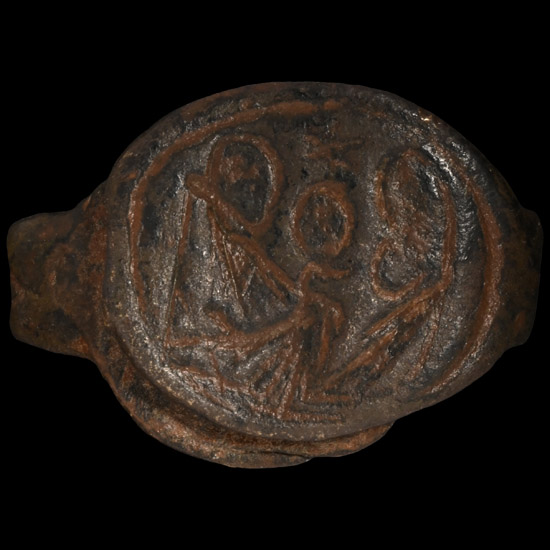
Byzantine Bronze Ring with Nativity Scene
Circa 14th century A.D.Sold for (Inc. bp): £169
Comprising a thick rectangular-section hoop and two overlapping discoid bezels, the upper one with a depiction of the Nativity. 6.74 grams, 23.33 mm overall, 1.85 x 13.82 mm internal diameter (approximate size British H, USA 3 3/4, Europe 6.18, Japan 6)
From the private collection of a European gentleman (1942-2024), formed since the 1970s. -
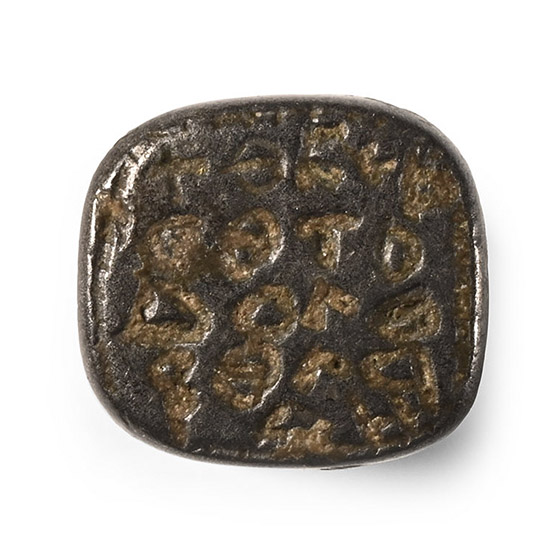
Byzantine Seal Matrix with Inscription
Circa 11th-12th century A.D.Estimate: £80 - 100 (+bp*)
Opening Bid: £44
With inscription '+ΘKEB / OΘTO / ΔΟΛΟ / ΤΘΛΑ' for 'ΘΕΟΤΟΚΕ ΒΟΗΘΕI ΤΩ ΔΟΥΛΩ ΤΟΥ ΘΕΟΥ ΛΑΔΕ' (Mother of God, help Lades, the servant of God). 13.1 grams, 18 mm
From an important collection formed before 1988, London and Geneva.
The stamp seals that have survived in large numbers from Byzantium are objects a few centimetres high and conical in shape, featuring a sealing surface at the lower end and a pendant at the upper end. They served the same function as signet rings and were used to seal everyday objects, primarily for personal purposes, using wax and other soft materials.
