
Loading, please wait...


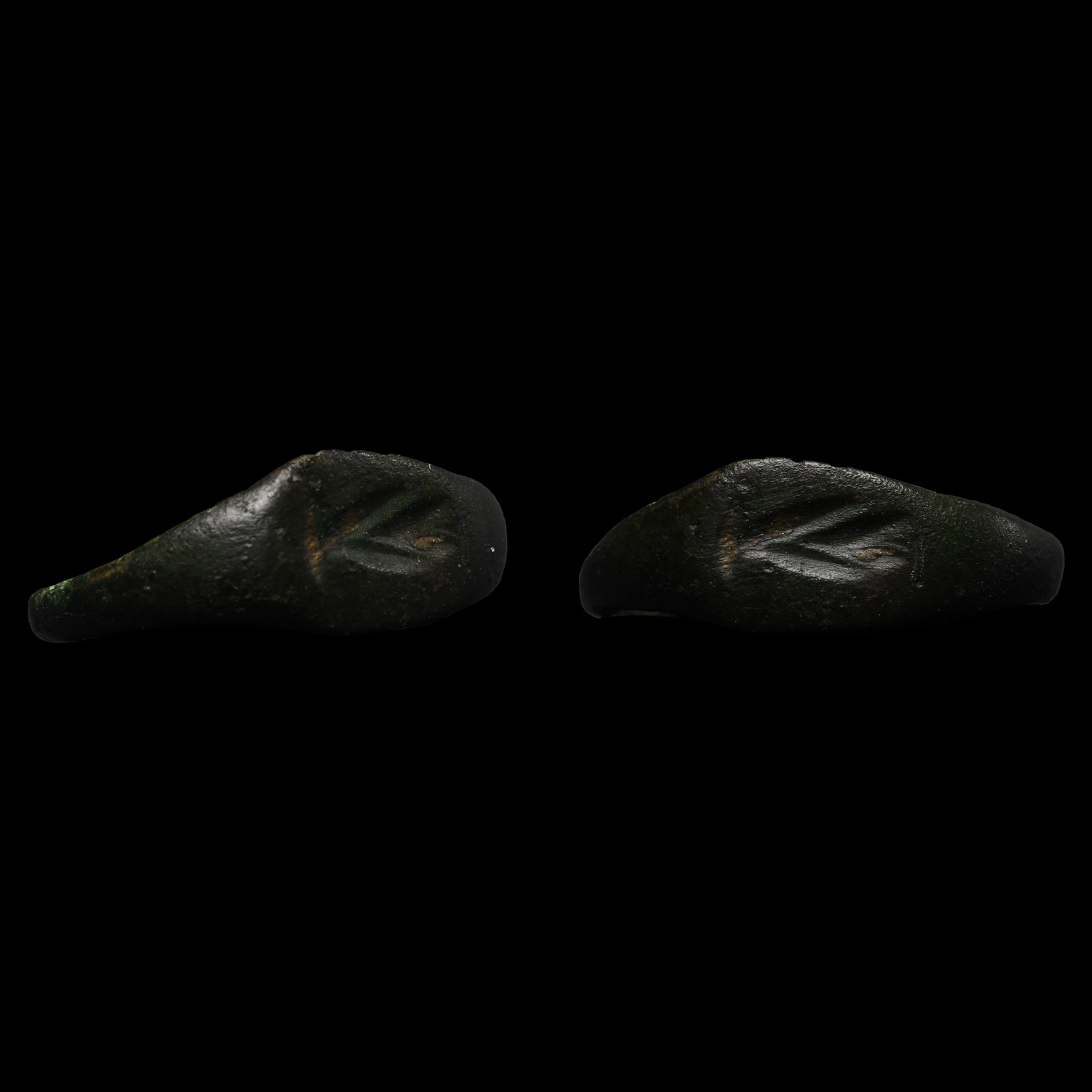
LOT 0956
Byzantine Bronze Ring with Hand of God
6TH-8TH CENTURY A.D.
5/8 in. (1.34 grams, 18.66 mm overall, 15.68 mm internal diameter (approximate size British F, USA 2 3/4, Europe 3.67, Japan 3)).
Integral ellipsoid plaque with incuse hand motif. [No Reserve]
ProvenanceAcquired 1980-2015.
Ex Abelita family collection.
TimeLine Auctions follows a vetting process to ensure the authenticity and legality of all items, reinforcing our commitment to integrity and responsible trading. Each antiquity, antique, and coin lot undergoes thorough examination by a vetting committee of at least ten external specialists, professional trade association members, scientists, and archaeologists: Our Vetting Process
AUCTIONS:
TimeLine is a leading auction house specialising in antiquities, ancient art, collectables, natural history, coins, medals, and books. Our auctions offer museums, collectors, historians, and enthusiasts the opportunity to acquire unique and historically significant pieces.
-
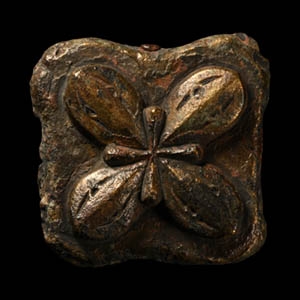
Byzantine Bronze Patrix Die for a Belt Mount
6th-7th century A.D.Sold for (Inc. bp): £65
Comprising a quatrefoil modelled in high-relief with equal-armed cross to the centre, on a lozengiform base. 42.4 grams, 37 mm
Acquired in the 1980s. From the collection of a London antiquarian. -
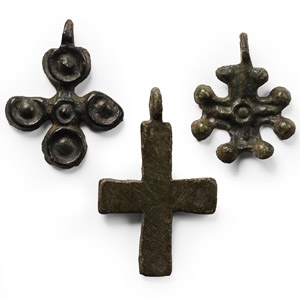
Byzantine Bronze Cross Pendant Group
6th-8th century A.D.Sold for (Inc. bp): £117
Comprising three crosses, two decorative and one plain. 11.3 grams total, 22-36 mm
Ex German art market, 2000s. Acquired from an EU collector living in London. From the collection of Surrey, UK, gentleman. -
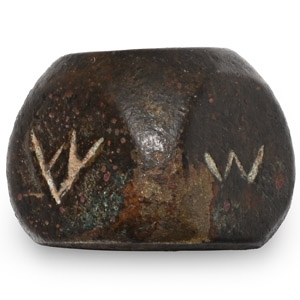
Byzantine AE Three(?) Unciae Weight
Circa 5th-7th century A.D.Sold for (Inc. bp): £65
In the form of a cube engraved on five sides: ᏌΓ and M and A and X and V. 26 grams, 16 mm
From the collection of a gentleman, acquired on the London art market in the 1990s.
