
Loading, please wait...
_900x900.jpg "Byzantine Bronze Ring with 'Globus Cruciger' Gemstone")
_200x200.jpg "Byzantine Bronze Ring with 'Globus Cruciger' Gemstone")
.jpg "Byzantine Bronze Ring with 'Globus Cruciger' Gemstone")
LOT 0766
Byzantine Bronze Ring with 'Globus Cruciger' Gemstone
CIRCA 6TH-8TH CENTURY A.D.
1 in. (4.75 grams, 24.93 mm overall, 17.59 mm internal diameter (approximate size British M 1/2, USA 6 1/4, Europe 13.09, Japan 12)).
With narrow, flat-bottomed hoop and tapering shoulders, inset garnet cabochon with 'globus cruciger' motif.
ProvenanceAcquired on the German art market before 2000.
Property of a Surrey, UK, collector.
The globus cruciger comprises a sphere surmounted by a cross potent, symbolising the domination of the world by Christianity.
CONDITIONTimeLine Auctions follows a vetting process to ensure the authenticity and legality of all items, reinforcing our commitment to integrity and responsible trading. Each antiquity, antique, and coin lot undergoes thorough examination by a vetting committee of at least ten external specialists, professional trade association members, scientists, and archaeologists: Our Vetting Process
AUCTIONS:
TimeLine is a leading auction house specialising in antiquities, ancient art, collectables, natural history, coins, medals, and books. Our auctions offer museums, collectors, historians, and enthusiasts the opportunity to acquire unique and historically significant pieces.
-
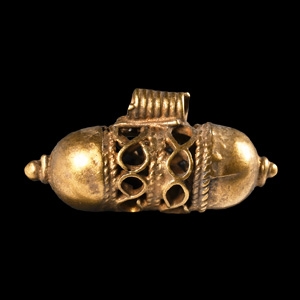
Byzantine Gold Filigree Pendant
6th-10th century A.D.Sold for (Inc. bp): £247
Two sheet gold domes flanking a tube of filigree loops and braided bands, ribbed collar above, granule cluster to each end. 0.79 grams, 15 mm
From a late Japanese specialist collector, 1970-2000s. -
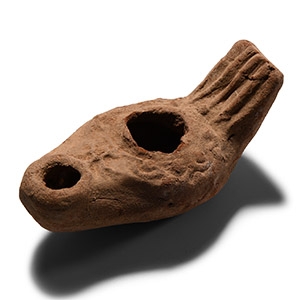
Byzantine Terracotta Slipper Oil Lamp
Circa 5th-8th century A.D.Sold for (Inc. bp): £20
With a sub-circular filling hole enclosed within a vegetal border, striated handle to the rear and cross motif to base. 59 grams, 91 mm
Acquired in the 1980s-1990s. Property of a Nottinghamshire gentleman. -
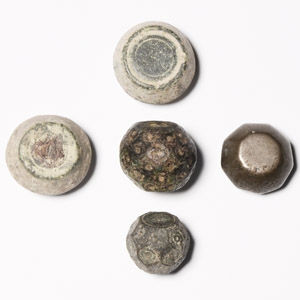
Byzantine Bronze Trade Weight Collection
Circa 8th-12th century A.D.Sold for (Inc. bp): £33
Mixed group of barrel-shaped, biconvex and other trade weights, some with punched markings. 244 grams total, 18-25 mm
Ex Simmons Gallery, London E11, UK, in the 1990s. From a North London collection.
