
Loading, please wait...

LOT 0928
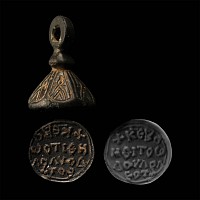
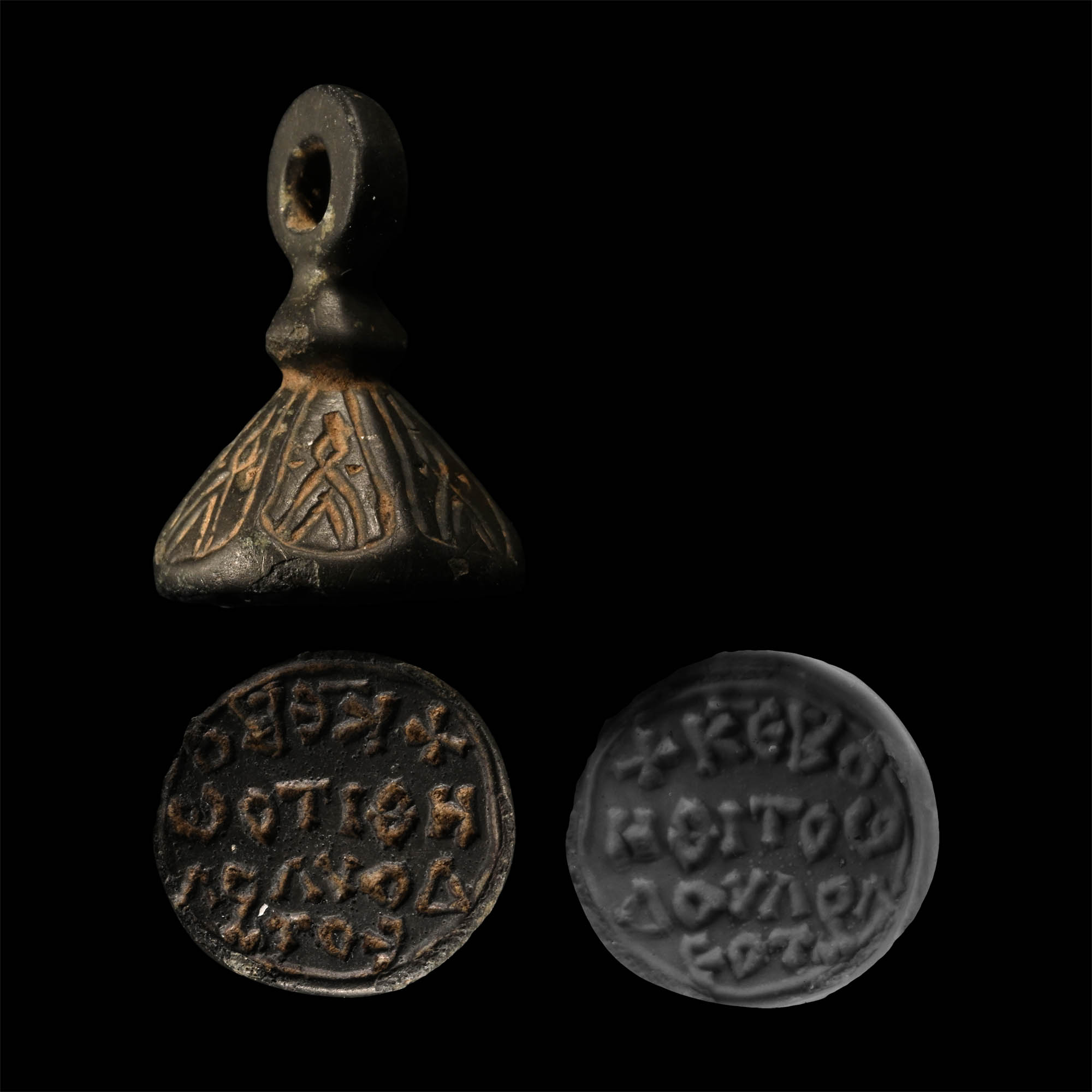
Byzantine Bronze 'Lord Help Leon the Servant' Stamp Seal
5TH-7TH CENTURY A.D.
1 in. (15.6 grams, 25 mm).
Comprising a conical body with segmented outer face and loop motifs, biconvex baluster, thick loop; retrograde legend to the underside: '+KE BO / HΘITOV / ΔΟΥΛΟ / ΛΕΟΤΑ (Lord help Leon the servant).
ProvenanceFrom the private collection of Mr K.A., acquired in the 1990s-early 2000s.
CONDITIONTimeLine Auctions follows a vetting process to ensure the authenticity and legality of all items, reinforcing our commitment to integrity and responsible trading. Each antiquity, antique, and coin lot undergoes thorough examination by a vetting committee of at least ten external specialists, professional trade association members, scientists, and archaeologists: Our Vetting Process
AUCTIONS:
TimeLine is a leading auction house specialising in antiquities, ancient art, collectables, natural history, coins, medals, and books. Our auctions offer museums, collectors, historians, and enthusiasts the opportunity to acquire unique and historically significant pieces.
LOT 0928
Byzantine Bronze 'Lord Help Leon the Servant' Stamp Seal
Sold for (Inc. bp): £358
-
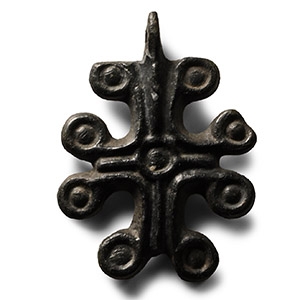
Byzantine Bronze Cross Pendant
6th-8th century A.D.Sold for (Inc. bp): £156
With raised median ribs and a central ring-and-dot motif, integral suspension loop, each arm with a pair of projecting ring-and-dot lobes. 6.09 grams, 35 mm
Ex German art market, 2000s. Acquired from an EU collector living in London. From the collection of Surrey, UK, gentleman. -
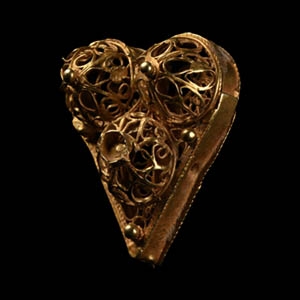
Byzantine Gold Heart-Shaped Fitting
Circa 6th-8th century A.D.Sold for (Inc. bp): £494
Openwork bead or pendant with heart-shaped frame and three domes to the obverse, each formed as a filigree cage; one with cell at the apex and the others with knop finials; granules to the obverse, filigree swirls to the reverse. 2.93 grams, 24 mm
Ex property of a late Japanese collector, 1970-2000s. -
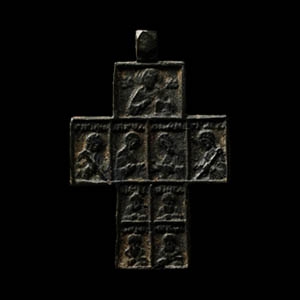
Byzantine Bronze Pendant with Saints
Circa 10th-12th century A.D.Sold for (Inc. bp): £390
Cruciform with segmented obverse, each cell with the bust of a saint and legend above. 25 grams, 63 mm
Private collection formed in Europe in the 1980s. Westminster collection, central London, UK.
