
Loading, please wait...
LOT 0853
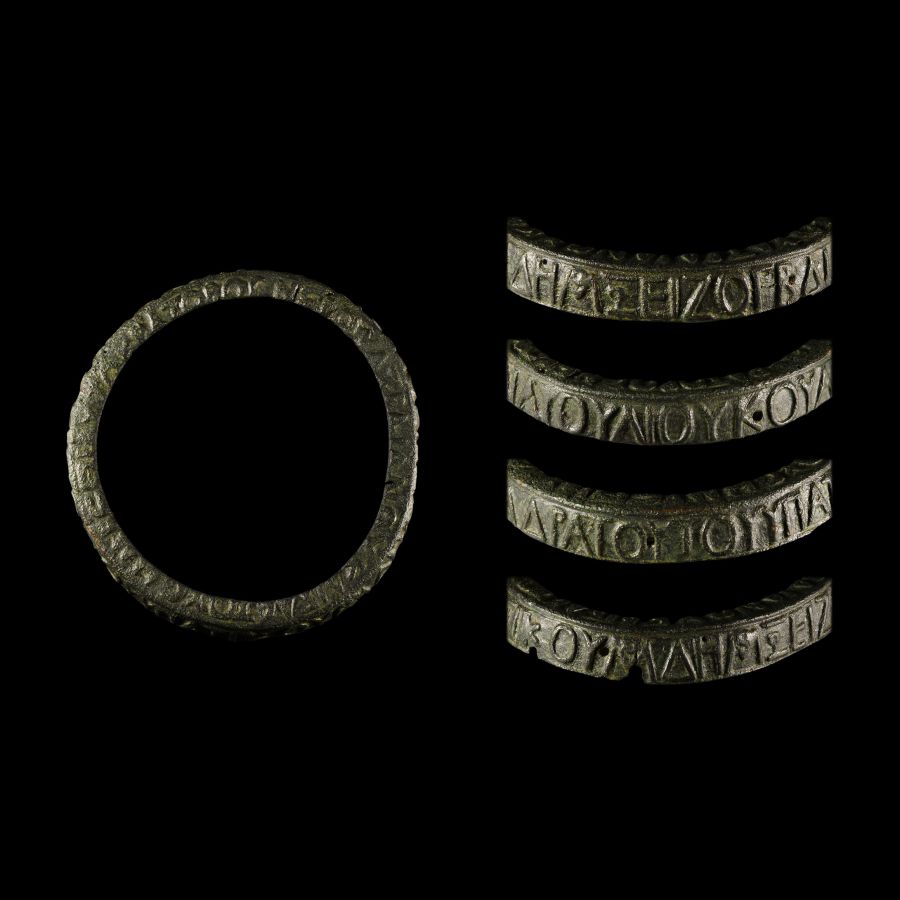
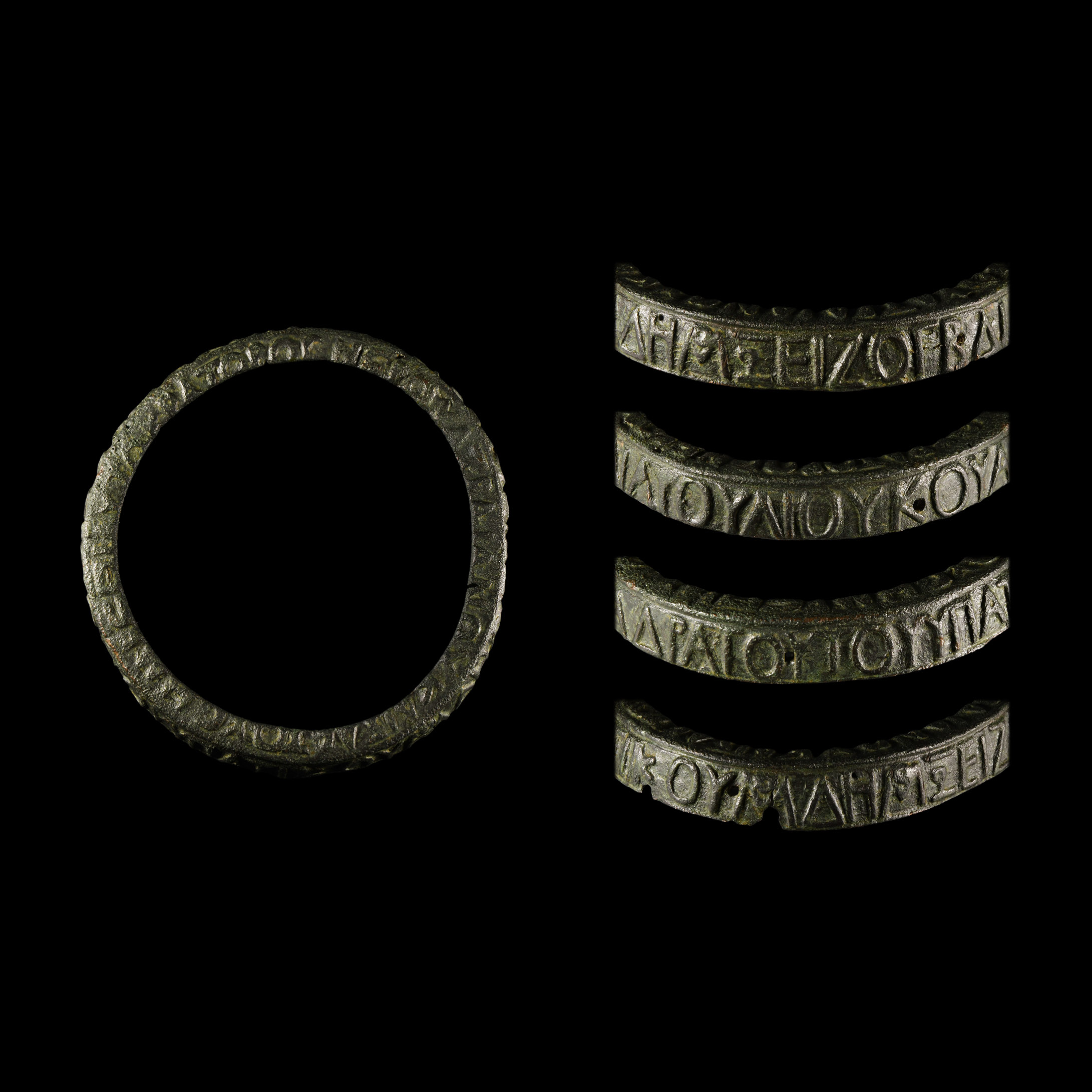
Byzantine Bronze Inscribed Vessel Rim
CIRCA 6TH-8TH CENTURY A.D.
6 in. (257 grams, 15 cm wide).
Sub-circular in form, displaying an inscription in raised Greek lettering to the upper and side faces; pierced for attachment; the main inscription on the border should be read 'Μ ΔΗΜ ΞΕΙΖΟΓ ΒΛΙΑ TΟΥ ΛΙΟΥΚΟΥ ΑΔΡΑΤΟΥ ΤΟΥ ΥΠΑΤΙΚΟΥ' = M(ichail) Dem(etrios) Exizoglos to the consularis Ioulios Quadratos.
ProvenanceEx Simmons Gallery, London E11, UK, in the 1990s.
From a North London collection.
Cf. a small bronze tripod stand in the Archaeological Museum of Delphi, inv. 8404.
FootnotesThe vessel was probably part of a gift given by a certain Michail Demetrios to an officer of (ΥΠΑΤΙΚΟΥ) i.e. Consularis Rank. The shape recalls that of small tripods stands.
CONDITIONTimeLine Auctions follows a vetting process to ensure the authenticity and legality of all items, reinforcing our commitment to integrity and responsible trading. Each antiquity, antique, and coin lot undergoes thorough examination by a vetting committee of at least ten external specialists, professional trade association members, scientists, and archaeologists: Our Vetting Process
AUCTIONS:
TimeLine is a leading auction house specialising in antiquities, ancient art, collectables, natural history, coins, medals, and books. Our auctions offer museums, collectors, historians, and enthusiasts the opportunity to acquire unique and historically significant pieces.
-
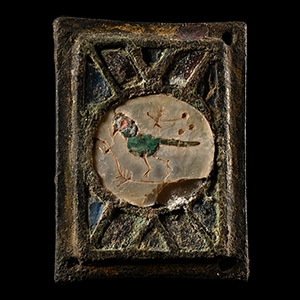
Byzantine Bronze Plaque with Bird Inlay
Circa 10th-11th century A.D.Estimate: £4,000 - 6,000 (‡+bp*)
Opening Bid: £2,000
Sub-rectangular in form with raised rectangular panel to centre, cells forming X-motif inlaid with red glass(?) against a blue field, central nacre(?) roundel engraved with a perched bird with polychrome enamelled detailing; trace remains of gilding to upper and side edges; piercing to each corner. 20.6 grams, 38 mm
Acquired in London, early 1980s. Purchased in Europe before 1992. Private collection, Europe. This lot has been checked against the Interpol Database of stolen works of art and is accompanied by search certificate number no.11811-206495.
The small square plaque was possibly part of the decoration of an Evangeliary, such as the enamels covering the binding of Henry II's Perikopenbuch, or the Siena Evangeliary (11th-13th century). Byzantium brought the enamel and cloisonné technique to its most perfect, refined and skilful expression. Between the 10th and 11th centuries it spreads its forms in the East and West and after some infiltration in the Romanesque-Lombard sphere, precious Eastern Roman cloisonnes were found in Russian art, reaching their apex in the Roman Empire during the 10th-12th centuries, in the decoration of icons and other artworks. -
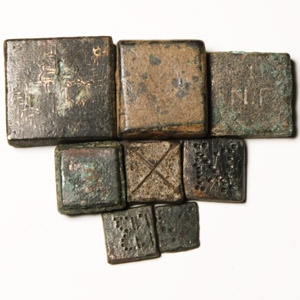
Byzantine Bronze Weight Collection
8th-12th century A.D.Sold for (Inc. bp): £59
Consisting of square-shaped weights of various sizes, most displaying markings to one or more faces in the form of Christian crosses; X-motifs; pricked letters; inscribed Greek letters; together with one weight featuring gusseted side walls. 92 grams total, 9-21 mm
Ex Simmons Gallery, London E11, UK, in the 1990s. From a North London collection. -
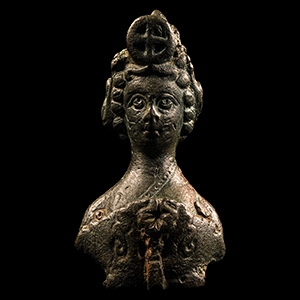
Byzantine Bronze Empress Mount
5th-6th century A.D.Sold for (Inc. bp): £1,040
Formed in the half-round as a youthful female bust, a cross in the middle of the high hair arrangement (propoloma). 193 grams, 97 mm
Ex Law Professor in Alexandria, prior to 1930. Ex collection M. Bouvier, Switzerland (1901-1980).
The image of the Roman Empress during the late Roman Empire, was connected to Christianity by the figure of the Empress Helena. Constantine had several cities renamed Helenopolis in honour of his mother, Helena, and she gained the political verification of power with the status nobilissima femina in 318 and the rank of Augusta in 324. Alongside her social and political image, Helena also had a significant reputation as a good Christian who was a patron and took care of poor people. Owing to this powerful religious image that was created, all other Christian women during the Eastern Roman Empire were encouraged spiritually by the fact that Helena was the mother of the first Christian emperor, and the image of the Roman empress was connected to the Christian image of the Mother of God, and represented on weights, bronze appliques and, in this case, maybe as an upper mount of a tripod.
