
Loading, please wait...
LOT 0875
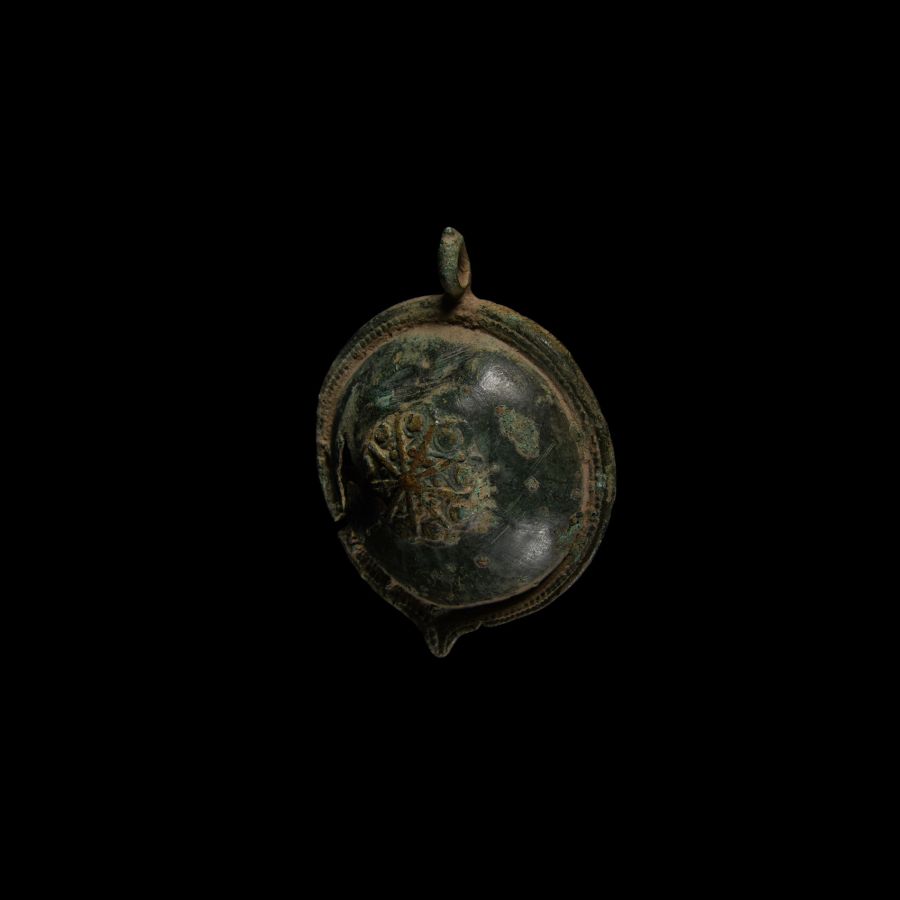
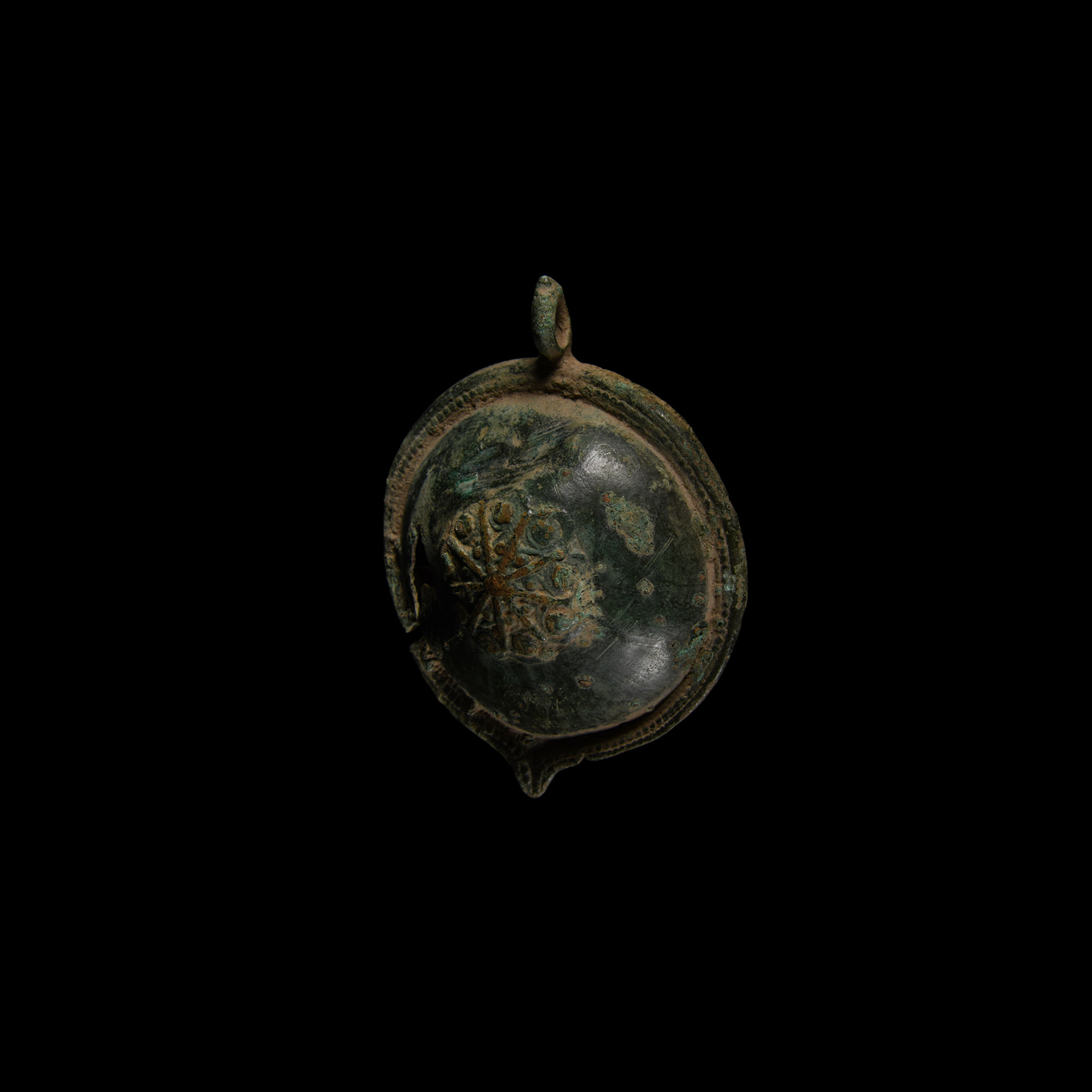
Byzantine Bronze Horse Harness Boss Pendant
15TH CENTURY A.D.
3 in. (28.6 grams, 75 mm).
Large domed centre with low-relief sun wheel design, pellets to the rim and suspension loop above. [No Reserve]
ProvenanceFrom the collection of a North American gentleman, formed in the 1990s.
LiteratureCf. Papanikola-Bakirtzi, D. (ed.), Everyday life in Byzantium. Byzantine Hours. Works and days in Byzantium, Exhibition catalogue, Thessaloniki, White Tower October 2001-January 2002, Athens, 2002, no.488, for similar.
FootnotesIn the late period of Byzantium, round-shaped buckles and horse harness mounts were often decorated with beaded edges and with floral embossed ornaments, under the influence of the Ottoman Turks. They have the shape of a small shield and impressed decoration of a rose. If belt appliques, they have an extra boss for attachment, instead of the loop usually attached to the horse harness pendants.
CONDITIONTimeLine Auctions follows a vetting process to ensure the authenticity and legality of all items, reinforcing our commitment to integrity and responsible trading. Each antiquity, antique, and coin lot undergoes thorough examination by a vetting committee of at least ten external specialists, professional trade association members, scientists, and archaeologists: Our Vetting Process
AUCTIONS:
TimeLine is a leading auction house specialising in antiquities, ancient art, collectables, natural history, coins, medals, and books. Our auctions offer museums, collectors, historians, and enthusiasts the opportunity to acquire unique and historically significant pieces.
-
Byzantine Bronze Reliquary Cross Pendant Plate
10th-12th century A.D.Sold for (Inc. bp): £260
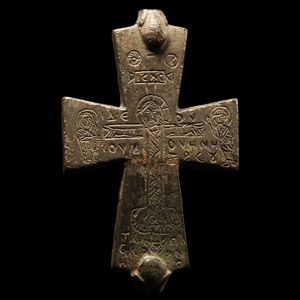
The frontal section of an enkolpion, with the representation of crucified Jesus among Saint Mary and Saint John; Christ dressed in a long tunic (colobium) decorated with parallel stripes (clavi) and patterned hatches, his head turned to the right; his wounds on the cross are marked by nails; the cross standing upon a small hill, identified by rare inscription 'Ο ΤΟΠΟС КРАΝΙΟΥ' (a place of a skull, Matthew 27:33), indicating Golgota; the titulum with inscription 'Ι(ΗСΟΥ)С X(ΡΙ СΤΟ)C' (Jesus Christ), and the sun (left) with the moon (right); the central inscription corresponds to the words of the Gospel of John 19:26: 'here is your son, (ΙΔΕ Ο Υ {ΙΟ} С {C}ΟΥ ) here is your Mother (ΙΔΟΥ Η ΜΗΤ{Η}Ρ CΟΥ)'. 56.5 grams, 86 mm
Formerly in a 1980s collection. Acquired on the UK art market. Previously the property of an Essex gentleman.
Usually the reliquary crosses or enkolpia, were composed of two separate halves, inside of which a relic of a saint was contained; this could have been a piece of cloth or a bone. This extraordinary piece is very rare due to containing part of the Gospel of John about the Crucifixion. -
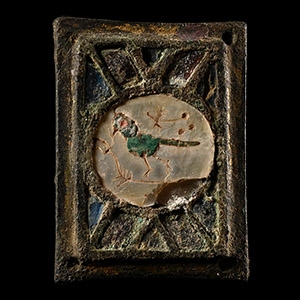
Byzantine Bronze Plaque with Bird Inlay
Circa 10th-11th century A.D.Estimate: £4,000 - 6,000 (‡+bp*)
Opening Bid: £2,000
Sub-rectangular in form with raised rectangular panel to centre, cells forming X-motif inlaid with red glass(?) against a blue field, central nacre(?) roundel engraved with a perched bird with polychrome enamelled detailing; trace remains of gilding to upper and side edges; piercing to each corner. 20.6 grams, 38 mm
Acquired in London, early 1980s. Purchased in Europe before 1992. Private collection, Europe. This lot has been checked against the Interpol Database of stolen works of art and is accompanied by search certificate number no.11811-206495.
The small square plaque was possibly part of the decoration of an Evangeliary, such as the enamels covering the binding of Henry II's Perikopenbuch, or the Siena Evangeliary (11th-13th century). Byzantium brought the enamel and cloisonné technique to its most perfect, refined and skilful expression. Between the 10th and 11th centuries it spreads its forms in the East and West and after some infiltration in the Romanesque-Lombard sphere, precious Eastern Roman cloisonnes were found in Russian art, reaching their apex in the Roman Empire during the 10th-12th centuries, in the decoration of icons and other artworks. -
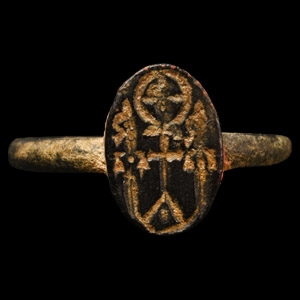
Byzantine Bronze Ring with Cross
6th century A.D.Sold for (Inc. bp): £169
Facetted hoop supporting an ellipsoid bezel with forked cross (crucifixus dolorosus )supporting a cross-in-roudel motif, cross potent to each flank. 4.20 grams, 24.91 mm overall, 20.22 mm internal diameter (approximate size British U, USA 10, Europe 22.52, Japan 21)
Collected from 1969-1999. From the collection of the late Mr S.M., London, UK.
