
Loading, please wait...
_900x900.jpg "Byzantine Bronze Hanging Polycandelon")
_200x200.jpg "Byzantine Bronze Hanging Polycandelon")
.jpg "Byzantine Bronze Hanging Polycandelon")
LOT 0179
Byzantine Bronze Hanging Polycandelon
CIRCA 8TH-10TH CENTURY A.D.
35 1/2 in. (1.01 kg, 90 cm high).
Annular in plan with six holes to accept lamp-bowls, suspended on three convergent chains with pierced discs and chain-links and a substantial hook with conical knop finial; additional length of chain for attachment to a ceiling mount.
ProvenanceProperty of a Californian, USA, collector.
This lot is accompanied by an illustrated lot declaration signed by the Head of the Antiquities Department, Dr Raffaele D’Amato.
TimeLine Auctions follows a vetting process to ensure the authenticity and legality of all items, reinforcing our commitment to integrity and responsible trading. Each antiquity, antique, and coin lot undergoes thorough examination by a vetting committee of at least ten external specialists, professional trade association members, scientists, and archaeologists: Our Vetting Process
AUCTIONS:
TimeLine is a leading auction house specialising in antiquities, ancient art, collectables, natural history, coins, medals, and books. Our auctions offer museums, collectors, historians, and enthusiasts the opportunity to acquire unique and historically significant pieces.
-
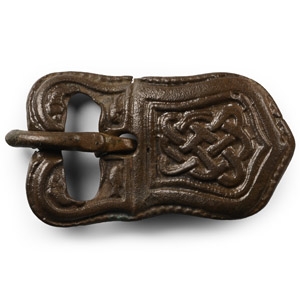
Byzantine Bronze Buckle with Entwined Beasts
8th-10th century A.D.Sold for (Inc. bp): £78
Comprising a waisted D-shaped plate with interlace motif in low-relief, kidney-shaped rectangular-section loop with raised detailing, flat tongue; three mounting studs to reverse. 25.6 grams, 60 mm
Ex German art market, 2000s. Acquired from an EU collector living in London. From the collection of Surrey, UK, gentleman. This lot is accompanied by an illustrated lot declaration signed by the Head of the Antiquities Department, Dr Raffaele D’Amato. -
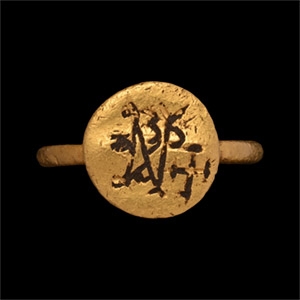
Byzantine Gold Ring with Monogram
6th-7th century A.D.Estimate: £1,500 - 2,000 (+bp*)
Opening Bid: £600
Round-section hoop supporting a disc bezel with engraved monogram incorporating a cross potent and the letters N, O, P, E, Z and others; old collector's ticket. 3.29 grams, 17.57 mm overall, 15.91 mm internal diameter (approximate size British I 1/2, USA 4 1/2, Europe 8.07, Japan 7)
From an early 20th century collection based on the collector's ticket. Property of a Californian, USA, collector. Accompanied by an old collector's ticket. This lot has been cleared against the Art Loss Register database, and is accompanied by an illustrated lot declaration signed by the Head of the Antiquities Department, Dr Raffaele D’Amato. -
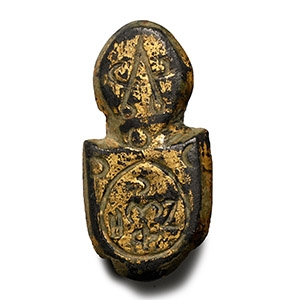
Byzantine Gilt Bronze Mount with Inscription
8th-10th century A.D.Sold for (Inc. bp): £72
Shoe-shaped belt plaque with incised lambda on the disc, D-shaped head with pierced lugs to reverse and incised circle containing 'Φ /ΖωΗ/C'. 6.38 grams, 31 mm
Ex German art market, 2000s. Acquired from an EU collector living in London. From the collection of Surrey, UK, gentleman. This lot is accompanied by an illustrated lot declaration signed by the Head of the Antiquities Department, Dr Raffaele D’Amato.
The strap end bears a reference to the words of Jesus: John, 8:12 and 14.6 (I am the light of the world…I am the way and the truth and the life). It is highly possible that the belt was that of an important ecclesiastic Eastern Roman prelate.
