
Loading, please wait...
LOT 0796
Byzantine Bread Stamp Group
6TH-7TH CENTURY A.D.
1 1/2 in. (40.8 grams total, 38 mm each).
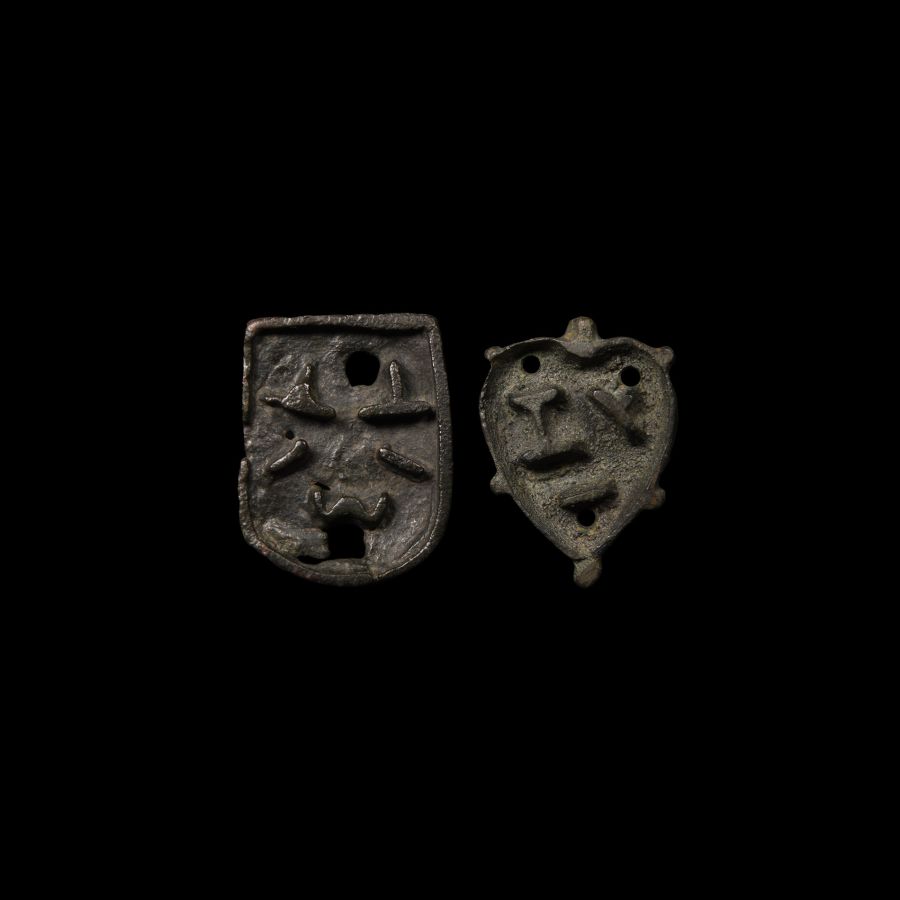
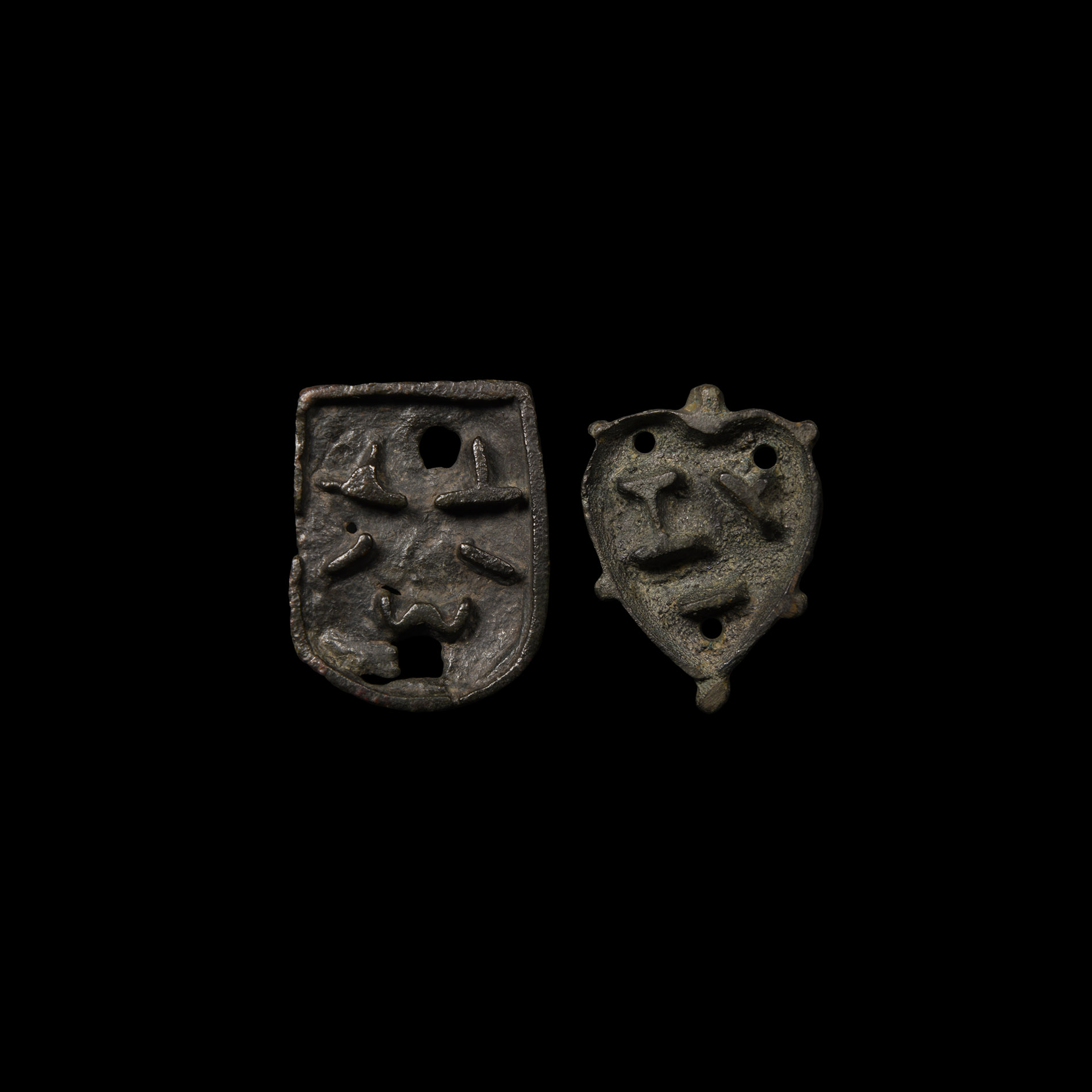
A group of two bread stamps: one sub-rectangular in form with Greek capital letters (Mi, Iota, Iota, Tau and Tau, Iota, Eta) in raised relief, suspension lug to reverse; a leaf-shaped stamp with lugs to the perimeter and three raised letters to the centre, suspension lug to reverse. [2]
ProvenanceAcquired before 2000.
From the collection of a European gentleman living in the UK.
Cf. for similar letters, a stamp published by Dalton, O.M., Catalogue of Early Christian Antiquities and Objects from the Christian East in the Department of British and Medieval Antiquities and Ethnography of the British Museum, London, 1901, no.491.
FootnotesThe larger bronze stamps are generally known in the relevant literature as bread stamps. These were used on the bread consecrated during the Holy Liturgy and then given to the believers as the Body of Christ during the Holy Communion, as well as to the bread which was given as a present at the end of the Liturgy, as 'Blessed bread' or Antidoron. Similar seals are still used today in the Orthodox Church.
CONDITIONTimeLine Auctions follows a vetting process to ensure the authenticity and legality of all items, reinforcing our commitment to integrity and responsible trading. Each antiquity, antique, and coin lot undergoes thorough examination by a vetting committee of at least ten external specialists, professional trade association members, scientists, and archaeologists: Our Vetting Process
AUCTIONS:
TimeLine is a leading auction house specialising in antiquities, ancient art, collectables, natural history, coins, medals, and books. Our auctions offer museums, collectors, historians, and enthusiasts the opportunity to acquire unique and historically significant pieces.
LOT 0796
Byzantine Bread Stamp Group
Estimate £150 - 200€170 - 230 (for guidance only)$200 - 270 (for guidance only)
-
Byzantine Chain with Cross Pendant
Circa 6th-8th century A.D.Estimate: £200 - 300 (+bp*)
Opening Bid: £100
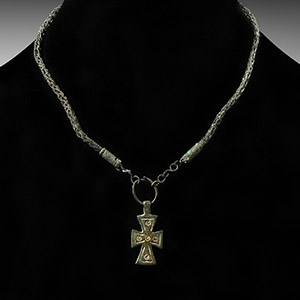
A copper-alloy trichinopoly chain with cruciform pendant, decorated on one face with a geometric design representing the five wounds of Christ. 14.5 grams, 40 cm
Acquired in the late 1990s-2000. Property of an East London gentleman. -
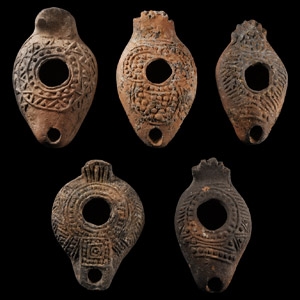
Byzantine Terracotta Slipper Lamp Collection
6th-7th century A.D.Estimate: £1,000 - 1,400 (‡+bp*)
Opening Bid: £500
A collection of five terracotta oil lamps including slipper and discoid types with shaped ledge handles, each decorated with raised geometric motifs composed largely of pellets and plain lines. 337 grams total, 8.9-10.1 cm
Ex Y.M. collection, Tiberias, Israel. Private Swiss collection.
Some authors suggest that these 'candlestick' lamps were produced in or around Jerusalem: this has been confirmed by the discovery of a lamp workshop at Zuba, in which large candlestick lamps with a radiating pattern and their moulds were found. Based on evidence from the City of David and the Jewish Quarter, these lamps begin to appear in the mid-6th century and continue throughout the 7th century A.D. -
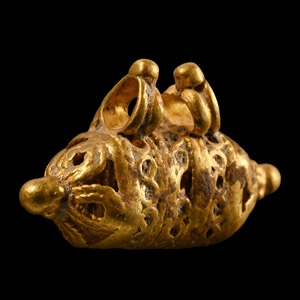
Byzantine Gold Openwork Pendant
Circa 12th-14th century A.D.Sold for (Inc. bp): £364
A capsule-shaped openwork gold pendant decorated with vertical columns of filigree figures of eight between beaded tracks, domed cap to each terminal formed as four-petalled flowers with central pellet; two ribbed suspension loops with apex granules. 2.25 grams, 18 mm
Acquired 1969-1999. London collection of the late Mr S.M., thence by descent.
