
Loading, please wait...

LOT 0857
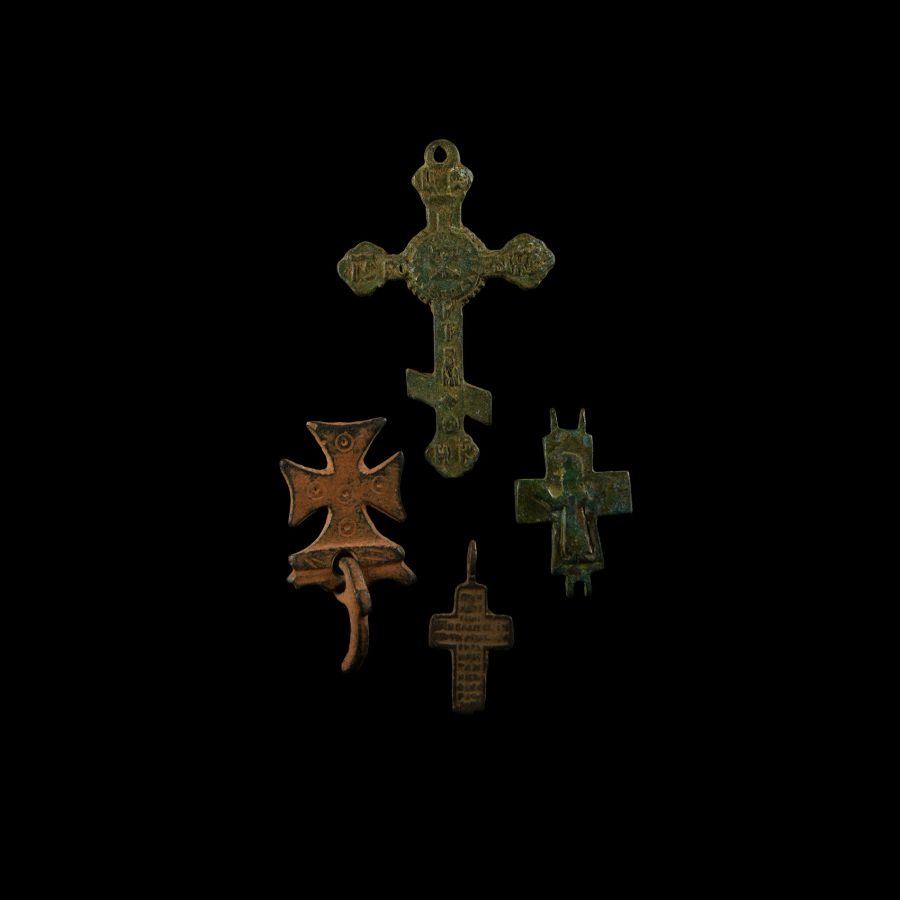
Byzantine and Post-Byzantine Bronze Cross Group
7TH-19TH CENTURY A.D.
1 3/8 - 2 7/8 in. (51.8 grams total, 36-73 mm).
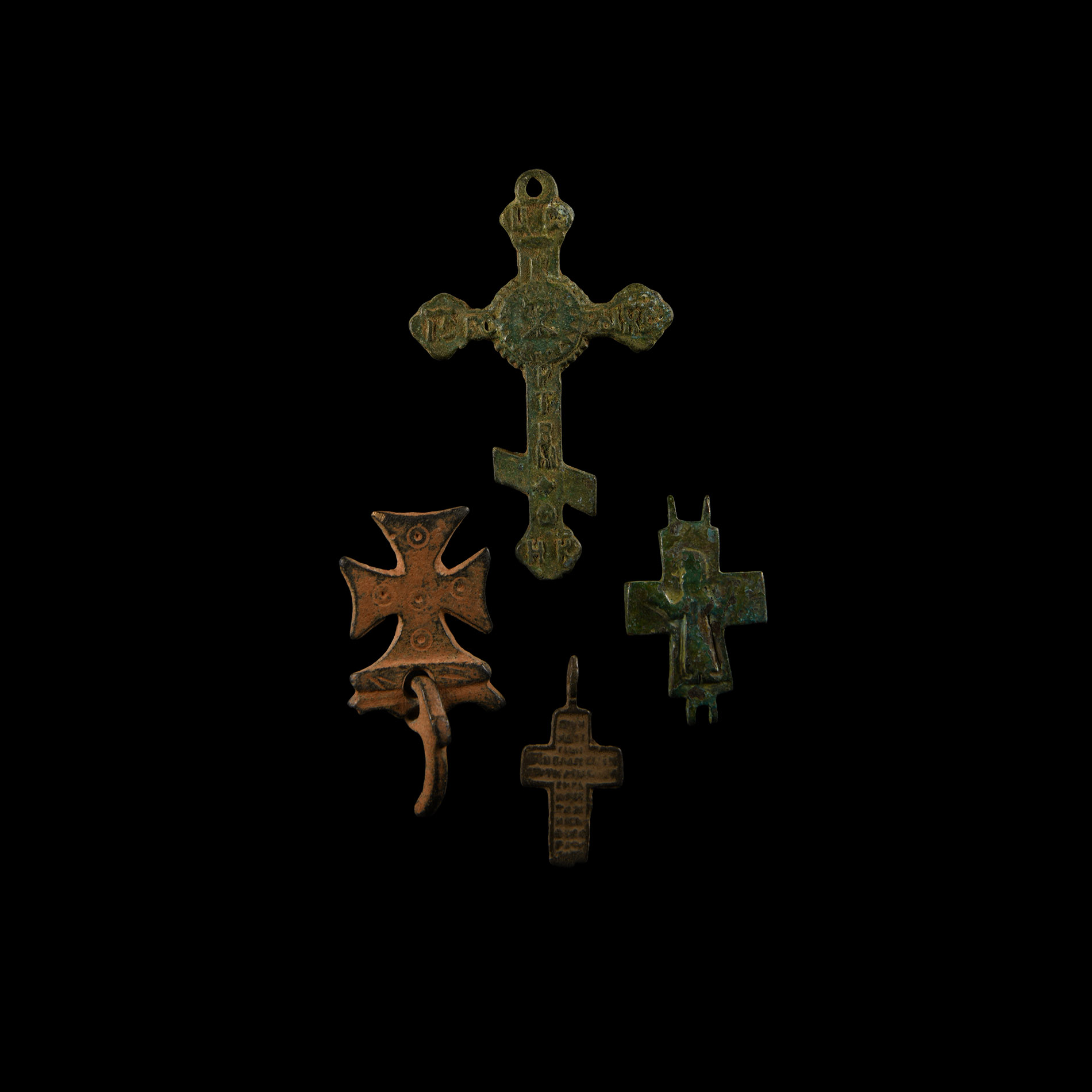
Comprising: a cross buckle with pin; the upper plate of a small enkolpion with a praying Virgin or Saint; two orthodox pectoral crosses, both with inscription 'IC' (Iesus) 'XC' (Christos ) 'NIKA' (Christ is victorious); the smallest cross with invocation-prayer engraved on the back. [4, No Reserve]
ProvenanceAcquired on the UK art market.
Property of a Ruislip, UK, gentleman, by inheritance.
Cf. Schulze-Dörrlamm, M., Byzantinische Gürtelschnallen und Gürtelbeschläge im Römisch-Germanischen Zentralmuseum. Teil 2. Die Schnallen mit Scharnierbeschläg und Schnallen mit angegossenem Riemendurchzug des 7. bis 10. Jahrhunderts, Mainz, 2009, pp.9ff, fig.227.
FootnotesThe fragment of the simpler Maltese cross mount corresponds to the type E2 of Schulze-Dörrlamm, here with straight arms with rounded corners. It resembles the cross-shaped hinge fittings of the belt buckles from Herrera de Pisuerga and tomb 9 from El Tesorillo from Visigoth Spain, two bronze fittings from Lusitania and the buckle with busts of saints and the Greek inscription 'Light and Life' from Korbous in Tunisia. These kind of buckles were also found in male warrior graves.
CONDITIONTimeLine Auctions follows a vetting process to ensure the authenticity and legality of all items, reinforcing our commitment to integrity and responsible trading. Each antiquity, antique, and coin lot undergoes thorough examination by a vetting committee of at least ten external specialists, professional trade association members, scientists, and archaeologists: Our Vetting Process
AUCTIONS:
TimeLine is a leading auction house specialising in antiquities, ancient art, collectables, natural history, coins, medals, and books. Our auctions offer museums, collectors, historians, and enthusiasts the opportunity to acquire unique and historically significant pieces.
-
Byzantine Ribbed Glass Cosmetic Bottle with Trail
Circa 5th-6th century A.D.Sold for (Inc. bp): £33
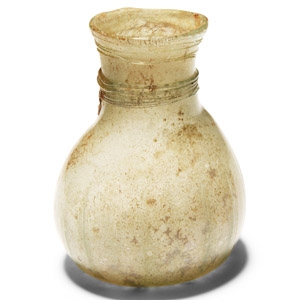
Globular-bodied with a cylindrical neck and everted rim, applied trails around the neck and shallow vertical ribbing rising from the base up the lower body. 15.3 grams, 57 mm
Ex Coincraft, London WC1. Ex private Merseyside, UK, collection. Accompanied by a Coincraft certificate of authenticity. -

Byzantine Gold Hair Ornament with Earrings and Original Chain
6th-8th century A.D.Estimate: £7,000 - 9,000 (+bp*)
Opening Bid: £3,889
The chain composed of gussetted sheet-gold links interspersed with filigree-framed medallions embossed with facing busts; the chain attached to the penannular earring hoops by openwork filigree pendants with pearl drops, two further pearl drops to the hoops. 26.35 grams, 77 cm long
Acquired from Fred Leighton, New York, ca.1982. Important North West London collection. Accompanied by an academic report by Dr Raffaele D’Amato. This lot has been checked against the Interpol Database of stolen works of art and is accompanied by search certificate number no.11047-184615.
The characters within the medallions, derived from the imagines clipeatae and possibly representing unbearded dignitaries (eunuchs?) clad in their court cloak, are typical of the 7th century. This suggests the possibility that the chain belonged to an aristocratic woman. -
Byzantine Bronze Plaque with Bird Inlay
Circa 10th-11th century A.D.Estimate: £4,000 - 6,000 (‡+bp*)
Opening Bid: £2,000
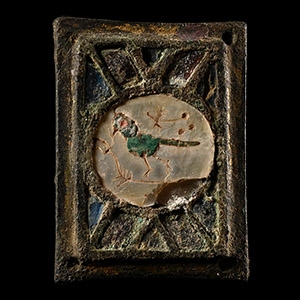
Sub-rectangular in form with raised rectangular panel to centre, cells forming X-motif inlaid with red glass(?) against a blue field, central nacre(?) roundel engraved with a perched bird with polychrome enamelled detailing; trace remains of gilding to upper and side edges; piercing to each corner. 20.6 grams, 38 mm
Acquired in London, early 1980s. Purchased in Europe before 1992. Private collection, Europe. This lot has been checked against the Interpol Database of stolen works of art and is accompanied by search certificate number no.11811-206495.
The small square plaque was possibly part of the decoration of an Evangeliary, such as the enamels covering the binding of Henry II's Perikopenbuch, or the Siena Evangeliary (11th-13th century). Byzantium brought the enamel and cloisonné technique to its most perfect, refined and skilful expression. Between the 10th and 11th centuries it spreads its forms in the East and West and after some infiltration in the Romanesque-Lombard sphere, precious Eastern Roman cloisonnes were found in Russian art, reaching their apex in the Roman Empire during the 10th-12th centuries, in the decoration of icons and other artworks.
