
Loading, please wait...

LOT 0679
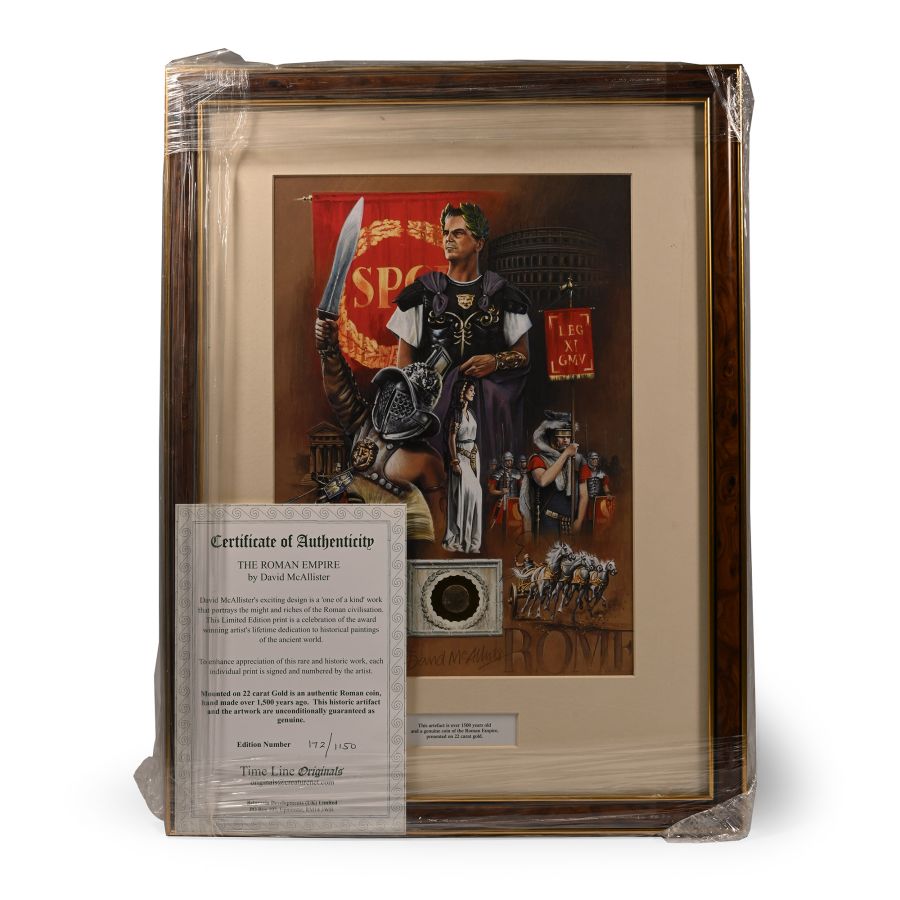
Bronze Roman Coin and Framed Limited Edition Print
3RD CENTURY A.D. AND LATER
19 1/2 x 14 3/4 in. (1.26 kg, 49.5 x 37.5 cm).
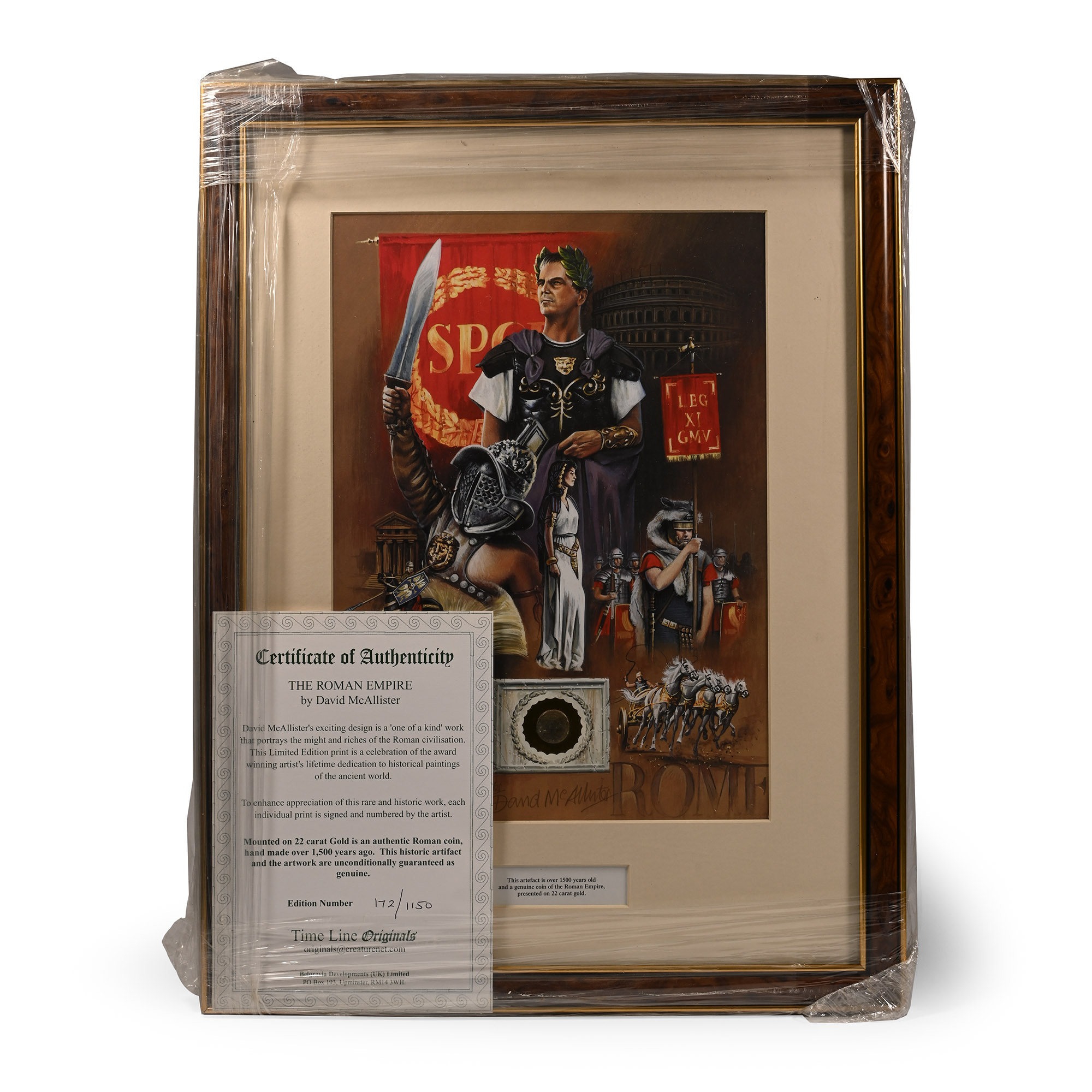
The coin of Constantine the Great (272-337 A.D.) mounted on 22 carat gold foil, framed with an art print signed by the artist David McAllister, depicting scenes of Roman military activity; limited edition number 172/1150. [No Reserve]
ProvenanceUK gallery, early 2000s.
Accompanied by a previous numbered certificate of authenticity.
Cf. for parallel scientific reconstructive paintings Wilcox P., McBride A., Rome's Enemies (2), Gallic and British Celts, London, 1985, pl.G.
FootnotesDavid McAllister's exciting design is a 'one of a kind' work that portrays the might and riches of the Roman civilisation. This limited edition print is a celebration of the award winning artist's lifetime dedication to historical paintings of the ancient world. To enhance appreciation of this rare and historic work, each individual print is signed and numbered by the artist.
CONDITIONTimeLine Auctions follows a vetting process to ensure the authenticity and legality of all items, reinforcing our commitment to integrity and responsible trading. Each antiquity, antique, and coin lot undergoes thorough examination by a vetting committee of at least ten external specialists, professional trade association members, scientists, and archaeologists: Our Vetting Process
AUCTIONS:
TimeLine is a leading auction house specialising in antiquities, ancient art, collectables, natural history, coins, medals, and books. Our auctions offer museums, collectors, historians, and enthusiasts the opportunity to acquire unique and historically significant pieces.
-
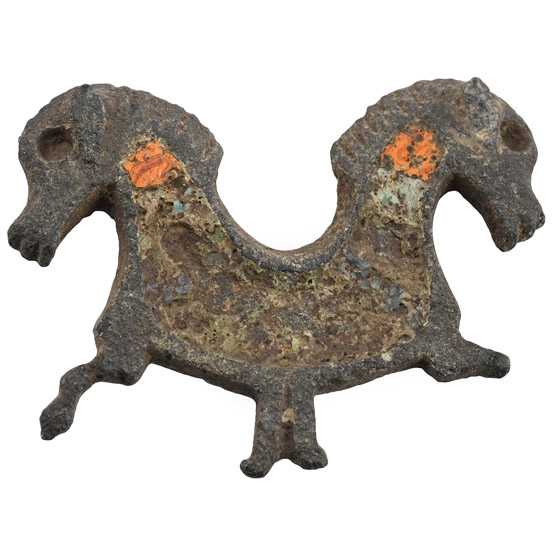
Roman Bronze Two-Headed Sea Horse Brooch
Circa 2nd-3rd century A.D.Sold for (Inc. bp): £683
Plate brooch with pin-lugs, pin and catch to reverse, addorsed equine heads with recesses to accept enamel. 9.25 grams, 37 mm
Ex German art market, 2000s. Acquired from an EU collector living in London. From the collection of a Surrey, UK, gentleman. -
.jpg)
Post-Classical Glass Paste Cameo of Saint Demetrius
17th-18th century A.D. or earlierSold for (Inc. bp): £3,380
Discoid inlay with facing figure modelled in the half-round, clad in reticulated armour with pauldron and pteruges, cloak to the shoulders, small targe-type shield with cross in circle motif, grasping a spear held across the body; bare-headed with curly hair and beaded nimbus surrounding; legend in the field 'ΟΔΗΜΗΤΡΙΟC' (Dimitrios). 9.43 grams, 31 mm
Private English collection, formed between the late 1970s and early 1990s. Private collection, London, UK. This lot has been checked against the Interpol Database of stolen works of art and is accompanied by search certificate number no.13150-248707. -
.jpg)
Roman Carnelian Gemstone with Eros, the Greek God of Love Holding a Theatrical Mask
1st century A.D.Estimate: £4,000 - 5,000 (+bp*)
Opening Bid: £2,000
Plano-convex in section with intaglio scene: a small winged character stands beneath a large theatrical mask, supporting it on his shoulders; supplied with a museum-quality impression. 1.8 grams, 17 mm
Acquired on the UK art market. Private collection, England. This lot has been checked against the Interpol Database of stolen works of art and is accompanied by search certificate number no.13118-249633.
The young Eros appears with his face inside the wide-open mouth of the mask, looking out as a spectator. The mask is held in his small hands and is characterised by a thick beard, large orbital cavities, and short hair with ribbons. He is depicted in three-quarters seen from behind, engraved and polished with great skill. The stone has a convex surface with traces of ancient burning at the bottom and slight wear marks.
