
Loading, please wait...
LOT 1291
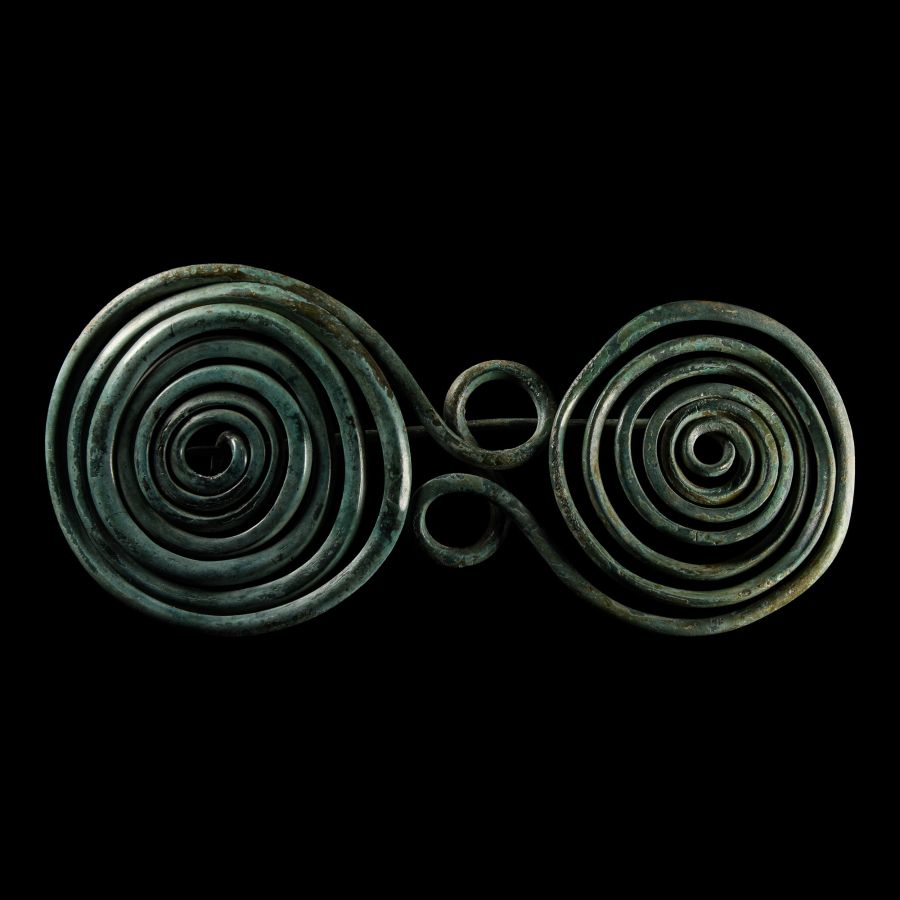
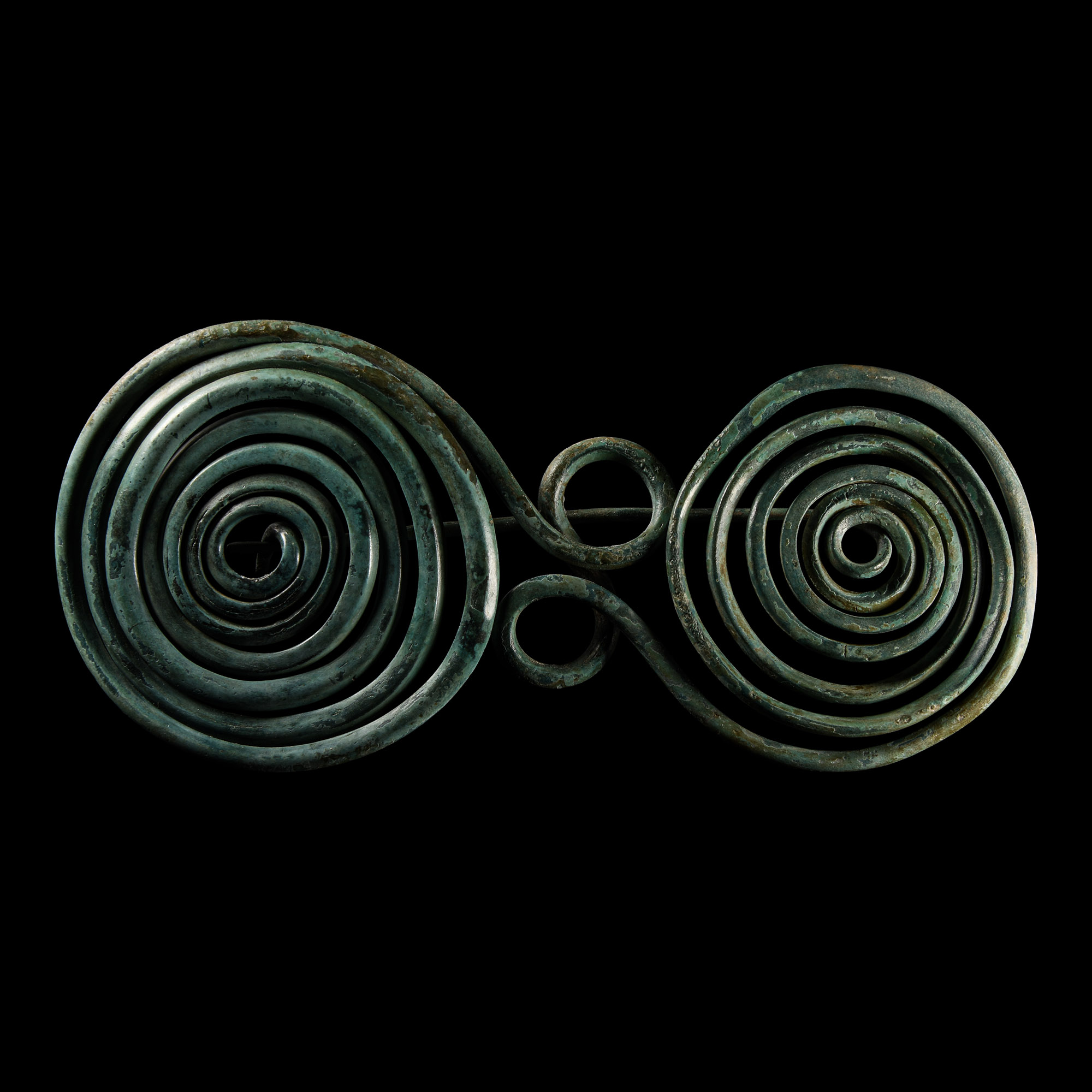
Bronze Age Spectacle Brooch
8TH-7TH CENTURY B.C.
5 1/4 in. (84 grams, 13.3 cm).
Comprising a pair of opposing wire coils decreasing in thickness from edge to centre, a figure-of-eight to the centre; integral pin and catch-plate to the reverse. [No Reserve]
ProvenanceFrom the family collection of a Surrey gentleman since before 1960.
LiteratureCf. Bietti-Sestieri, A.M. and Macnamara, E., Prehistoric Metal Artefacts from Italy (3500–720 BC) in the British Museum, London, 2008, fig.615, for similar; Hambleton, J.M., Fibulae of the ninth through seventh centuries BC in Central Italy, Florida, 2008, fig.2-2b.
FootnotesThe spectacle fibula was widely distributed from the Balkans and northern Greece to southern Italy. Seven variations occur under this type with modifications made to the discs of the fibulae as well as the central connecting device. In the first and second variations
(variant 2-2b of Hambleton, the type here), the discs are coiled, whereas in the third and fourth the centre of the coil is left open. The figure eight loop also becomes shorter and wider in the fourth variant.
TimeLine Auctions follows a vetting process to ensure the authenticity and legality of all items, reinforcing our commitment to integrity and responsible trading. Each antiquity, antique, and coin lot undergoes thorough examination by a vetting committee of at least ten external specialists, professional trade association members, scientists, and archaeologists: Our Vetting Process
AUCTIONS:
TimeLine is a leading auction house specialising in antiquities, ancient art, collectables, natural history, coins, medals, and books. Our auctions offer museums, collectors, historians, and enthusiasts the opportunity to acquire unique and historically significant pieces.
-
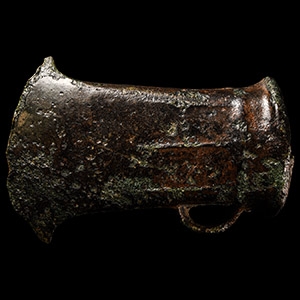
Bronze Age British Socketted Axehead
Late Bronze Age, 1200-800 B.C.Sold for (Inc. bp): £156
The outer faces decorated with three parallel lines, single side loop and convex cutting edge; socket chipped at one side. 160 grams, 79 mm
Found in Norfolk before 1990. Acquired on the UK market, 1990s. Property of a retired academic. -
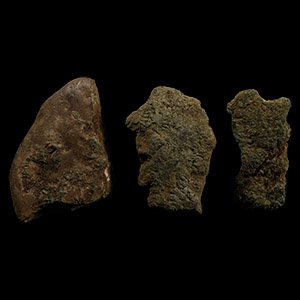
Bronze Age Pancake Ingot Fragment Group
2nd-1st millennium B.C.Sold for (Inc. bp): £26
Comprising three pieces of copper 'bun' ingot, one showing the characteristic edge cross-section. 508 grams total, 54-69 mm
UK gallery, early 2000s.
These bun ingots were cast in shallow saucer depressions cut into rock where the copper ore was mined and smelted; they were then carried and traded across Europe before being broken up, melted down and having tin added to form bronze alloy; fragments such as these are frequently found as part of smith's hoards of, usually, worn out tools, weapons and raw material from the Late Bronze Age. -
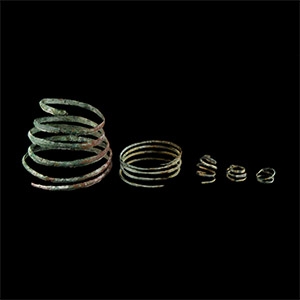
Bronze Age Coiled Bracelet and Ring Group
2nd-1st millennium B.C.Sold for (Inc. bp): £85
Two coiled bracelets with D-section and round-section bodies; three differently sized coiled rings. 62.3 grams total, 13-70 mm
Acquired on the UK art market. Property of a Ruislip, UK, gentleman, by inheritance.
