
Loading, please wait...
_900x900.jpg "Bronze Age Gold Torc-Shaped Bracelet")
_200x200.jpg "Bronze Age Gold Torc-Shaped Bracelet")
_900x900.jpg "Bronze Age Gold Torc-Shaped Bracelet")
_200x200.jpg "Bronze Age Gold Torc-Shaped Bracelet")
_900x900.jpg "Bronze Age Gold Torc-Shaped Bracelet")
_200x200.jpg "Bronze Age Gold Torc-Shaped Bracelet")
.jpg "Bronze Age Gold Torc-Shaped Bracelet")
.jpg "Bronze Age Gold Torc-Shaped Bracelet")
.jpg "Bronze Age Gold Torc-Shaped Bracelet")
LOT 0276
Bronze Age Gold Torc-Shaped Bracelet
EARLY 1ST MILLENNIUM B.C.
3 5/8 in. (173 grams, 93 mm wide).
Of solid heavy penannular form, round in section with clubbed terminals.
ProvenanceFrom the collection of a North American gentleman, formed in the 1990s.
This lot has been checked against the Interpol Database of stolen works of art and is accompanied by search certificate number no.11879-200623.
Cf. The British Museum, museum number 1849,0627.1, for a similar example dated 11th-8th century B.C.
CONDITIONTimeLine Auctions follows a vetting process to ensure the authenticity and legality of all items, reinforcing our commitment to integrity and responsible trading. Each antiquity, antique, and coin lot undergoes thorough examination by a vetting committee of at least ten external specialists, professional trade association members, scientists, and archaeologists: Our Vetting Process
AUCTIONS:
TimeLine is a leading auction house specialising in antiquities, ancient art, collectables, natural history, coins, medals, and books. Our auctions offer museums, collectors, historians, and enthusiasts the opportunity to acquire unique and historically significant pieces.
-
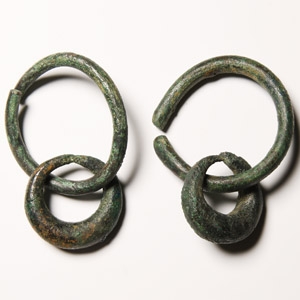
Bronze Age Pendant Pair
10th-6th century B.C.Sold for (Inc. bp): £111
Comprising a pair of heavy crescent-shaped penannular rings each attached to a split ring. 84 grams total, 62-63 mm
Ex old English collection. London art market, 1980s. -
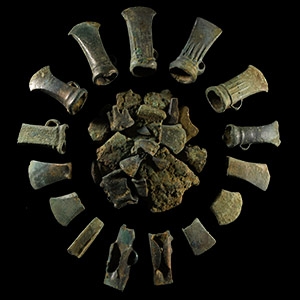
'The Braintree' Bronze Age Axehead and Foundry 'Carp's Tongue/Ewart Phase' Hoard
Deposited circa 900-800 B.C.Sold for (Inc. bp): £3,380
Being an entire 'founder' hoard deposit comprising: complete socketted axes (6; three with linear ornament to sockets); fragments of socketted and earlier type palstave axes (18, including two that fit together); fragments of other items (4) and pieces of copper 'bun' ingot (8). 5.20 kg total, 2-11 cm
Found whilst searching with a metal detector in Braintree, Essex, UK, on 14th August 2019. Accompanied by a copy of the British Museum's Portable Antiquities Scheme (PAS) report no.BM-C514EA and with a copy of the Harwich Museum loan form. Disclaimed under the Treasure Act with reference number 2019 T731.
The composition of this hoard is quite typical of similar deposits found across south-eastern England and dating to the Late Bronze Age; most such finds include broken fragments together with pieces of ingot and some complete items, as seen here. It is unusual to see an entire deposit offered together as most such are either held in museums or have been divided up. -
.jpg)
Bronze Age Socketted Axehead Fragment
2nd-1st millennium B.C.Sold for (Inc. bp): £26
Featuring a convex cutting edge and wedge-shaped cheeks with crescentic blade; socket damaged in antiquity. 159 grams, 71 mm
UK gallery, early 2000s.
