
Loading, please wait...
LOT 1287
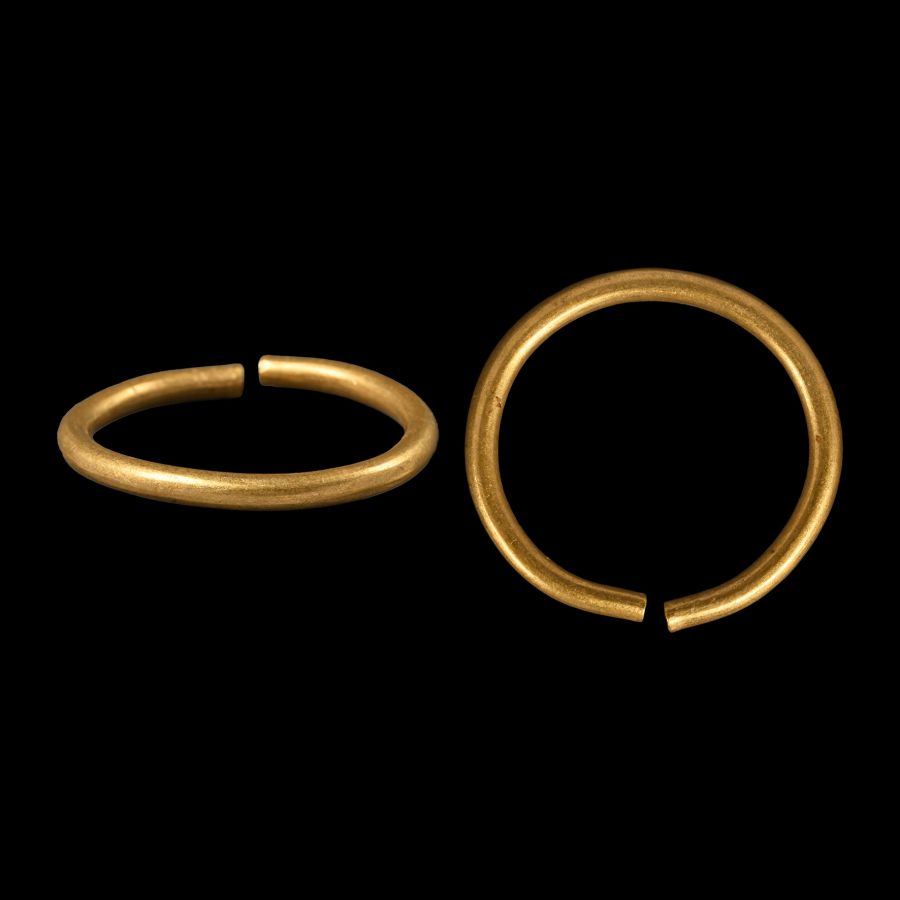
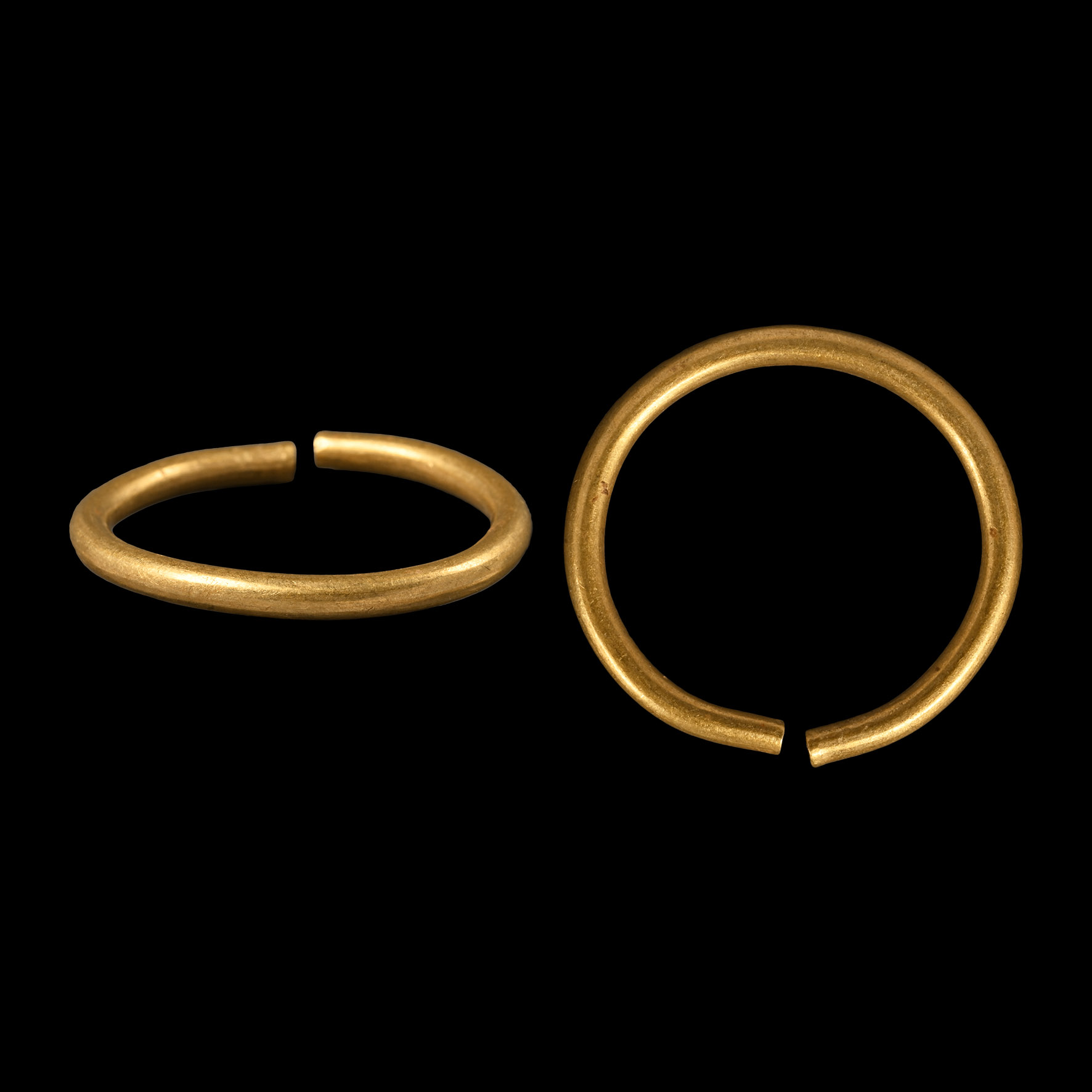
Bronze Age Gold Open-Ended Ring
1ST MILLENNIUM B.C.
1 in. (4.22 grams, 25.12 mm overall, 20.54 mm internal diameter (approximate size British U, USA 10, Europe 22.52, Japan 21)).
With round-section shank and butted joint.
ProvenanceEx Alexander Cotton collection, Brockenhurst, UK, 1970s.
Private collection Surrey, UK, 2000s.
TimeLine Auctions follows a vetting process to ensure the authenticity and legality of all items, reinforcing our commitment to integrity and responsible trading. Each antiquity, antique, and coin lot undergoes thorough examination by a vetting committee of at least ten external specialists, professional trade association members, scientists, and archaeologists: Our Vetting Process
AUCTIONS:
TimeLine is a leading auction house specialising in antiquities, ancient art, collectables, natural history, coins, medals, and books. Our auctions offer museums, collectors, historians, and enthusiasts the opportunity to acquire unique and historically significant pieces.
-
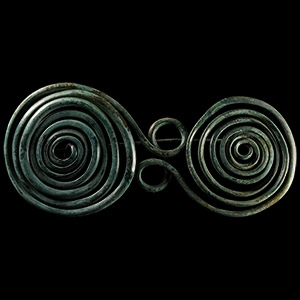
Bronze Age Spectacle Brooch
8th-7th century B.C.Sold for (Inc. bp): £312
Comprising a pair of opposing wire coils decreasing in thickness from edge to centre, a figure-of-eight to the centre; integral pin and catch-plate to the reverse. 84 grams, 13.3 cm
From the family collection of a Surrey gentleman since before 1960.
The spectacle fibula was widely distributed from the Balkans and northern Greece to southern Italy. Seven variations occur under this type with modifications made to the discs of the fibulae as well as the central connecting device. In the first and second variations (variant 2-2b of Hambleton, the type here), the discs are coiled, whereas in the third and fourth the centre of the coil is left open. The figure eight loop also becomes shorter and wider in the fourth variant. -
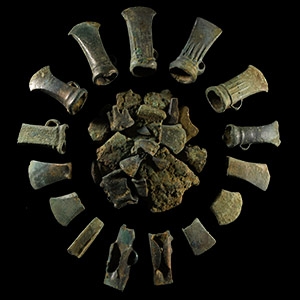
'The Braintree' Bronze Age Axehead and Foundry 'Carp's Tongue/Ewart Phase' Hoard
Deposited circa 900-800 B.C.Sold for (Inc. bp): £3,380
Being an entire 'founder' hoard deposit comprising: complete socketted axes (6; three with linear ornament to sockets); fragments of socketted and earlier type palstave axes (18, including two that fit together); fragments of other items (4) and pieces of copper 'bun' ingot (8). 5.20 kg total, 2-11 cm
Found whilst searching with a metal detector in Braintree, Essex, UK, on 14th August 2019. Accompanied by a copy of the British Museum's Portable Antiquities Scheme (PAS) report no.BM-C514EA and with a copy of the Harwich Museum loan form. Disclaimed under the Treasure Act with reference number 2019 T731.
The composition of this hoard is quite typical of similar deposits found across south-eastern England and dating to the Late Bronze Age; most such finds include broken fragments together with pieces of ingot and some complete items, as seen here. It is unusual to see an entire deposit offered together as most such are either held in museums or have been divided up. -
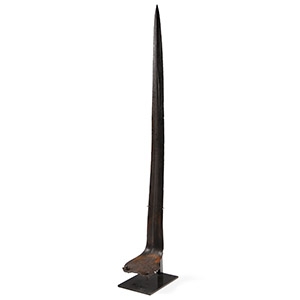
Bronze Age Sacrificed British Long Sword
1500-1100 B.C.Estimate: £5,000 - 7,000 (+bp*)
Opening Bid: £2,500
Bronze sword or rapier with gently tapering cutting edges, thick midrib with lateral beading for most of the blade's length; flared plate to the hilt with two holes at the end to accept attachment rivets; substantially complete; mounted on a custom-made stand. 918 grams total, 57 cm high including stand
Reputedly found in the River Blackwater, Bradwell, Essex. with Christie's, South Kensington, 13 May 2003, lot 259. This lot has been checked against the Interpol Database of stolen works of art and is accompanied by search certificate number no.11881-207821.
In the terminology of Bronze Age studies, a weapon of this type less than 30 cm in length is called a 'dirk' and beyond that length it is classified as a 'rapier'. The longer examples are sometimes considered to have been impractical for use as weapons due to the limitations of the casting process making the blade brittle; however, the evidence for repairs and modifications indicates that they were frequently retained in active use for some time.
