
Loading, please wait...

LOT 1780
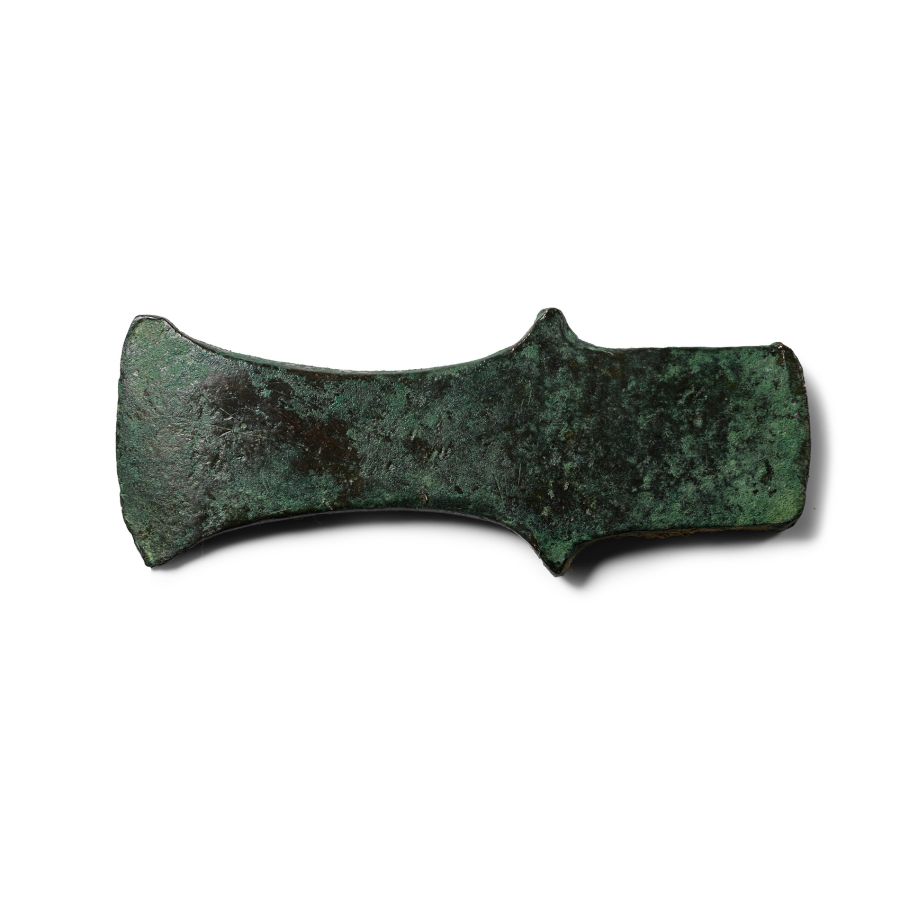
Bronze Age Flanged Flat Axe
CENTRAL EUROPE, 2ND MILLENNIUM B.C.
5 3/8 in. (340 grams, 13.5 cm).
With a curved blade, two flanges to the outer edge, crescentic-shaped butt.
ProvenanceAcquired in Europe before 1992.
Ex Swiss collection.
This lot is accompanied by an illustrated lot declaration signed by the Head of the Antiquities Department, Dr Raffaele D’Amato.
TimeLine Auctions follows a vetting process to ensure the authenticity and legality of all items, reinforcing our commitment to integrity and responsible trading. Each antiquity, antique, and coin lot undergoes thorough examination by a vetting committee of at least ten external specialists, professional trade association members, scientists, and archaeologists: Our Vetting Process
AUCTIONS:
TimeLine is a leading auction house specialising in antiquities, ancient art, collectables, natural history, coins, medals, and books. Our auctions offer museums, collectors, historians, and enthusiasts the opportunity to acquire unique and historically significant pieces.
-
Bronze Age Bull's Head Necklace
10th-8th century B.C.Estimate: £800 - 1,000 (+bp*)
Opening Bid: £400
Restrung necklace of tubular beads, some corrugated and others with two loops to the underside, each loop with a flared dangle; interstitial biconvex barrel-shaped beads and sturdy zoomorphic type with ropework detailing to the tube and bull-head below with openwork muzzle; pierced domed disc at each end. 250 grams, 35.5 cm
From the private collection of a London gentleman, from his grandfather's collection formed before the early 1970s. This lot is accompanied by an illustrated lot declaration signed by the Head of the Antiquities Department, Dr Raffaele D’Amato. -
Bronze Age Ribbed Ring
Late Tumulus-early Urnfield Period, circa 1400-1200 B.C.Sold for (Inc. bp): £143
Penannular finger ring with graduated transverse ribs to the shank. 17.97 grams, 39.24 mm
UK private collection before 2000. Acquired on the UK art market. Property of a London, UK, gentleman. This lot is accompanied by an illustrated lot declaration signed by the Head of the Antiquities Department, Dr Raffaele D’Amato. -
.jpg)
Bronze Age Socketted Spearhead
Central Europe, late 2nd-early 1st millennium B.C.Sold for (Inc. bp): £715
Broad leaf-shaped blade with a gusseted midrib, lateral holes for attachment. 130 grams, 16.7 cm
Ex German collection, 1990s. This lot is accompanied by an illustrated lot declaration signed by the Head of the Antiquities Department, Dr Raffaele D’Amato.
