
Loading, please wait...
_900x900.jpg "Bronze Age Decorated Sceptre Head")
_200x200.jpg "Bronze Age Decorated Sceptre Head")
.jpg "Bronze Age Decorated Sceptre Head")
LOT 0278
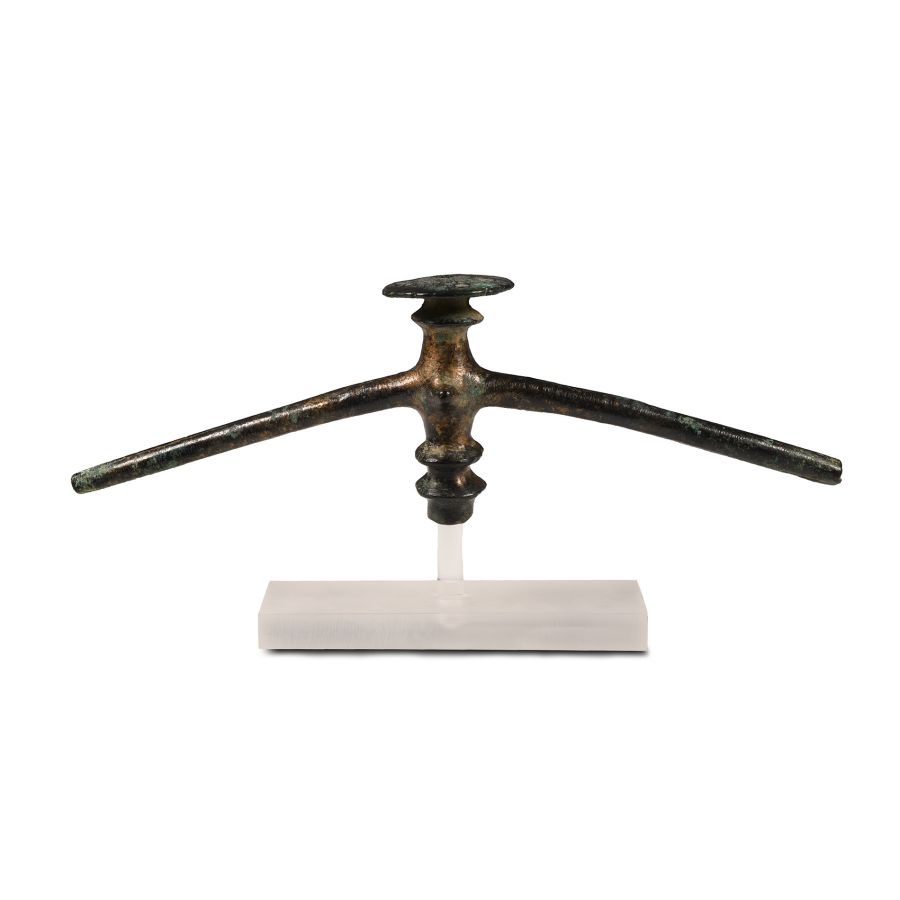
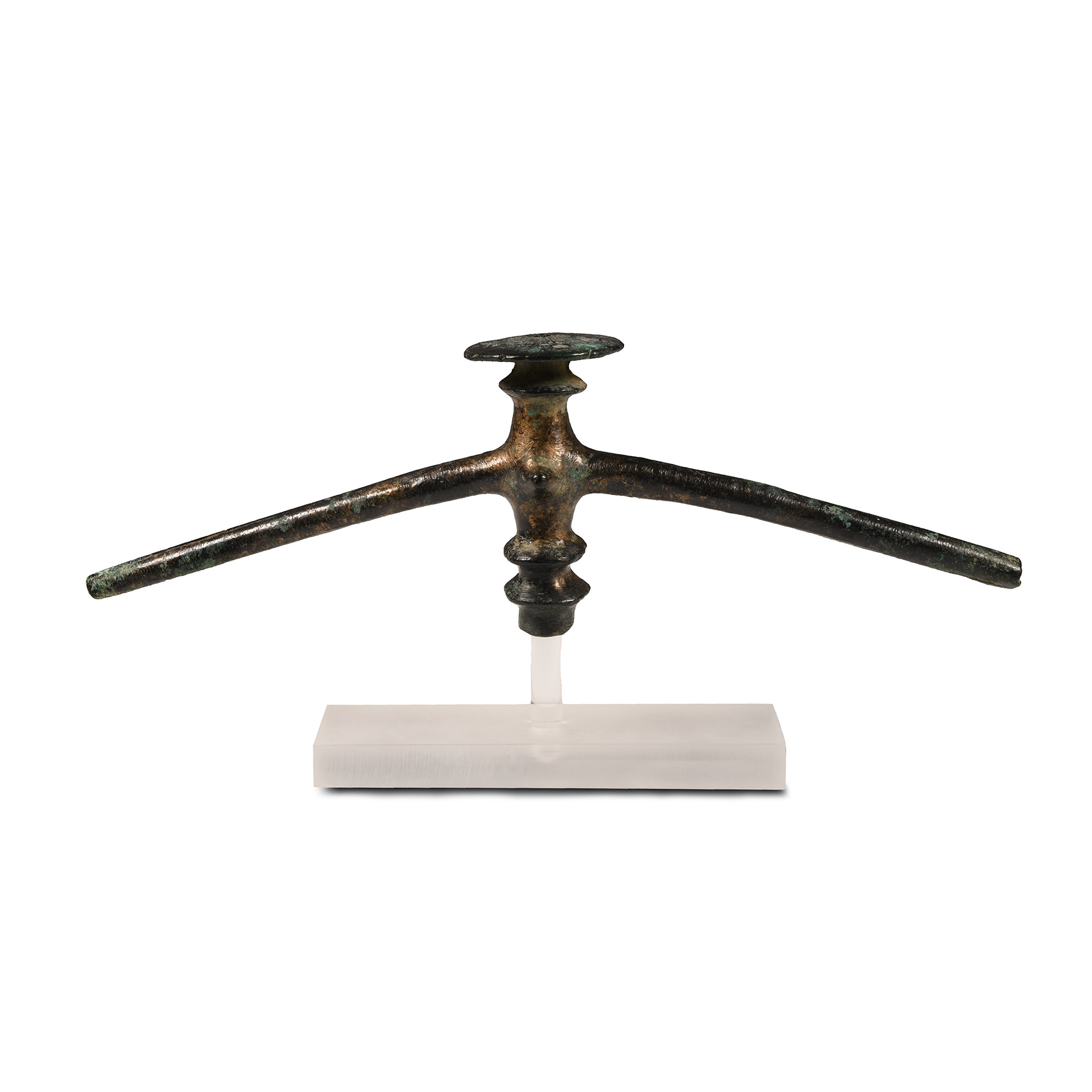
Bronze Age Decorated Sceptre Head
1200-1000 B.C.
11 5/8 in. (621 grams total, 29.5 cm wide including stand).
The stem composed of two vertically arranged bicones, conical knop to chest, collar and broad everted head above, two downwards-directed tapering round-section arms; mounted on a custom-made display base.
ProvenanceAcquired in Europe before 2000.
Private collection, Europe.
TimeLine Auctions follows a vetting process to ensure the authenticity and legality of all items, reinforcing our commitment to integrity and responsible trading. Each antiquity, antique, and coin lot undergoes thorough examination by a vetting committee of at least ten external specialists, professional trade association members, scientists, and archaeologists: Our Vetting Process
AUCTIONS:
TimeLine is a leading auction house specialising in antiquities, ancient art, collectables, natural history, coins, medals, and books. Our auctions offer museums, collectors, historians, and enthusiasts the opportunity to acquire unique and historically significant pieces.
-
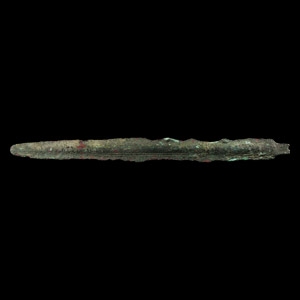
Bronze Age Rapier or Short Sword Blade
11th-9th century B.C.Sold for (Inc. bp): £169
With ogival sides, a raised mid-rib and lozenge-shaped shoulders, remains of the tang with a hole for the insertion of the fastening rivet. 223 grams, 31.5 cm
Acquired in the late 19th century. Ex private collection, Liverpool, UK. Helios Gallery Antiquities, Wiltshire, UK. Private collection, Preston, UK. Accompanied by a certificate of authenticity from Helios Gallery no.H3163r.
The top of the sword is missing, and the shape of the blade resembles that of swords of the late European Bronze Age, but the particular shape of the central groove of the blade, which forms a three-quarter median rib before tapering towards the point, could lead one to believe that the sword was of the antennal type with median rib, like the sword from Central Italy preserved in the Calvet Museum, Avignon. -
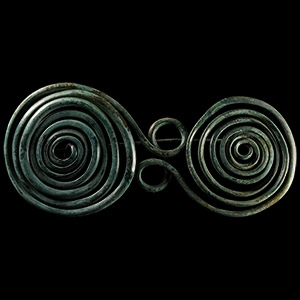
Bronze Age Spectacle Brooch
8th-7th century B.C.Sold for (Inc. bp): £312
Comprising a pair of opposing wire coils decreasing in thickness from edge to centre, a figure-of-eight to the centre; integral pin and catch-plate to the reverse. 84 grams, 13.3 cm
From the family collection of a Surrey gentleman since before 1960.
The spectacle fibula was widely distributed from the Balkans and northern Greece to southern Italy. Seven variations occur under this type with modifications made to the discs of the fibulae as well as the central connecting device. In the first and second variations (variant 2-2b of Hambleton, the type here), the discs are coiled, whereas in the third and fourth the centre of the coil is left open. The figure eight loop also becomes shorter and wider in the fourth variant. -
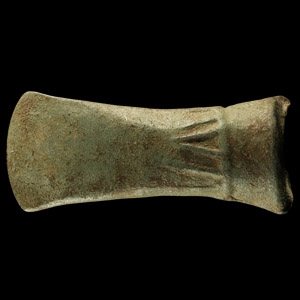
Large Bronze Age Socketted Axehead
2nd millennium B.C.Sold for (Inc. bp): £117
Featuring an elliptical socket and wedge-shaped cheeks with convex cutting edge, raised concentric triangle-in-trapezoid to both sides of the neck. 485 grams, 13.5 cm
Private collection formed in Europe in the 1980s. Westminster collection, central London, UK.
