
Loading, please wait...
LOT 0558
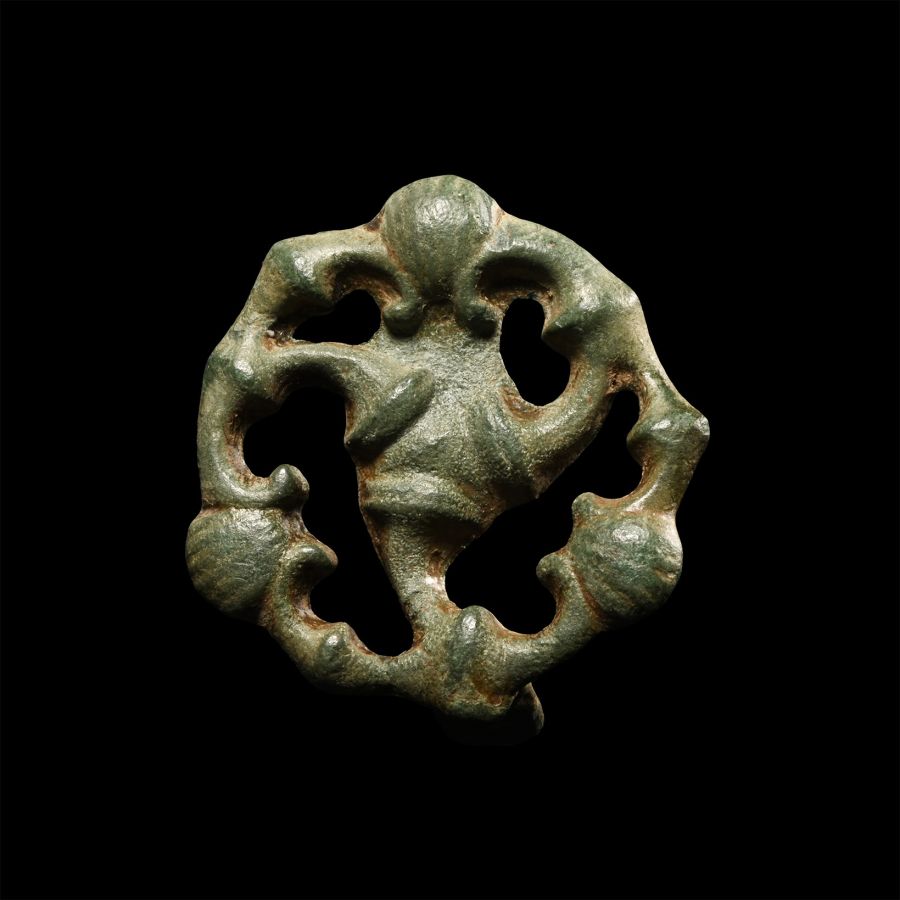
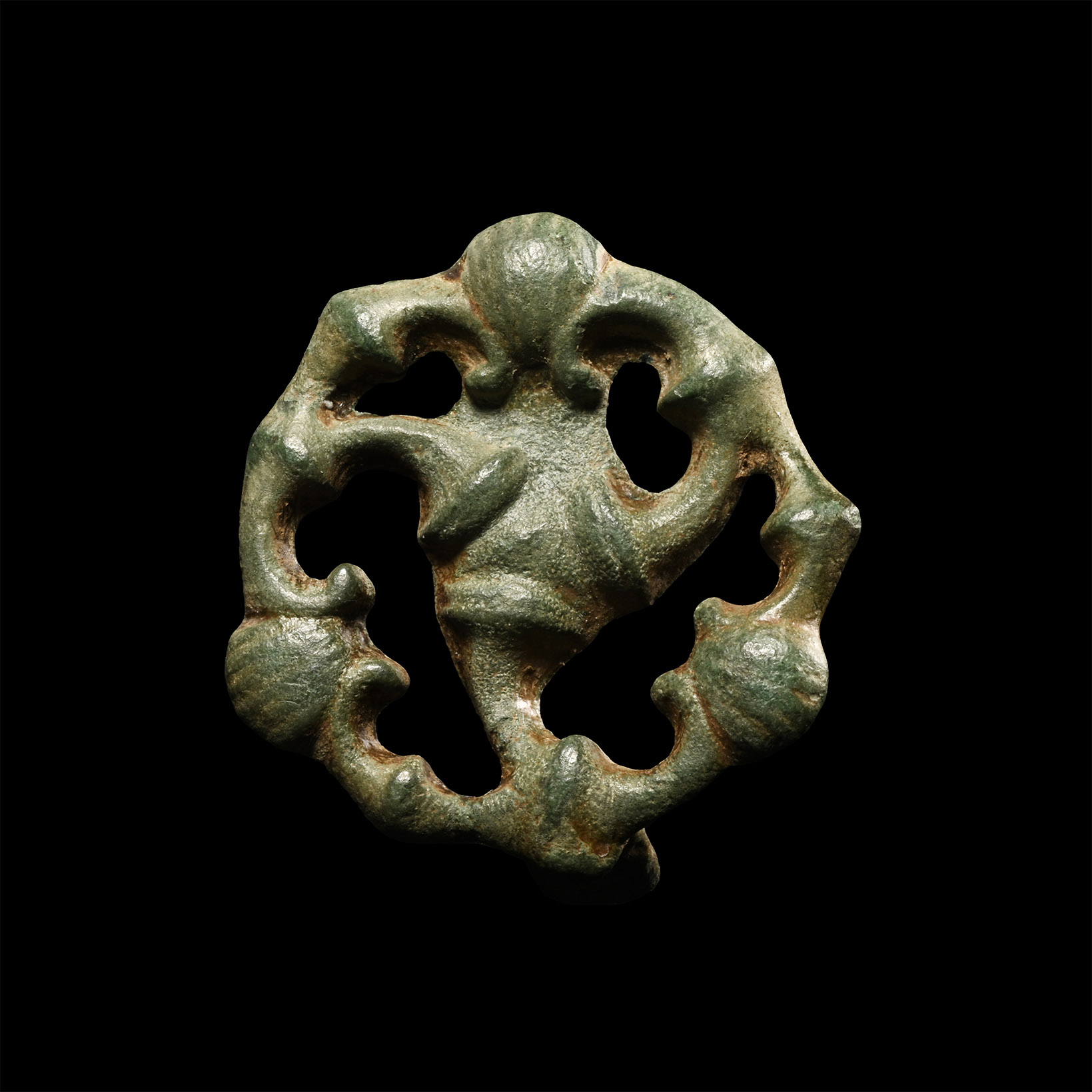
British Roman Military Bronze Plate Brooch with Scallop Shells and Trumpets
2ND-3RD CENTURY A.D.
1 3/8 in. (10.8 grams, 35 mm).
The face moulded with a central motif of three trumpet heads all meeting at a triangular central point, in-between each outer trumpet motif is a scallop-shell like element; the reverse carry's a single rectangular lug for the spring and pin, and a single transverse rectangular tab to act as a catchplate, but appears to be unfinished. [No Reserve]
ProvenanceFound whilst searching with a metal detector near Kettlewell with Starbotton, North Yorkshire, UK, early 2022.
The evidence of the manufacturing process makes this find a 'Find of Note', and has been designated by the British Museum's Portable Antiquities Scheme to be of Regional importance.
Accompanied by a copy of the British Museum's Portable Antiquities Scheme (PAS) report no.SWYOR-A1B317.
Cf. Hattatt, R., Ancient Brooches and Other Artefacts, Oxford, 1989, item 1624.
FootnotesMackreth notes that this brooch is uncommon in Britain. This brooch directly parallels LIN-B8C6EB and no.11664 (Mackreth 2011, p.172-173, Type 7c, no.11664, p.115).
CONDITIONTimeLine Auctions follows a vetting process to ensure the authenticity and legality of all items, reinforcing our commitment to integrity and responsible trading. Each antiquity, antique, and coin lot undergoes thorough examination by a vetting committee of at least ten external specialists, professional trade association members, scientists, and archaeologists: Our Vetting Process
AUCTIONS:
TimeLine is a leading auction house specialising in antiquities, ancient art, collectables, natural history, coins, medals, and books. Our auctions offer museums, collectors, historians, and enthusiasts the opportunity to acquire unique and historically significant pieces.
LOT 0558
British Roman Military Bronze Plate Brooch with Scallop Shells and Trumpets
Sold for (Inc. bp): £111
-
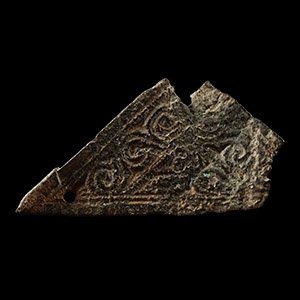
Late Roman Bronze Triangular Belt Mount with Scrolls
4th-5th century A.D.Sold for (Inc. bp): £39
Triangular with dense block of floral-scroll motifs, beaded borders; pierced at the angle for attachment. 5.57 grams, 58 mm
Private collection formed in the 1990s. Acquired from a central London gallery. Property of an Essex gentleman.
By the second half of the 4th century, broad Roman military belts were decorated with chip-carved mounts and plates. The fittings were realised by punching or by chip carving different patterns and motifs. -
.jpg)
Roman Clear Cut-Glass Beaker
Circa 4th century A.D.Estimate: £700 - 900 (+bp*)
Opening Bid: £350
Translucent glass with wheel-cut bands creating registers of ellipses and circles. 189 grams, 11 cm wide
Fine condition, repaired.
Acquired on the French art market, 1990s-early 2000s. From an important Paris gallery, France. Ex private Parisian collection. -
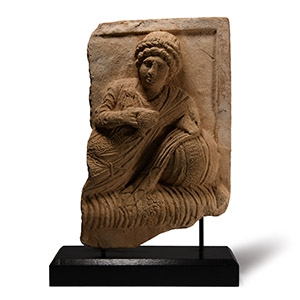
Eastern Roman Sandstone Frieze Fragment with Banquet Scene
Circa 2nd-3rd century A.D.Sold for (Inc. bp): £2,470
The rectangular stele modelled in the half-round representing a banqueting scene with elaborate couch and reclining character; the couch with banded and padded platform, rounded cushion with bands of ornament; the figure depicting a young noble wearing a male Palmyrene costume with band of scrolled foliage ornament, hair dressed into braided tresses and wound round the brow; left arm supporting the body on the cushion, right hand placed before the chest holding the handle of a footed kylix; rectangular border; mounted on a custom-made stand; head restored. 11.2 kg total, 46 cm including stand
Ex P.A., Hertfordshire, UK, specialist collection of Greek art, 1980-1990s.
The character shows a typical male in Palmyrene costume, with long sleeved tunic and large central band, decorated with interlaced vegetal embroidery. Its position is typical of the so-called 'banquet' reliefs. The belt is also decidedly masculine. The sculpture, originally headless, was probably reworked in the upper part, with the addition of a female head incompatible with the rest of the body.
