
Loading, please wait...
_900x900.jpg "British Fairbairn-Sykes 'Beaded and Ringed' Commando Dagger in Scabbard")
_200x200.jpg "British Fairbairn-Sykes 'Beaded and Ringed' Commando Dagger in Scabbard")
_900x900.jpg "British Fairbairn-Sykes 'Beaded and Ringed' Commando Dagger in Scabbard")
_200x200.jpg "British Fairbairn-Sykes 'Beaded and Ringed' Commando Dagger in Scabbard")
.jpg "British Fairbairn-Sykes 'Beaded and Ringed' Commando Dagger in Scabbard")
.jpg "British Fairbairn-Sykes 'Beaded and Ringed' Commando Dagger in Scabbard")
LOT 1047
British Fairbairn-Sykes 'Beaded and Ringed' Commando Dagger in Scabbard
CIRCA 1942 A.D.
13 in. (254 grams, 33 cm overall).
By Rodgers, with finely shaped 15cm stiletto blade with traces of original black finish tapering to a steel oval guard and fitted with a brass 'beaded and ringed' shaped hilt secured by a copper pommel nut; the hilt bearing the War Department 'broad arrow' and '2' marks near to the guard; with the original leather scabbard fitted with brass rivets and chape, pierced for belt wear and with the side flaps for sewing cut away as commonly seen when belt worn; the dagger showing wear with minor chipping to the blade, and movement in the hilt. [No Reserve]
ProvenanceProperty of a Luton, UK gentleman, by inheritance.
LiteratureSee Thompson, L., Commando Dagger, Paladin, 1985, pp.56-57, for this type.
FootnotesIn the autumn of 1942, the Rodgers firm produced what many consider to be the best of all the wartime Fairbairn-Sykes knives: the 'Beads and Ridges' model (or 'Beaded and Ringed'); so-called for its distinctive grip pattern to the brass hilt of single rings of tiny beads, interspersed between sections of four to seven plain rings. The blade is delicate and uniform, and the weapon, though light, is well balanced. The blade finish was black (as this example) or nickel. All of this type are considered to be at least scarce. According to both Fredrick Stephens and Leroy Thompson the type was a commercial variant for private purchase; however, there are some rare cases of this type which were officially issued with the War Department broad arrow and number marks, as with this example.
CONDITIONTimeLine Auctions follows a vetting process to ensure the authenticity and legality of all items, reinforcing our commitment to integrity and responsible trading. Each antiquity, antique, and coin lot undergoes thorough examination by a vetting committee of at least ten external specialists, professional trade association members, scientists, and archaeologists: Our Vetting Process
AUCTIONS:
TimeLine is a leading auction house specialising in antiquities, ancient art, collectables, natural history, coins, medals, and books. Our auctions offer museums, collectors, historians, and enthusiasts the opportunity to acquire unique and historically significant pieces.
LOT 1047
British Fairbairn-Sykes 'Beaded and Ringed' Commando Dagger in Scabbard
Sold for (Inc. bp): £1,170
-
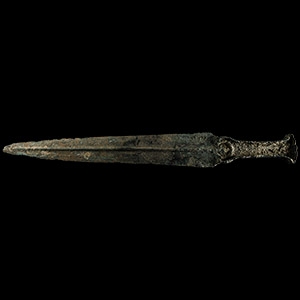
Luristan Bronze Short Sword
Circa 1000 B.C.Sold for (Inc. bp): £312
The blade with a tapering profile, triangular in overall form, with slender shoulders, penannular guard with strong midrib, flanged hilt with crenellated grip, widening slightly into a fan-shaped pommel, cracked. 421 grams, 42 cm
Acquired 1980-2015. Ex Abelita family collection.
These types of short sword or dirks were usually cast in one piece, and the penannular rib in relief was cast on at the same time with the handle of the blade. In some cases, however, the penannular rib was later cast on the dagger, possibly to strengthen a weak point at the junction of hilt and blade. The flanged hilt was originally inlaid with organic material such as bone. -
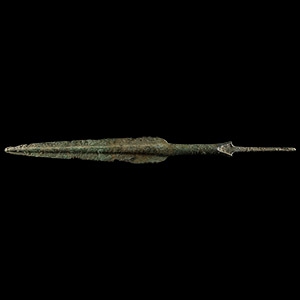
Amlash Type Spearhead Bronze Spearhead Blade
13th-12th century B.C.Sold for (Inc. bp): £143
Showing a long tapering blade with rounded shoulders and prominent mid-rib, the tang straight and rectangular in section. 348 grams, 43.4 cm
Acquired 1980-2015. Ex Abelita family collection.
The weapon belongs to the type 1 of the Khorasani spearhead classification, mainly from Marlik or Amlash areas. Similar pieces have been dated by Stutzinger to 1200-1100 B.C., but the period of use is attested to at least until 1000 B.C. -
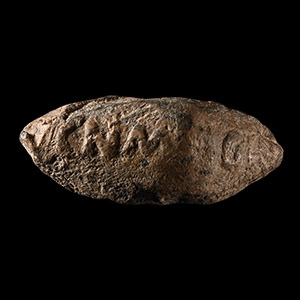
Roman 'Pompey the Great' Lead Slingshot
1st century B.C.Sold for (Inc. bp): £286
Biconical lead slingshot (glans) with inscription in Latin letters 'CN' (Cneius) 'MAG' (Magnus) on one side, and 'IMP' for 'IMPERATOR' (victorious general) to the other side, i.e Gnaeus Pompeius Magnus Imperator (Pompey the Great the victorious general). 47 grams, 39 mm
Ex M.Cummings, UK, 1990s.
The shot (Völling type 1C) is marked with the abbreviated name of Gnaeus Pompey; it was used in quantity at the Battle of Monda (or Munda) against Julius Caesar, 17th March 45 BC. The projectiles were made of different materials: lead (glandes) or in pottery or stone (lapides missiles). Sometimes they were signed with the name of the general, like our specimen.
