Loading, please wait...
LOT 1775
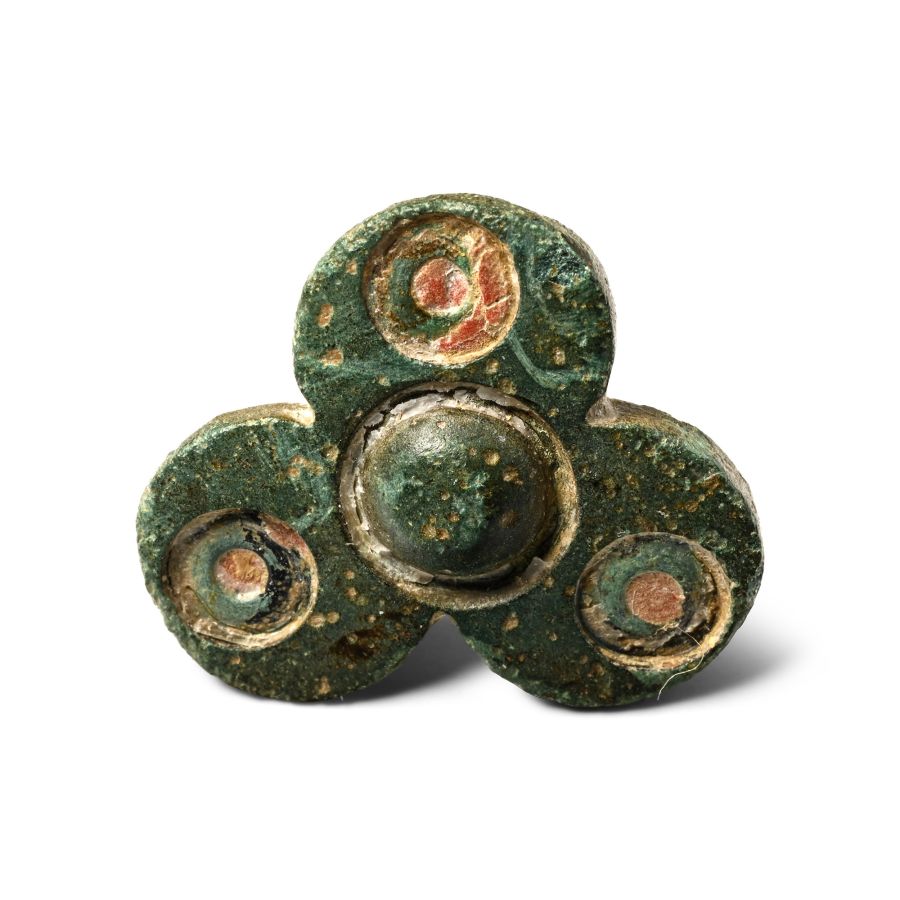
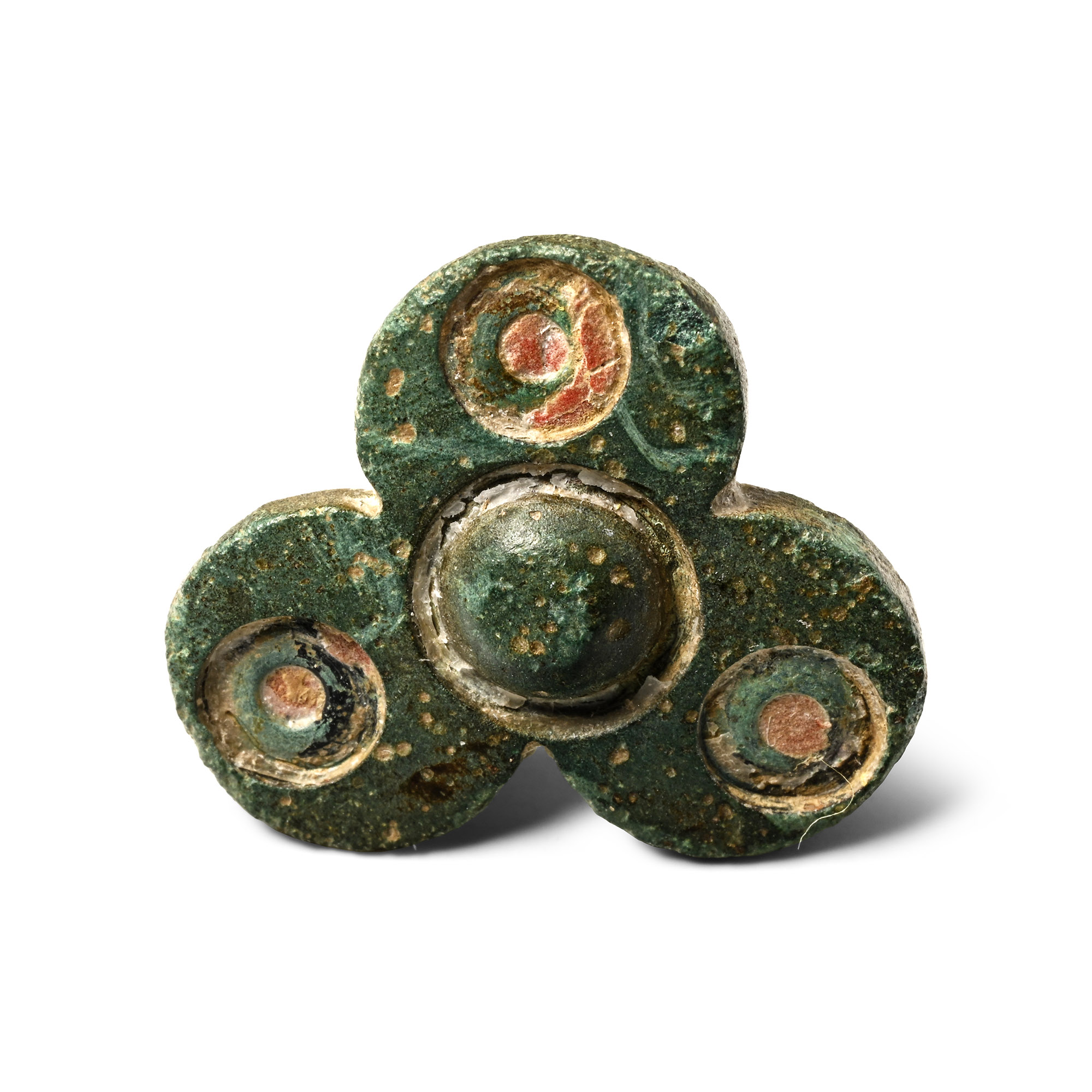
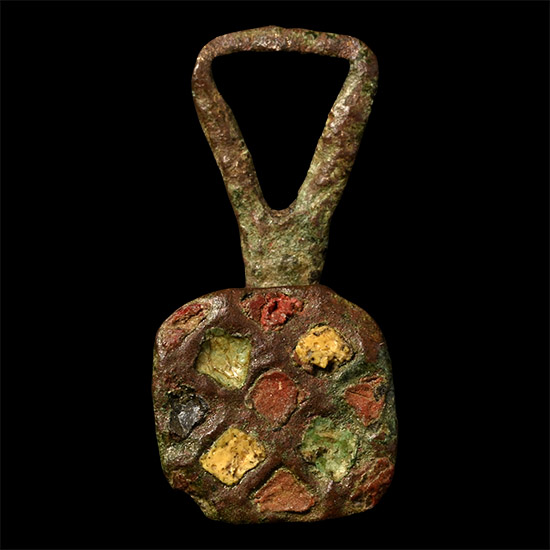
British Celtic Enamelled Bronze Trefoil Mount
IRON AGE, 1ST CENTURY B.C.-1ST CENTURY A.D.
7/8 in. (5.5 grams, 21 mm).
Formed as a trefoil with a central boss and stem to the reverse; each lobe with an eccentrically placed circular enamel-filled cell. [No Reserve]
ProvenanceFound Thrapston, Northamptonshire, UK.
Recorded with UKDFD no.53268.
Cf. the openwork trefoil fittings with La Tène designs from Stanwick published in Smith, R.A., British Museum Guide to Early Iron Age Antiquities 1925, reprinted Ipswich, 1994, p.138-42.
CONDITIONTimeLine Auctions follows a vetting process to ensure the authenticity and legality of all items, reinforcing our commitment to integrity and responsible trading. Each antiquity, antique, and coin lot undergoes thorough examination by a vetting committee of at least ten external specialists, professional trade association members, scientists, and archaeologists: Our Vetting Process
AUCTIONS:
TimeLine is a leading auction house specialising in antiquities, ancient art, collectables, natural history, coins, medals, and books. Our auctions offer museums, collectors, historians, and enthusiasts the opportunity to acquire unique and historically significant pieces.
LOT 1775
British Celtic Enamelled Bronze Trefoil Mount
Estimate £60 - 80€70 - 93 (for guidance only)$81 - 108 (for guidance only)
Opening Bid
£5 (EUR 6; USD 7) +BP*
-
'The Miller' Romano-Celtic Bronze Leaping Boar Statuette
1st century B.C.-1st century A.D.Estimate: £3,000 - 4,000 (+bp*)
Opening Bid: £1,500
Depicted in a dynamic pose with its front legs raised and the weight of the body borne on its hind legs, flared nostrils and large, round eyes; mounted on a custom-made display stand. 165 grams total, 73 mm wide including stand
Found Hampshire, UK, in the 1980s. From the collection of the late David Miller of Hemel Hempstead, UK, and a Cambridge collection of the 2000s. Accompanied by a previously illustrated catalogue card with provenance. This lot has been checked against the Interpol Database of stolen works of art and is accompanied by search certificate number no.13378-258774.
The small statuettes of boars found in Roman Britain and Gaul were likely used as votive figurines for cult places. They were widespread in the Roman provinces of Celtic origin. However, one cannot exclude the fact that many boars found in Britain belong to the pre-conquest era. One of the few types of bronze figurines that are known to precede the arrival of the Romans is, in fact, that of the boars. -
British Celtic Bronze Toggle and Loop Fastener
Iron Age, 1st century B.C.-1st century A.D.Estimate: £30 - 40 (+bp*)
Opening Bid: £5
Button-and-loop fastener with D-section segmented face, flared arm with round-section attachment loop. 17.5 grams, 28 mm
Found Wilden, Bedfordshire, UK. Recorded with UKDFD no.53478. -
Central Balkans Silver Ring with Spiralled Terminals and Axe Motif Ornament
Iron Age, 1st-2nd century A.D.Estimate: £700 - 900 (+bp*)
Opening Bid: £350
Robust ring of octagonal section, fashioned from drawn and hammered wire, the hoop terminating in tightly coiled spirals, which flank a rectangular ornament soldered across the bezel, recalling a miniature axe-head; the coils further reinforced with wrapped silver wire, securing the decorative composition. 8.30 grams, 28.40 mm overall, 21.70 x 19.32 mm internal diameter (approximate size British T 1/2, USA 9 3/4, Europe 21.89, Japan 21)
Bonhams, Fine Antiquities, 4 July 1998, no.19. Private collection, UK, 1990s. with Rupert Wace Ancient Art Ltd, London. with Ariadne Galleries, New York and London, acquired from the above at TEFAF 2014, New York. Private American collection, acquired from the above, 23 January 2017.
This ring belongs to the repertoire of autochthonous Balkan silverwork that flourished from the Roman conquest through the mid-3rd century. The type is closely related to ornaments documented in the Tekija and Bare hoards, where bracelets and rings with spiral-wrapped ends and miniature axes appear as apotropaic symbols. While the axe motif was deeply embedded in Dacian and Balkan visual culture, its execution here in silver, combined with wire wrapping and spiralled terminals, reflects the enduring influence of Hellenistic toreutics upon local craftsmanship. Rather than a Viking jewel, the ring finds its most convincing parallels among the Balkan-Danubian silver hoards of the early Roman Empire.