Loading, please wait...
LOT 2145
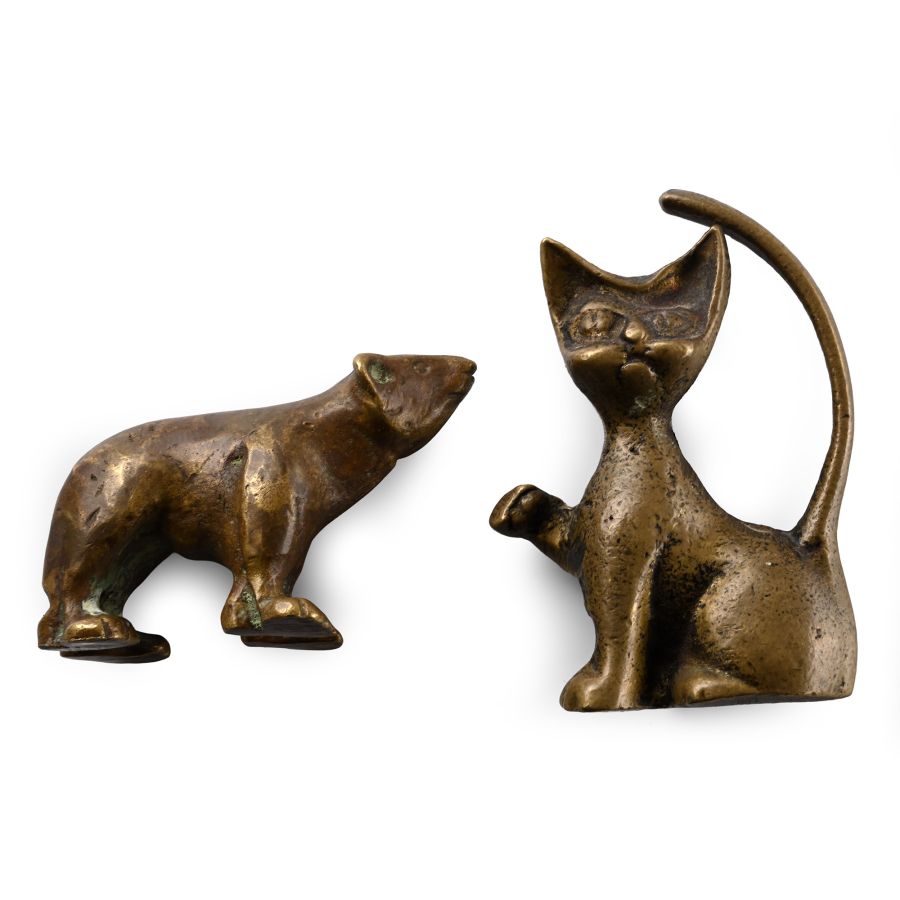
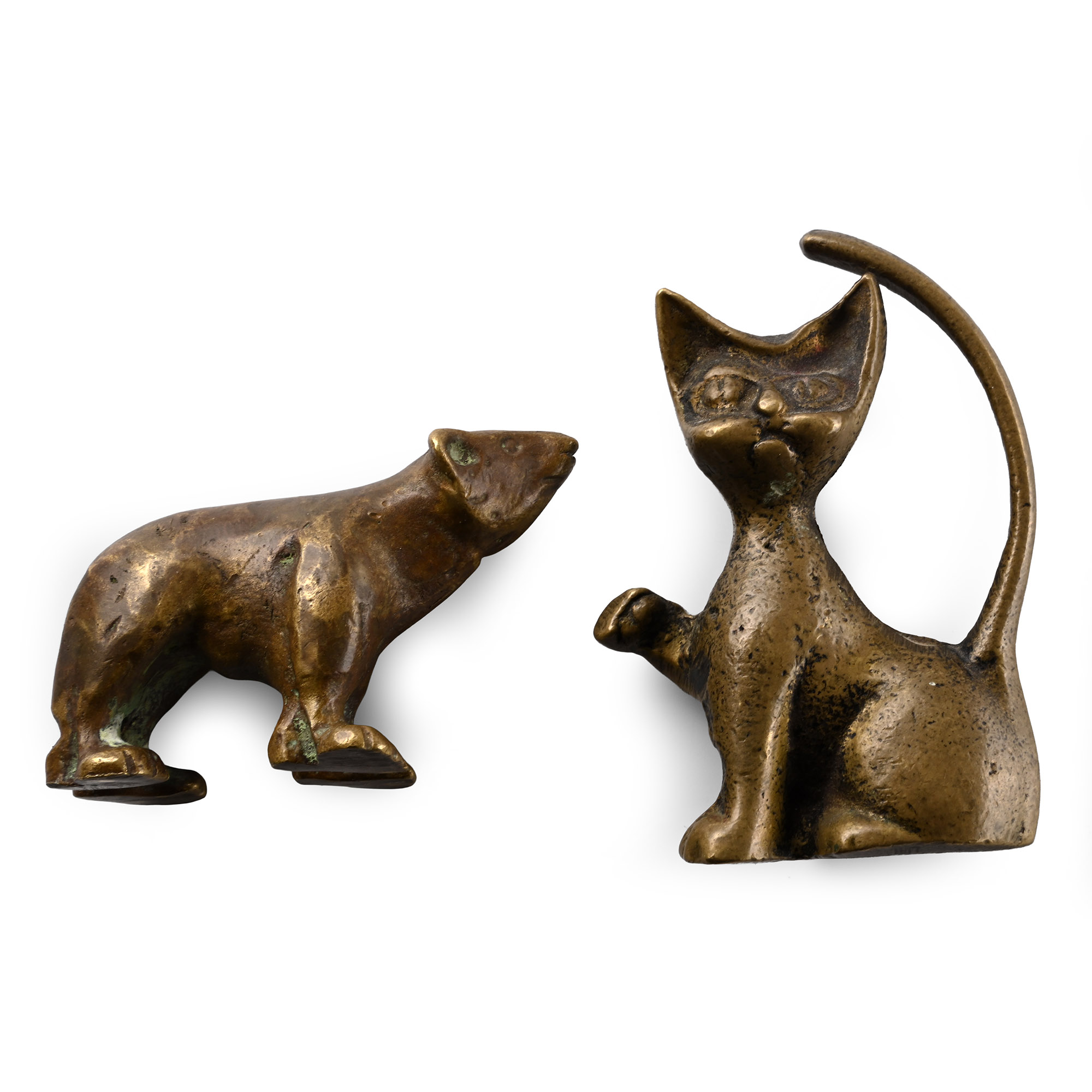
Brass Cat and Bear Statuettes
19TH-EARLY 20TH CENTURY A.D.
2 - 2 3/4 in. (280 grams total, 52-70 mm).
Comprising of a seated guardant cat with a raised leg and curved tail, a polar bear with head turned up. [2, No Reserve]
ProvenanceEx property of a London collector; acquired 1960s.
Property of a North London, UK, lady.
This lot is accompanied by an illustrated lot declaration signed by the Head of the Antiquities Department, Dr Raffaele D'Amato.
TimeLine Auctions follows a vetting process to ensure the authenticity and legality of all items, reinforcing our commitment to integrity and responsible trading. Each antiquity, antique, and coin lot undergoes thorough examination by a vetting committee of at least ten external specialists, professional trade association members, scientists, and archaeologists: Our Vetting Process
AUCTIONS:
TimeLine is a leading auction house specialising in antiquities, ancient art, collectables, natural history, coins, medals, and books. Our auctions offer museums, collectors, historians, and enthusiasts the opportunity to acquire unique and historically significant pieces.
-
Large Diptych of the Mother of God as Hodegetria
Early 16th century A.D.Estimate: £8,000 - 10,000 (+bp*)
Opening Bid: £4,000
Tempera on two wooden panels executed on a green ground; the upper part of the left panel showing the nimbate Theotokos (Mother of God) with veiled head and mantle, pointing the infant Jesus supported by her left hand, wearing a red-gold maphorion mantle over a dark blue robe with gold cuffs; the infant facing away to left, dressed in blue tunic, wrapped in a red orange shawl, right hand extended towards his mother in a blessing gesture; beside Mary inscriptions in red Greek letters 'ΜΡ' and 'ΘΥ' (Μήτηρ (τοῦ) Θεοῦ = Mother of God), and beside the child the Greek letters 'ΙϹ ΧϹ' (ΙΗϹΟΥϹ ΧΡΙϹΤΟϹ = Jesus Christ); in the lower part of the panel, God emerging as a half-bust from the sky, blessing the three theologians, Saint Basil of Caesarea, Saint John Chrysostom and Saint Gregory the Theologian, all dressed in ecclesiastic high garments, their names written in Greek beside their heads; the upper part of the right panel showing Christ Pantokrator, Lord of the Universe, the right hand in blessing gesture, the left hand holding a Gospel decorated with precious stones, wearing a blue chlamys and red sticharion embroidered with a gold clavus; in the lower part Saints Onuphrius, Saint Nicholas of Myra and Antony the Great of the Desert, the first naked and covered only by a leaf, the second in bishopric garments and the third in monastic garments, their names written in Greek beside their heads; all the haloes are in gold, the ones of Christ marked by a red cross. 3.6 kg, 49 x 55.5 cm (opened)
Acquired on the European art market. Private collection, London, UK. Accompanied by an academic report by Dr Raffaele D'Amato. This lot has been checked against the Interpol Database of stolen works of art and is accompanied by a search certificate number no.12794-240887. This lot has been cleared against the Art Loss Register database, and is accompanied by an illustrated lot declaration signed by the Head of the Antiquities Department, Dr Raffaele D'Amato.
The diptych is a synthesis of Orthodox belief: from one point of view, it shows the human nature of God, born from the Virgin; from the other the divine nature of Jesus Christ as the supreme Lord of the Universe. The icon skilfully depicts the subjects, with Mary pointing towards the infant Jesus, the faces rendered with dramatically emphasised features and dark tones. -
Stuart Period Silver Thimble
17th century A.D.Sold for (Inc. bp): £65
Tubular in form and slightly tapering with stamped waffle-pattern panels and reserved framing. 5.01 grams, 23 mm
Found whilst searching with a metal detector in Somersham, Suffolk, UK, in December 2019, declared as Treasure and disclaimed with Treasure reference no.2020 T286. Accompanied with a copy of the report for H M Coroner and the Treasure Act receipt. Recorded with the British Museum's Portable Antiquities Scheme (PAS) with report no.SF-E27D26. This lot is accompanied by an illustrated lot declaration signed by the Head of the Antiquities Department, Dr Raffaele D'Amato. -
Romanian Orthodox Royal Wooden Doors with Annunciation Scene
Circa 1750 A.D.Sold for (Inc. bp): £4,680
Each door a single board with graduated scalloped upper edge, horizontal wooden bars to the reverse, hand-forged iron hinge knuckles and D-section leader to left door; primed with tempera on both faces and painted on the obverse, each with a bottle-green field, blue-grey frontage with vermillion upper storey and gilt roof; Left Door: portion of city wall with tall, narrow building behind, balcony at the upper level with King David standing holding an unfurled scroll, wearing a gilt crown, vermillion tunic and blue mantle; before the wall a winged angel Gabriel holding a frond, wearing a draped mantle over ankle-length chiton and sandals; above, red painted legend 'BOUNA'; to the right edge, a D-section leader painted with red, white and blue diagonal stripes; Right Door: portion of city wall with tall, narrow building behind, balcony at the upper level with King Solomon standing holding a scroll and wearing a gilt crown, similar tunic and mantle to the other; dove descending towards Mary standing before the wall in front of a cushioned throne, with gilt nimbus around her head; red painted legend 'V E S T I R E' above; rare. 13.8 kg total, 132 x 34 cm each
Property of a London, UK, gentleman collector. Accompanied by a copy of a Romanian export licence. Accompanied by an academic report by Dr Raffaele D’Amato. This lot has been checked against the Interpol Database of stolen works of art and is accompanied by search certificate number no.12466-229954. This lot has been cleared against the Art Loss Register database, and is accompanied by an illustrated lot declaration signed by the Head of the Antiquities Department, Dr Raffaele D'Amato.
The 'royal doors' (Greek: Ωραία Πύλη) mark the entrance to the iconostasis (wooden screen hiding the altar) in an Eastern Orthodox church.