
Loading, please wait...
LOT 0564
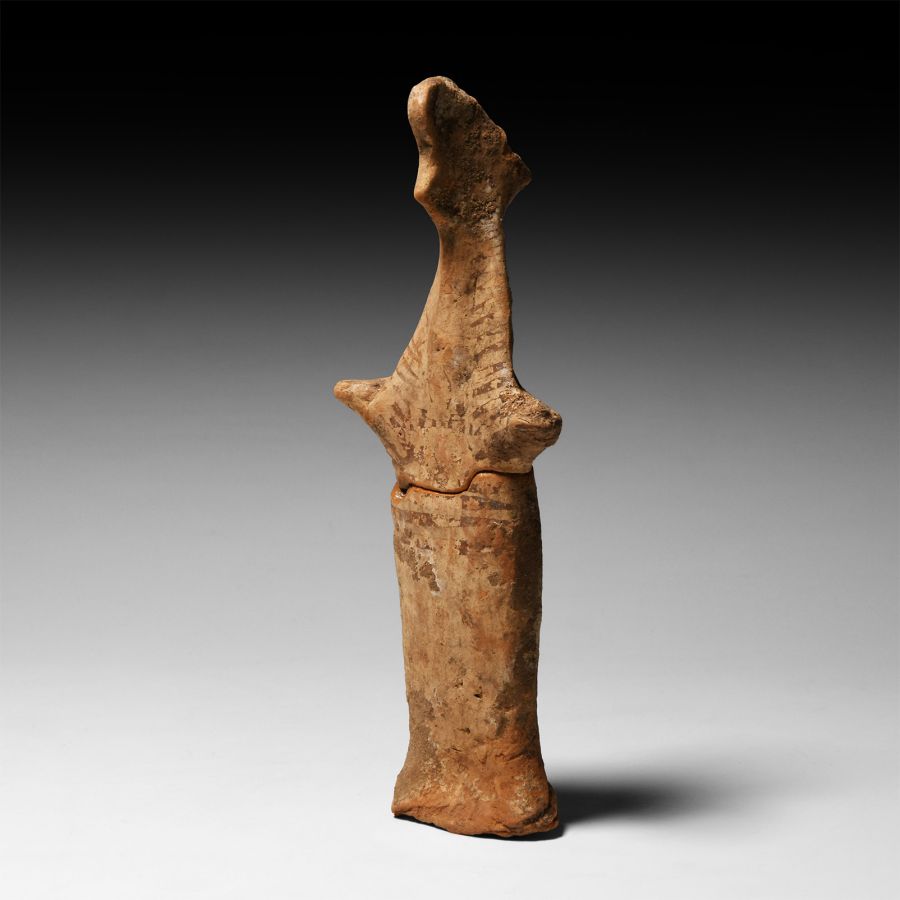
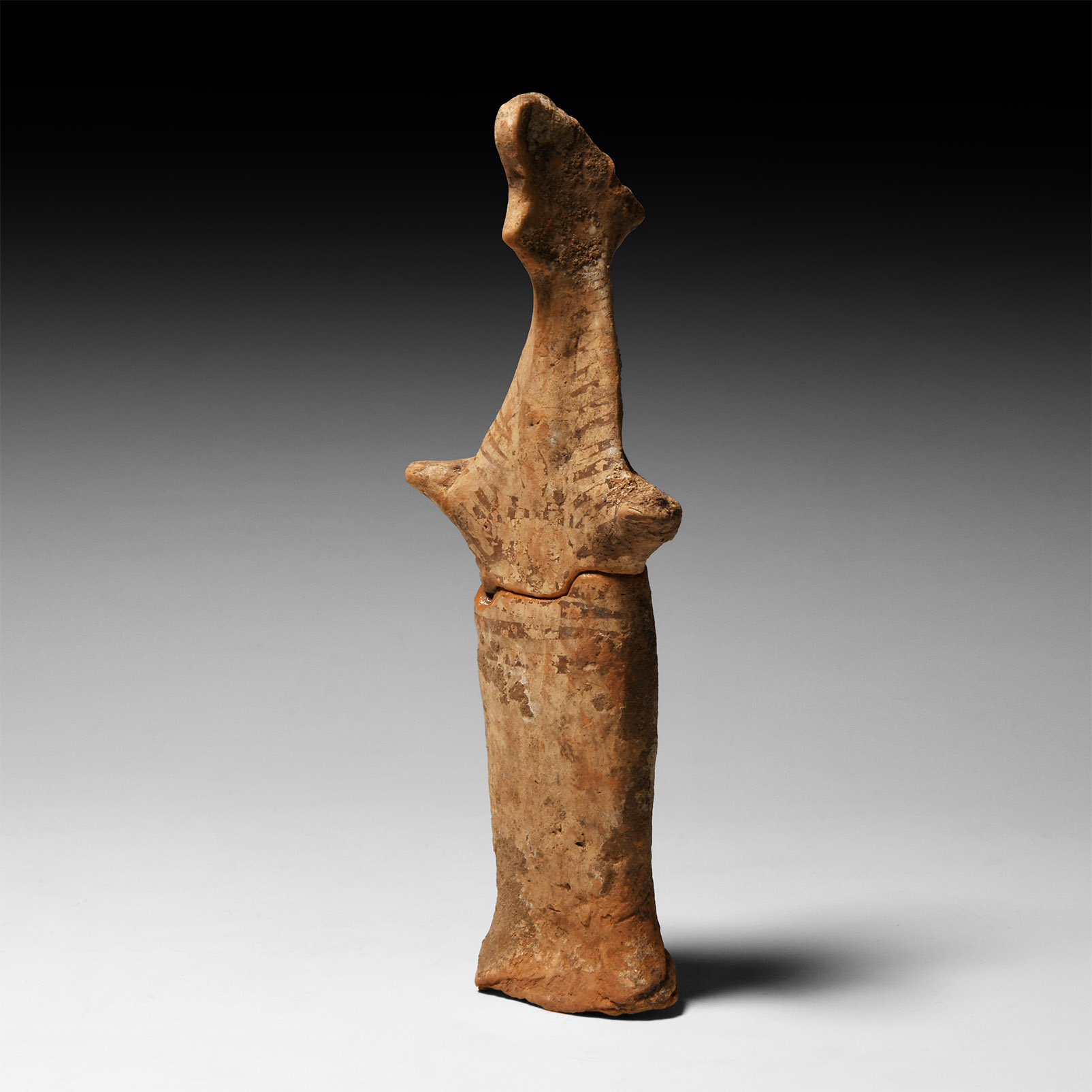
Boeotian Terracotta Idol
6TH CENTURY B.C.
6 1/2 in. (122 grams, 16.5 cm).
A terracotta idol formed with pinched stub arms and a pinched head crowned with a headpiece; remains of geometric detailing in painted pigment; repaired.
ProvenanceAcquired early 1990s.
Ex private American collection; thence by descent.
Private Swiss collection since 1998.
TimeLine Auctions follows a vetting process to ensure the authenticity and legality of all items, reinforcing our commitment to integrity and responsible trading. Each antiquity, antique, and coin lot undergoes thorough examination by a vetting committee of at least ten external specialists, professional trade association members, scientists, and archaeologists: Our Vetting Process
AUCTIONS:
TimeLine is a leading auction house specialising in antiquities, ancient art, collectables, natural history, coins, medals, and books. Our auctions offer museums, collectors, historians, and enthusiasts the opportunity to acquire unique and historically significant pieces.
-
.jpg)
Hellenistic Gold Ring with Figural Gemstone of Ares
Late 1st century B.C.Estimate: £1,500 - 2,000 (+bp*)
Opening Bid: £750
A hollow-formed gold finger ring with inset carnelian intaglio of a nude Ares wearing a plumed helmet, stooping to fill an amphora. 1.83 grams, 21.79 mm overall, 16.25 mm internal diameter (approximate size British K, USA 5 1/4, Europe 9.95, Japan 9)
Ex private European collection, Mr. W., 1950s-1990s. Acquired in 1998. with Antiquarium Ltd, New York, USA. English private collection. Accompanied by a copy of certificate of authenticity from Antiquarium Ltd, Fine Ancient Arts Gallery, dated 15 December 2016. -
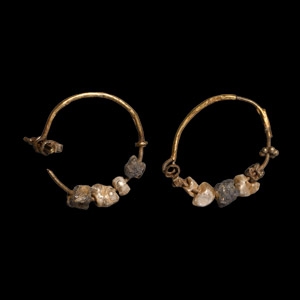
Greek Gold Hoop Earrings with Pearls
5th-3rd century B.C.Sold for (Inc. bp): £305
A matched pair of gold earrings, each composed of a round-section hoop, onto which are threaded pearl and filigree beads; one end detached. 1.4 grams total, 18-20 mm
Fine condition.
Acquired 1970-2010. Collection of a late Japanese gentleman. -
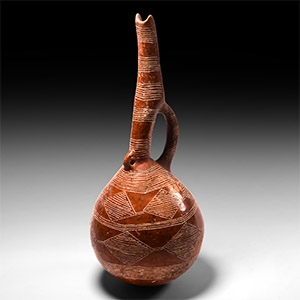
Early Cypriot Red Burnished Ware Jug
Circa 2300-1650 B.C.Sold for (Inc. bp): £1,300
A ceramic burnished ware zoomorphic jug with a piriform body, slender cylindrical neck with tapering U-section spout with integral handle to rear and perforated lug to the base of the neck at the front; decorated with a shallow incised geometric motifs composed of clusters of horizontal lines and bands of lozenges with hatched fill, chevrons along the spine of the handle; accompanied by a display stand; some restoration. 667 grams total, 33 cm high including stand
Acquired in the 1990s. From a North Yorkshire private collection, UK.
Red burnished ware pottery became the dominant pottery ware lasting into the Middle Bronze Age on the island of Cyprus. Vessels were handmade and covered with a slip, which was burnished and often decorated with patterns incised with a sharp cutting edge before being fired. Potters were able to produce vessels that were either mottled or painted in two colours, often red outside and black inside and on the exterior of the rim.
