
Loading, please wait...


LOT 0078
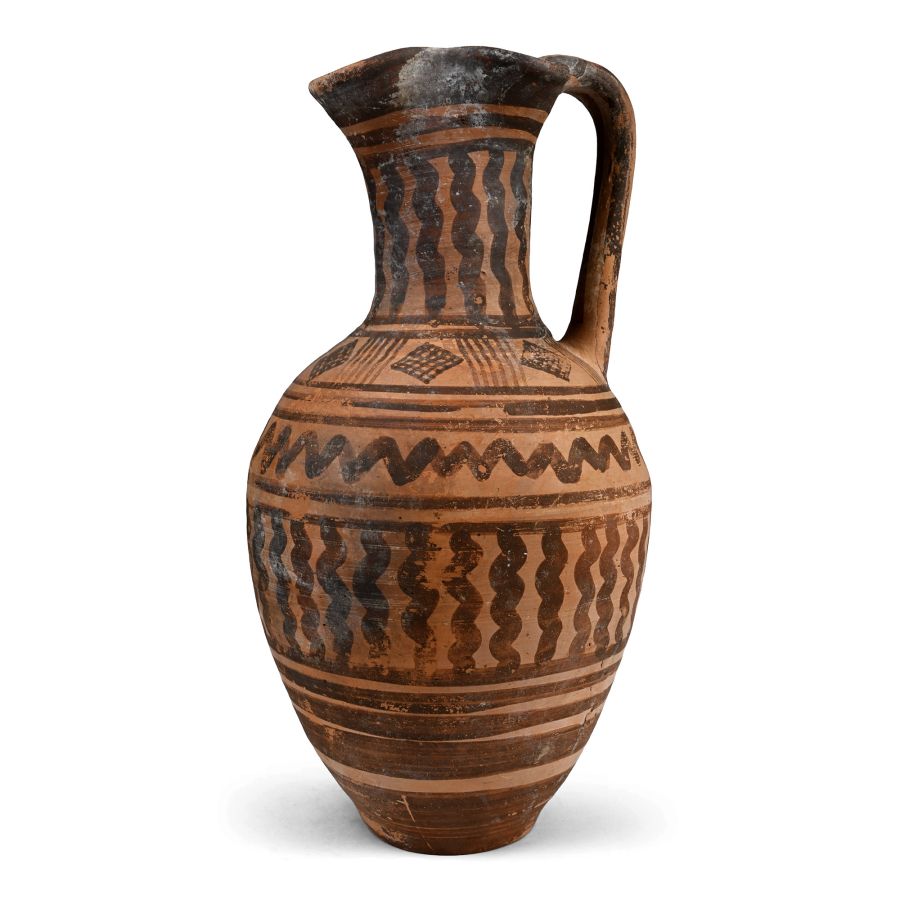
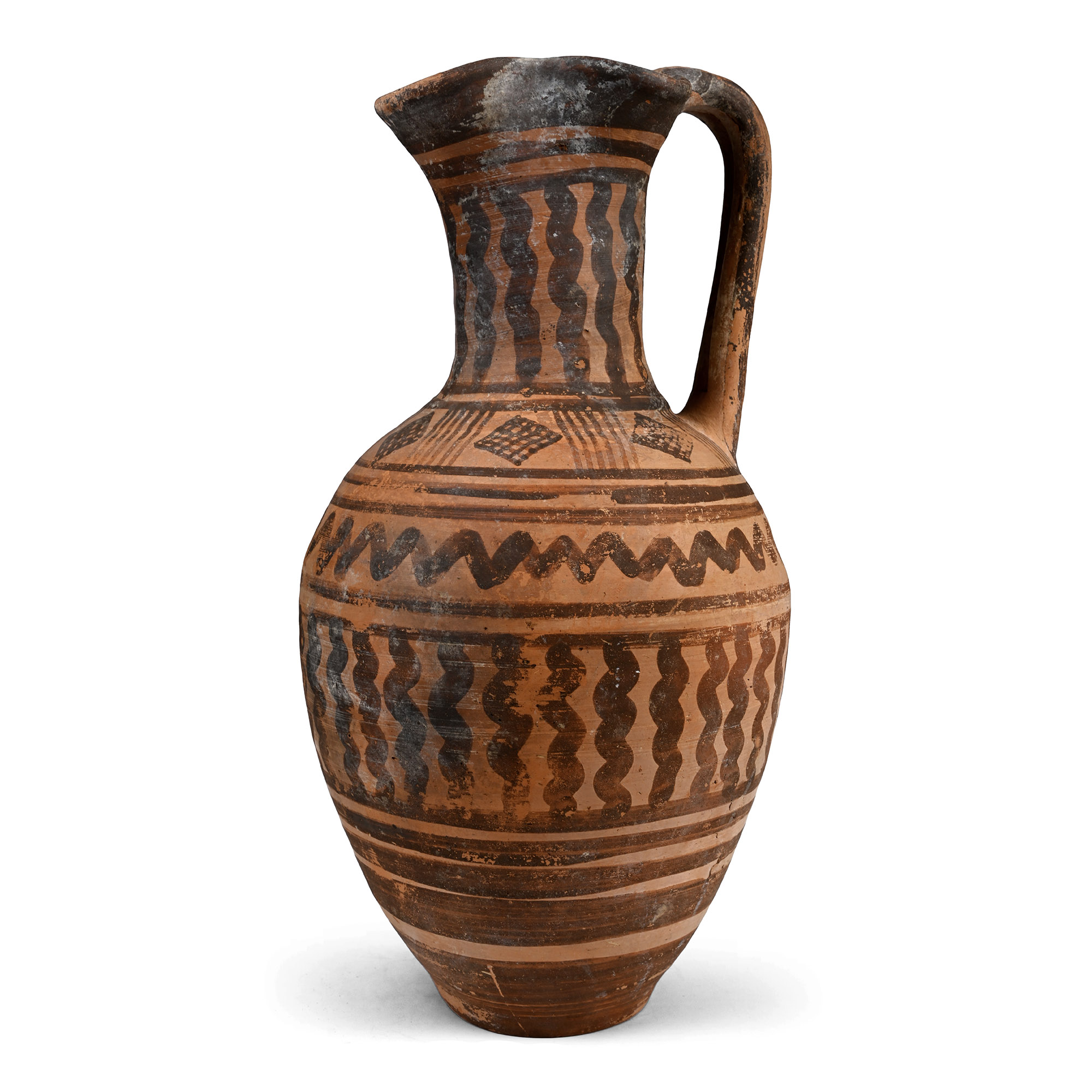
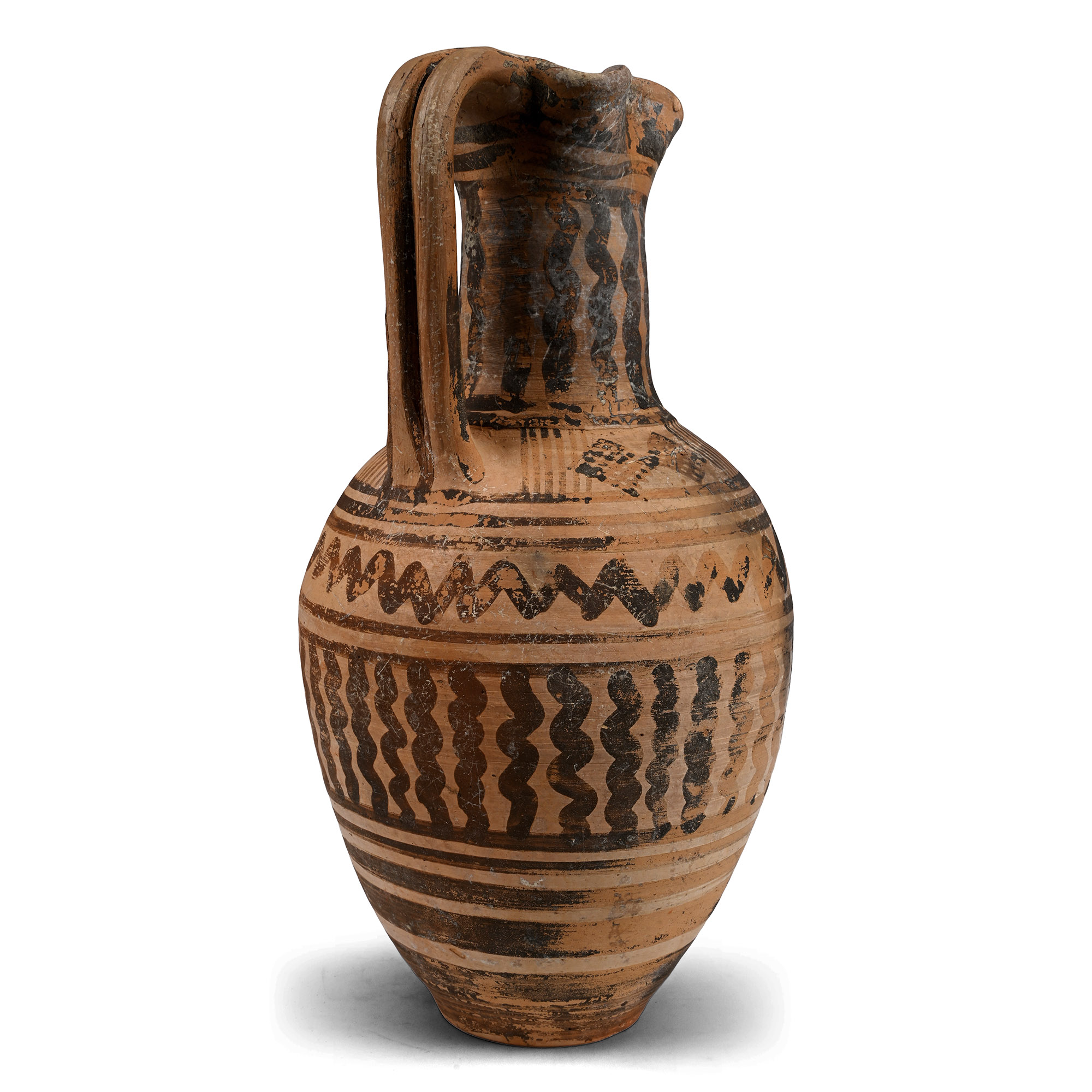
Boeotian Late Geometric Oinochoe
LATE 8TH CENTURY B.C.
13 1/2 in. (1.23 kg, 34 cm).
Ovoid body with tall neck and trefoil mouth, ribbed strap handle; body decorated with broad parallel bands and vertical zig-zags, with hatched lozenges along the shoulder.
ProvenanceEx Prof. Kurt Alder, Riehen, November 1978, from his uncle Dr Werner Alder, Lugano; thence by descent.
This lot has been checked against the Interpol Database of stolen works of art and is accompanied by search certificate no.13531-263113.
Cf. Boardman, J., Early Greek Vase Painting, 11th - 6th Centuries BC. A Handbook, London, 1998, figs. 114 and 119, for the shape and decoration with horizontal stripes; for a similar decorated oinochoe in the British Museum, accession no.1912.0522.1; see also, for an italic late geometric shape, BM 1977,1201.29.
FootnotesVessels of the Geometric period (900-700 BCE) are easily recognisable by their abstract decorative designs, which originate from woven textiles and baskets. While early period pottery typically had sparse geometric motifs on a black background, the amount of decoration increased progressively to the point that the objects from the late Geometric period are often entirely covered - in this example, even the strap handle is decorated.
CONDITIONTimeLine Auctions follows a vetting process to ensure the authenticity and legality of all items, reinforcing our commitment to integrity and responsible trading. Each antiquity, antique, and coin lot undergoes thorough examination by a vetting committee of at least ten external specialists, professional trade association members, scientists, and archaeologists: Our Vetting Process
AUCTIONS:
TimeLine is a leading auction house specialising in antiquities, ancient art, collectables, natural history, coins, medals, and books. Our auctions offer museums, collectors, historians, and enthusiasts the opportunity to acquire unique and historically significant pieces.
LOT 0078
Boeotian Late Geometric Oinochoe
Estimate £2,000 - 3,000€2,320 - 3,480 (for guidance only)$2,700 - 4,050 (for guidance only)
Opening Bid
£1,000 (EUR 1,160; USD 1,350) ‡+BP*
-
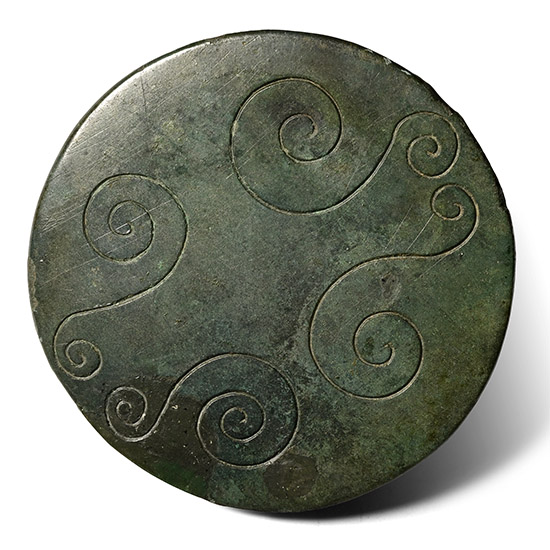
Scythian Bronze Roundel with Sea Scroll Pairs
Circa 5th-3rd century B.C.Estimate: £80 - 100 (+bp*)
Opening Bid: £5
With C-shaped round-section staple to the reverse, incised S-scrolls to the obverse forming a decorative design. 32.5 grams, 41 mm
Private collection formed in Europe in the 1980s. Westminster collection, central London, UK
The economical use of curvilinear forms is evidenced elsewhere in Scythian art - for example, in the tattoos on the preserved body of the man from Burial Mound 2 at Pazyryk in the Altai Mountains. -
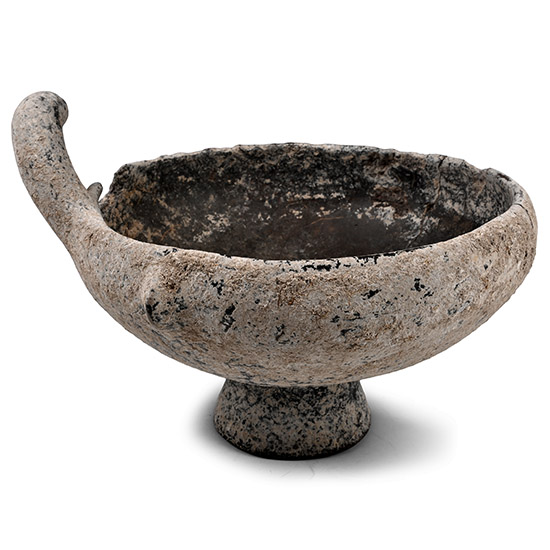
Villanovan Terracotta Stemmed Bowl with Handle
9th-8th century B.C.Estimate: £180 - 240 (‡+bp*)
Opening Bid: £90
Conical in profile with broad foot and inturned rim; single thick loop handle partly absent. 1.33 kg, 23.5 cm
Ex Prof. Kurt Alder, Riehen; thence by descent. -

Greek Solid Gold Earring Pair
4th-2nd century B.C.Estimate: £2,500 - 3,500 (‡+bp*)
Opening Bid: £1,389
Each a thick braided hoop with a collar of twisted filigree and a lion's mask finial. 18.43 grams total, 27 mm each
Private London collection, 1980s. Private collection, acquired on the British art market in 1993. This lot has been checked against the Interpol Database of stolen works of art and is accompanied by search certificate no.13185-249263.
The earrings belong to the hoop-type earrings, in which animal and human heads form the terminals as small miniature sculptures modelled in the round. The heads were attached to collars made from a single piece of gold. The group is characterised by lion heads.
