
Loading, please wait...
LOT 0387
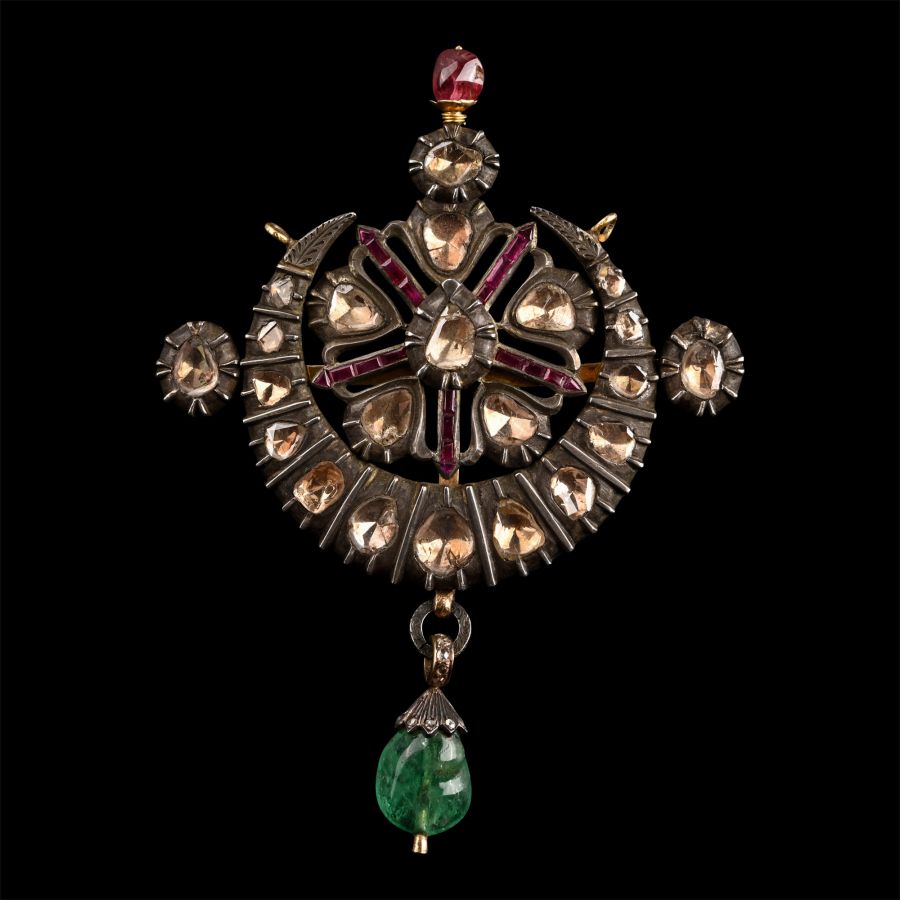
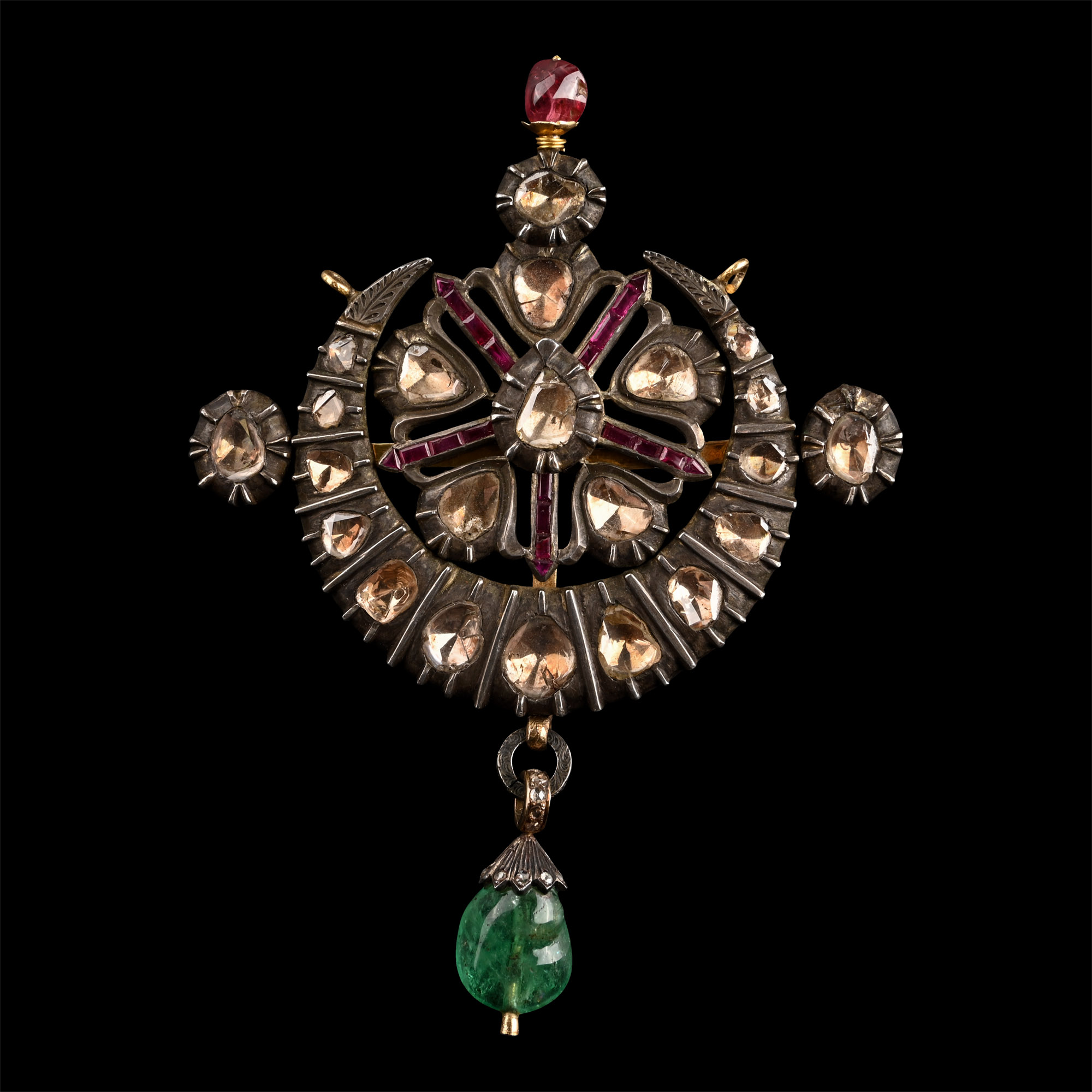
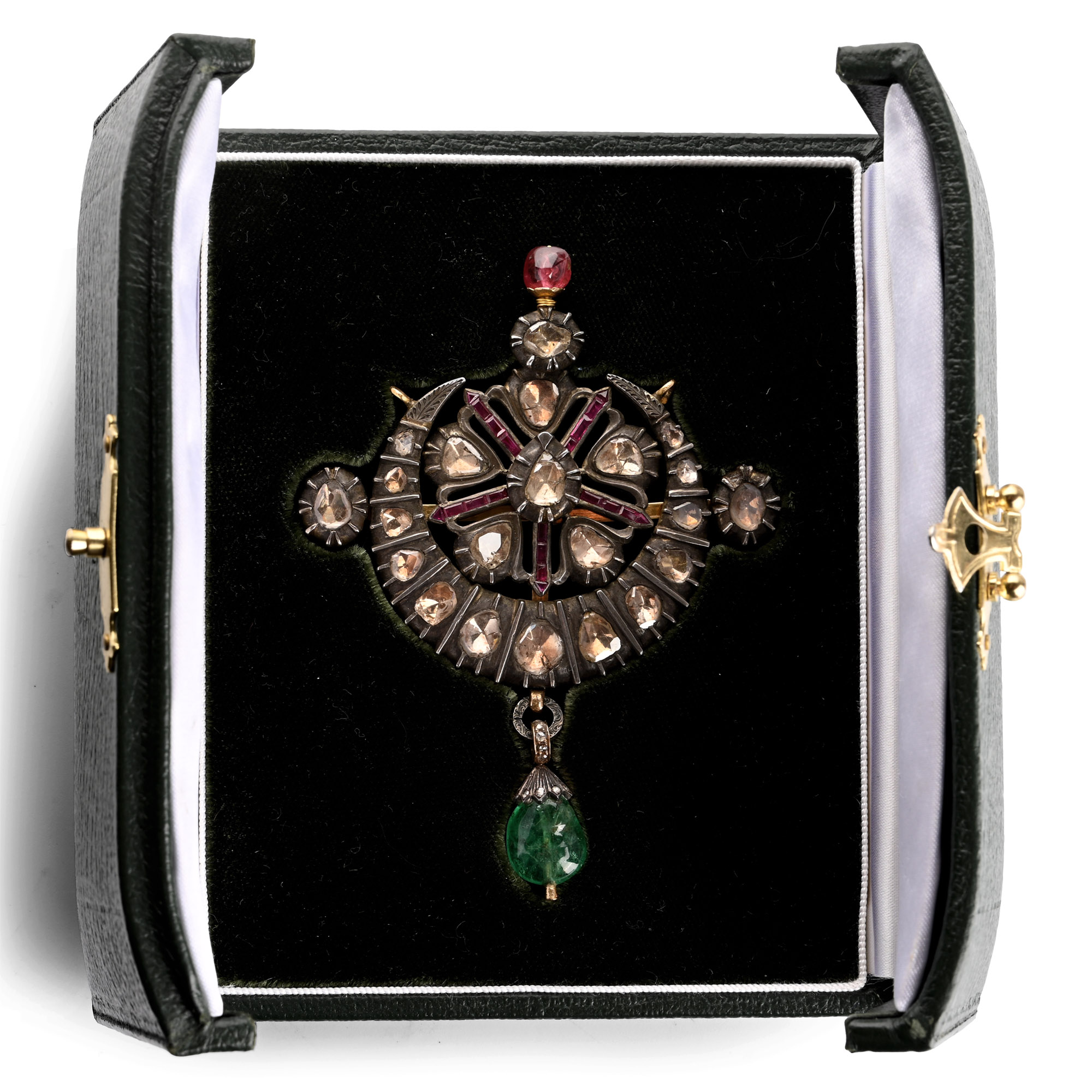
Bejewelled Naya Chand - Niyam Composite Pendant with Diamonds in Pachikam Setting
WESTERN INDIA, 19TH CENTURY A.D.
3 3 /4 in. (53.71 grams, 97 mm).
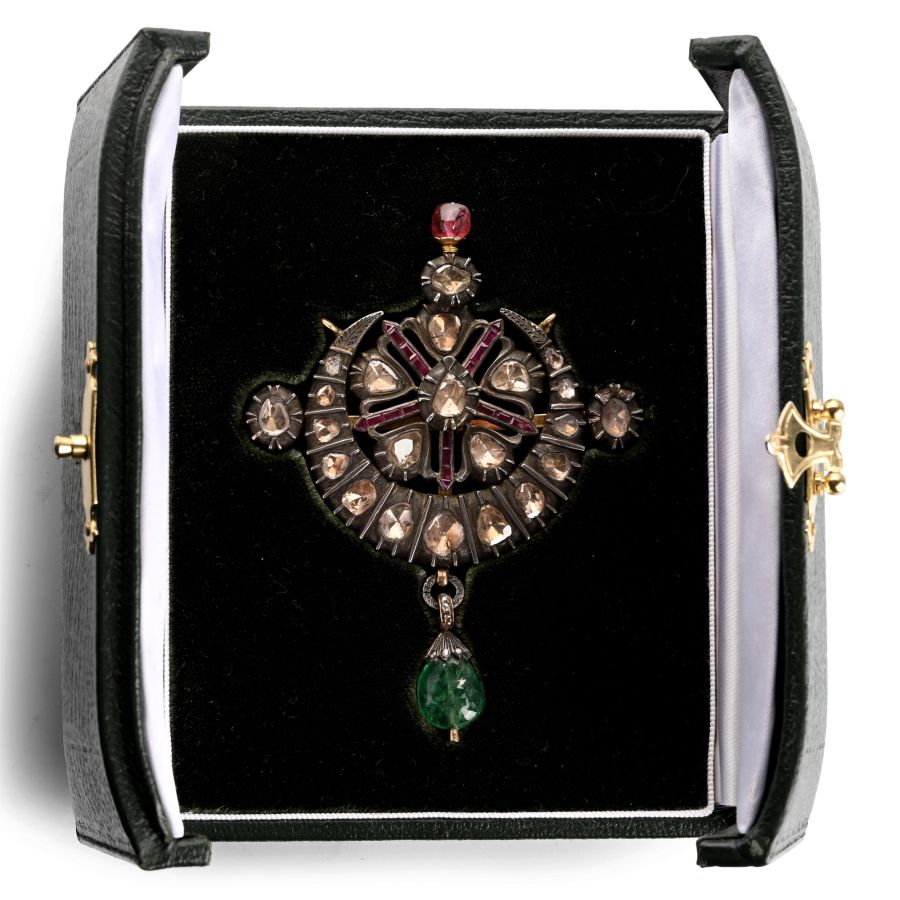
Comprising five different components joined at the back through an invisible sliding cross-like reticulate, designed as a traditional naya chand (crescent moon, also hilal) - niyam (flower) pendant en vogue during the Mughal era, with three diamond-set roundels at the top and sides, one surmounted by an untested bulbous ruby bead, and an unfacetted, drop-like carved emerald charm at the bottom; the centre of the niyam flower section irradiating five linear sprays set with narrow baguette rubies, the facetted diamonds covering the rest of the pendant's front set in a traditional Gujarati pachchikam (claw-like silver) setting; the reverse with a parcel-gilt sheet incised with dense vegetal meanderings, interlocking foliage, and floral blossoms; mounted in a padded, velvet-lined presentation case with tooled green leather, with integral display stand.
ProvenanceAcquired in the late 1980s-early 1990s.
Private collection, London.
This lot has been checked against the Interpol Database of stolen works of art and is accompanied by search certificate number no.12801-241423.
This lot has been cleared against the Art Loss Register database, and is accompanied by an illustrated lot declaration signed by the Head of the Antiquities Department, Dr Raffaele D'Amato.
Cf. Untracht, O., Traditional Jewelry of India, London, 1997, reprinted 2008, pp.353 – 354; for an analogous diamond-set pachchikam floral pendant and necklace attributed to Western India and dated late 19th century, please see Usha R., Krishnan,B. and Sushil Kumar M., Dance of the Peacock: Jewellery Traditions of India, Bombay, 1999, reprinted 2010, cat. 241, p.165; for a North Indian example, please see Taha Hussein Okada A., Jaffer, A., Treasures of the Mughals and the Maharajas: the Al-Thani Collection, exhibition catalogue, Milano, 2017, cat.175, pp.256 – 257.
FootnotesIn the history of Indian jewellery, the Mughal period remains a pivotal moment of maximal experimentation and extravagance, an era rich in developments and innovative juxtapositions. It is exactly at this time that several necklaces started incorporating long plaque-like pendants in their centres, often made of several individual adornments joint together. The naya chand - niyam and chand tara designs are classical examples of this trend. The first type usually incorporates a crescent moon-shaped pendant, either single or double, surmounted by a flower-shaped pendant with cabochon-cut gemstones (or glass); the latter has instead a crescent moon surmounted by a star. The Leitmotiv of the crescent is widely present in Indian jewellery across the Subcontinent, acting as an auspicious and protective symbol with several meanings, and it is not a prerogative of a specific social group or faith.The composite and modular nature of these pendants makes them easier to produce but also ideal to wear in different forms, fashion, and occasions, creating an evergreen piece of personal adornment. To a degree, their overall design and style are reminiscent of European military decorations and royal favours, which possibly sparked their seminal development in India. In the specific case of the present lot, the connection with European adornments does not end there. In fact, the faceted diamonds on the front of our pendant are set in a specific technique called pachchikam, a form of claw-like silver setting which enables encasing uncut gemstones and glass in a Western design, departing from the more traditional gold foil kundan setting. Pachchikam is an Indian jewellery craft originating in the region of Kutch in the Western Indian state of Gujarat, the home of exquisite silverware production. The term derives from ‘pachchigar’ which means ‘goldsmith' in the local bhasha (language, dialect). Its history is not well-researched or documented, therefore its origins are still unclear, but some early examples can be traced back to similar jewellery designs worn by the European nobility in the 16th century. It is likely that having admired these creations on their European counterparts, Indian noblemen requested their jewellers to produce analogous pieces, transforming them extensively with a local flare. In pachchikam settings, the first step is making a silver casing, which is then hollowed with grooves. The uncut gemstones and glasswork are then affixed and kept in these grooves thanks to tiny metal claws. The use of silver served a multitude of purposes: firstly, it was cheaper than gold; secondly, it was extremely malleable, making it easier to shape; but lastly, its close resemblance to platinum gave it that final Western touch so craved by Indians, especially in the late 19th century, when most of the members of prominent royal courts like the Nizams and Patialas became fond clients of European jewellery masons like Cartier and Van Cleef & Arpels.
CONDITIONTimeLine Auctions follows a vetting process to ensure the authenticity and legality of all items, reinforcing our commitment to integrity and responsible trading. Each antiquity, antique, and coin lot undergoes thorough examination by a vetting committee of at least ten external specialists, professional trade association members, scientists, and archaeologists: Our Vetting Process
AUCTIONS:
TimeLine is a leading auction house specialising in antiquities, ancient art, collectables, natural history, coins, medals, and books. Our auctions offer museums, collectors, historians, and enthusiasts the opportunity to acquire unique and historically significant pieces.
LOT 0387
Bejewelled Naya Chand - Niyam Composite Pendant with Diamonds in Pachikam Setting
Estimate £7,000 - 9,000€8,120 - 10,440 (for guidance only)$9,450 - 12,150 (for guidance only)
-
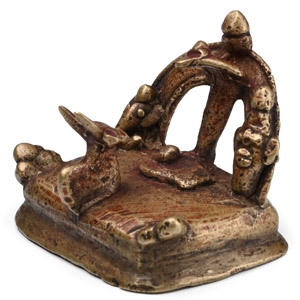
Copper-alloy Shiva Lingam Shrine with Nandi and Naga
India, circa late 19th-20th century A.D.Sold for (Inc. bp): £26
Rectangular shrine with Shiva Lingam arch, rearing cobra before the arch facing reclining Nandi. 100 grams, 58 mm wide
An important collection of Hindu art formed by the late Jeffery Romer in the 1990s. This lot is accompanied by an illustrated lot declaration signed by the Head of the Antiquities Department, Dr Raffaele D'Amato. -
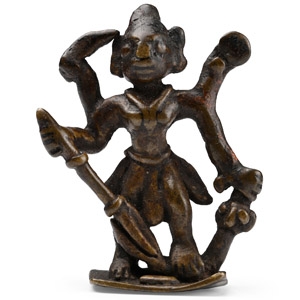
Copper-alloy Durga with Sceptre and Club
India, circa 18th-19th century A.D.Sold for (Inc. bp): £7
The goddess depicted standing and holding a weapon in each arm. 73 grams, 64 mm
An important collection of Hindu art formed by the late Jeffery Romer in the 1990s. This lot is accompanied by an illustrated lot declaration signed by the Head of the Antiquities Department, Dr Raffaele D'Amato. -
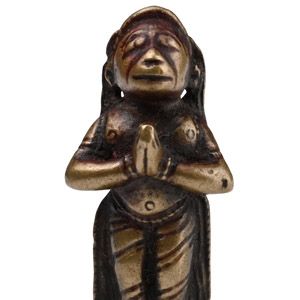
Copper-alloy Preying Hanuman Figure
India, circa 18th-19th century A.D.Sold for (Inc. bp): £7
The divine vanara depicted standing on a low pedestal with his palms held together. 40 grams, 52 mm
An important collection of Hindu art formed by the late Jeffery Romer in the 1990s. This lot is accompanied by an illustrated lot declaration signed by the Head of the Antiquities Department, Dr Raffaele D'Amato.
