
Loading, please wait...
LOT 2070
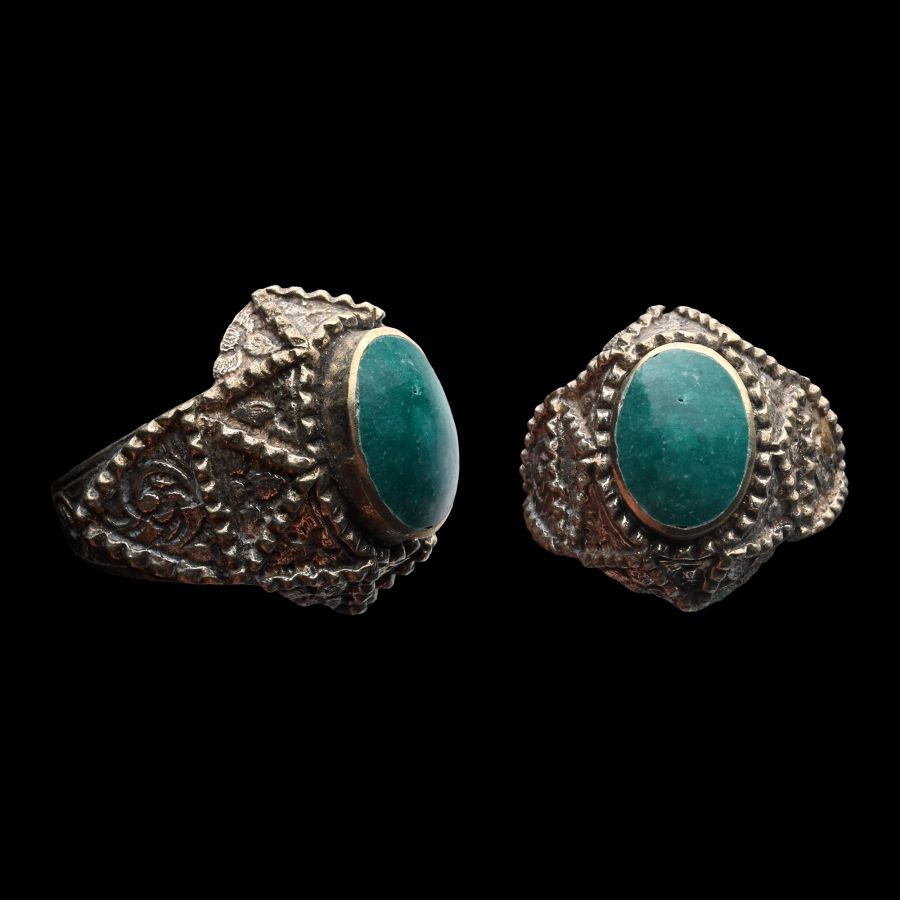
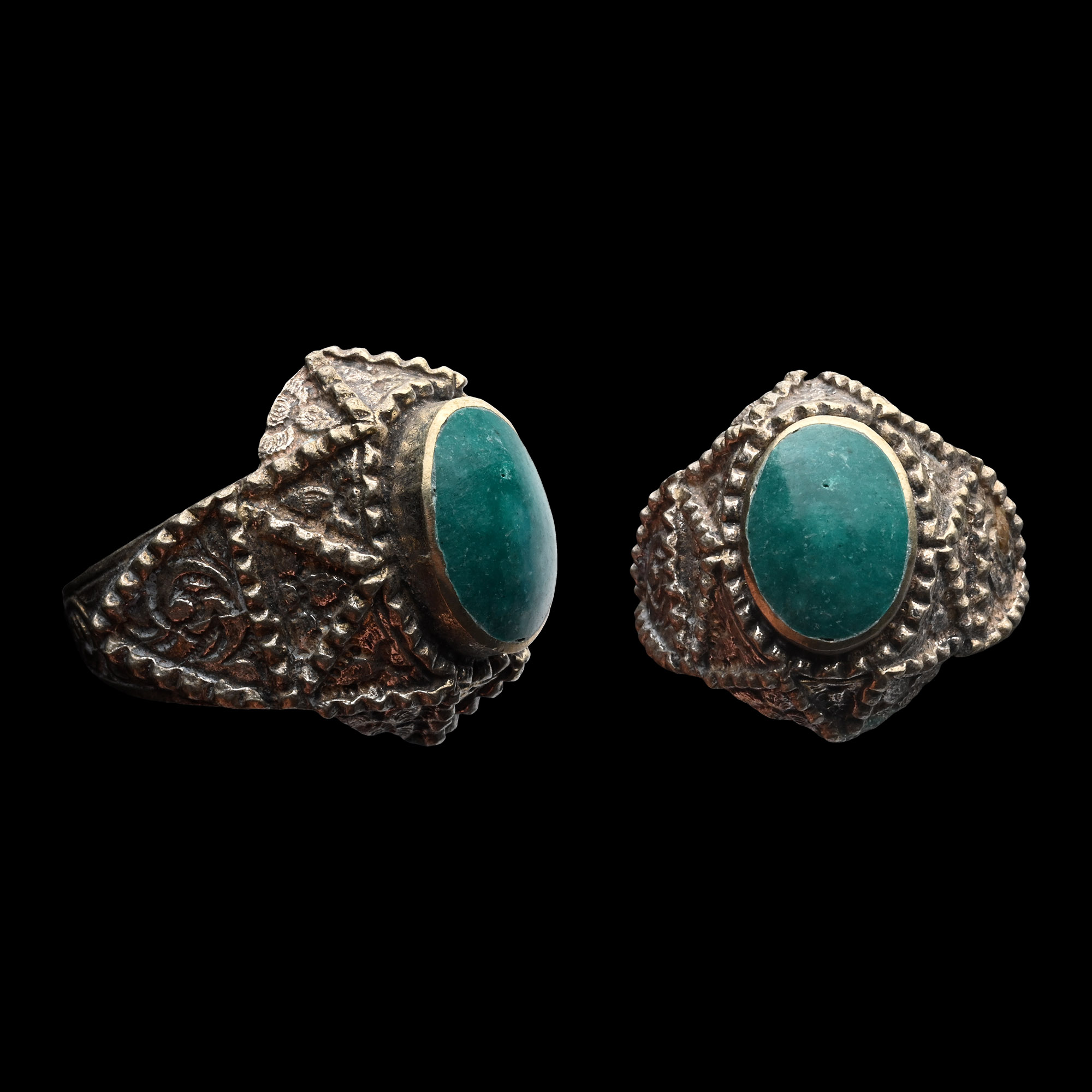
Bedouin Silver-Coloured Metal Ring with Gemstone
20TH CENTURY A.D.
1 1/4 in. (8.65 grams, 30.74 mm overall, 20.51 mm internal diameter (approximate size British P 1/2, USA 7 3/4, Europe 16.86, Japan 16)).
Raised pellet decoration on the hoop and bezel, set with a mottled green cabochon. [No Reserve]
ProvenanceLondon, UK, collection, 1980s-1990s.
CONDITIONTimeLine Auctions follows a vetting process to ensure the authenticity and legality of all items, reinforcing our commitment to integrity and responsible trading. Each antiquity, antique, and coin lot undergoes thorough examination by a vetting committee of at least ten external specialists, professional trade association members, scientists, and archaeologists: Our Vetting Process
AUCTIONS:
TimeLine is a leading auction house specialising in antiquities, ancient art, collectables, natural history, coins, medals, and books. Our auctions offer museums, collectors, historians, and enthusiasts the opportunity to acquire unique and historically significant pieces.
-
.jpg)
Georgian Era Gold Fob Seal with Carnelian Intaglio of Inigo Jones Attributed to Edward Burch
England, 18th century A.D.Estimate: £1,500 - 2,000 (+bp*)
Opening Bid: £750
Vibrant red carnelian intaglio skilfully carved with a bust of a mature man in three-quarter view, gazing right, wearing a wide-collared, buttoned tunic and a cap, long curly hair framing his bearded face with a deeply furrowed forehead; set in a gold frame with an amphora-like looped handle; supplied with a museum-quality impression. 11.72 grams, 33 mm
Acquired on the European art market.
Edward Burch (1730–1814) was a distinguished English gem engraver and miniaturist, celebrated for his intricate craftsmanship and artistic versatility. A founding member of the Royal Academy of Arts in 1768, Burch gained acclaim for his engraved gemstones, which often depicted classical and mythological themes, reflecting the neoclassical style of the Georgian era. His skill in miniature painting further demonstrated his artistic range and mastery of detail. Highly respected in his time, Burch’s works remain admired for their technical precision and elegance, preserving his legacy as a key figure in 18th-century British art. Inigo Jones (1573–1652) was a pioneering English architect who is widely regarded as the first significant figure to introduce the principles of Renaissance architecture to England. Influenced by his studies in Italy and the works of Andrea Palladio, Jones designed elegant structures characterised by classical symmetry, proportion, and restraint. His most famous works include the Banqueting House at Whitehall, the Queen’s House in Greenwich, and contributions to the layout of Covent Garden. Jones’s adoption of Palladian ideals marked a departure from the Gothic style that had dominated English architecture, laying the foundation for subsequent developments in the Classical tradition. -
.jpg)
Post Medieval Silver Ring with Vibrant Blood Orange Glass Insert
France, 18th century A.D.Sold for (Inc. bp): £208
Flat-section hoop and ellipsoid bezel with leaf detail to the shoulder, orange glass insert. 2.07 grams, 21.36 mm overall, 17.44 x 15.72 mm internal diameter (approximate size British O, USA 7, Europe 14.98, Japan 14)
Private collection, Europe. Acquired on the English art market. -
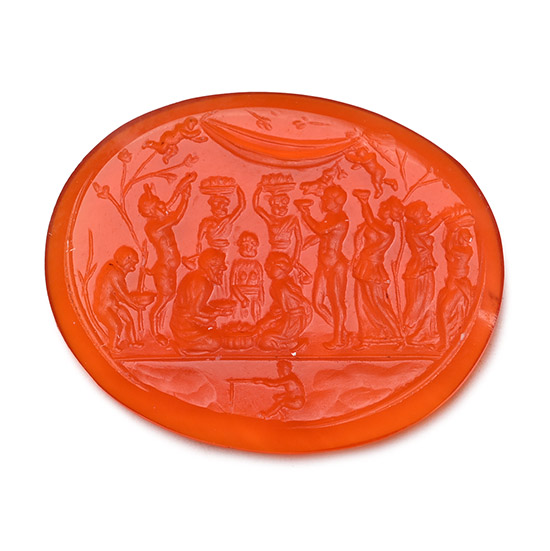
Renaissance Carnelian 'Michelangelo's Seal' Gemstone
18th century A.D.Sold for (Inc. bp): £702
Vibrant orange carnelian intaglio depicting a lively Bacchic scene with satyrs, wine-bearers and other participants beneath a canopy supported by two flying Cupids; below in the exergue, a small figure of a fisherman, fishing with a hook on the sea shore; supplied with a museum-quality impression. 1.21 grams, 21 mm
Acquired on the European art market.
The original 'Seal of Michelangelo' is a famous engraved carnelian gem, acquired by King Louis XIV in 1670. It is now housed in the Bibliothèque nationale de France. Long thought to be an ancient Greek masterpiece, and a subject of debate and controversy, it was subsequently identified by scholars as a Renaissance work by Pier Maria Serbaldi da Pescia.
