
Loading, please wait...


LOT 2006
Bedouin Silver-Coloured Metal Ring with Gemstone
20TH CENTURY A.D.
1 1/4 in. (12.24 grams, 32.81 mm overall, 19.86 mm internal diameter (approximate size British T 1/2, USA 9 3/4, Europe 21.89, Japan 21)).
Keeled hoop with decorative panels on the shoulders, oval bezel set with a green glass cabochon with a profile bust. [No Reserve]
ProvenanceLondon, UK, collection, 1980s-1990s.
CONDITIONTimeLine Auctions follows a vetting process to ensure the authenticity and legality of all items, reinforcing our commitment to integrity and responsible trading. Each antiquity, antique, and coin lot undergoes thorough examination by a vetting committee of at least ten external specialists, professional trade association members, scientists, and archaeologists: Our Vetting Process
AUCTIONS:
TimeLine is a leading auction house specialising in antiquities, ancient art, collectables, natural history, coins, medals, and books. Our auctions offer museums, collectors, historians, and enthusiasts the opportunity to acquire unique and historically significant pieces.
-

Post Medieval Iron Axehead
17th-18th century A.D.Sold for (Inc. bp): £39
With a wide, curving blade and an oval socket. 839 grams, 15.6 cm
Property of a Nottinghamshire, UK, gentleman. -

Anastasia Avante-Garde Fashion Portrait Editorial Proof by Inez van Lamsweerde & Vinoodh Matadin
Dated 11 May 2003 A.D.Sold for (Inc. bp): £585
Framed with a white card reveal, colour image of a young woman with digitally-added eye-mask; with collector's slip stating (inter alia) 'Archive Date: 11/05/03' and 'Historical Significance: Originally captured in 1994 for a groundbreaking 10-page editorial in The Face magazine, "Anastasia" is a museum-grade artwork celebrated as the very first instance of digital manipulation (Photoshop compositing) in fashion history. Large-scale gallery prints of this work are held in elite collections worldwide (including the Sir Elton John collection). This May 2003 proof tracks its syndication in Spain for a major visual arts or digital photography retrospective.' 174 grams, 35.5 x 28 cm including frame
Acquired on the USA art market. Property of a Harwich, UK, collector. -
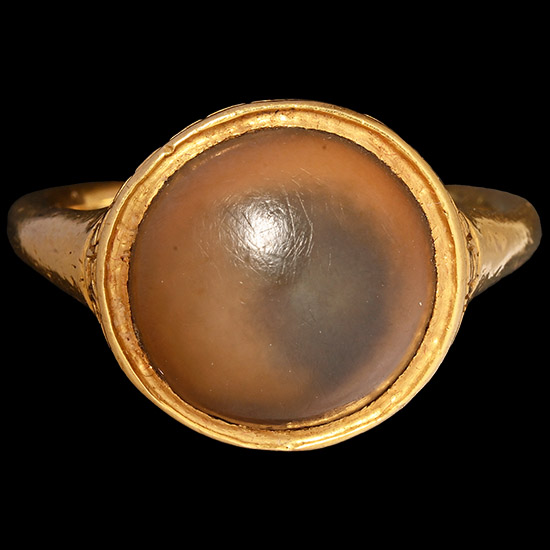
Renaissance Gold Ring with Toadstone
Western Europe, 16th century A.D.Estimate: £8,000 - 10,000 (+bp*)
Opening Bid: £4,000
Featuring a round-section large hoop expanding towards the shoulders, a large circular bezel with a Greek key motif encircling the outer rim and set with a brown 'toadstone'. 13.01 grams, 32.42 mm overall, 23.12 x 19.25 mm internal diameter (approximate size British V 1/2, USA 10 3/4, Europe 24.4, Japan 23)
Acquired on the European art market. This lot has been checked against the Interpol Database of stolen works of art and is accompanied by search certificate number no.13398-257996.
William Shakespeare’s As You Like It, circa 1599: 'Sweet are the uses of adversity, Which, like the toad, ugly and venomous, Wears yet a precious jewel in his head.' Toadstones are mythical stones that were thought to be found inside the head of a toad. They were believed to sweat, change colour or even heat up in the presence of poison. It was thought that a toadstone placed on bites from snakes, insects, spiders and shrews would extract poison from the wound. They were thought to bring good luck and ward off evil, whether in the present life or in the afterlife. The Book of Secrets from the 13th century recommends swallowing the stone to 'cleanse the bowels of filth and excrements'. The stone could then be retrieved and used again. They were often set as amulets and talismans, a practice that continued in Europe until the 18th century. Toadstones are actually the button-like fossilised teeth of Lepidotes, an extinct genus of fish common in the Jurassic and Cretaceous Periods, 200 to 100 million years ago.
