
Loading, please wait...
LOT 0375
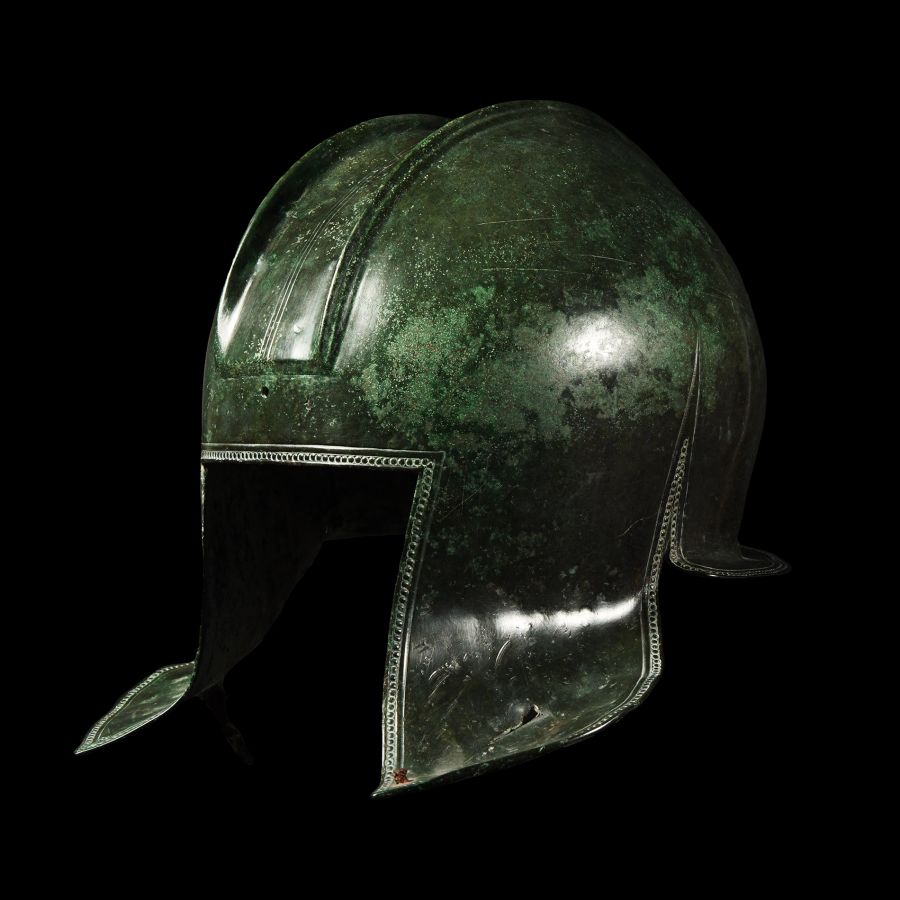
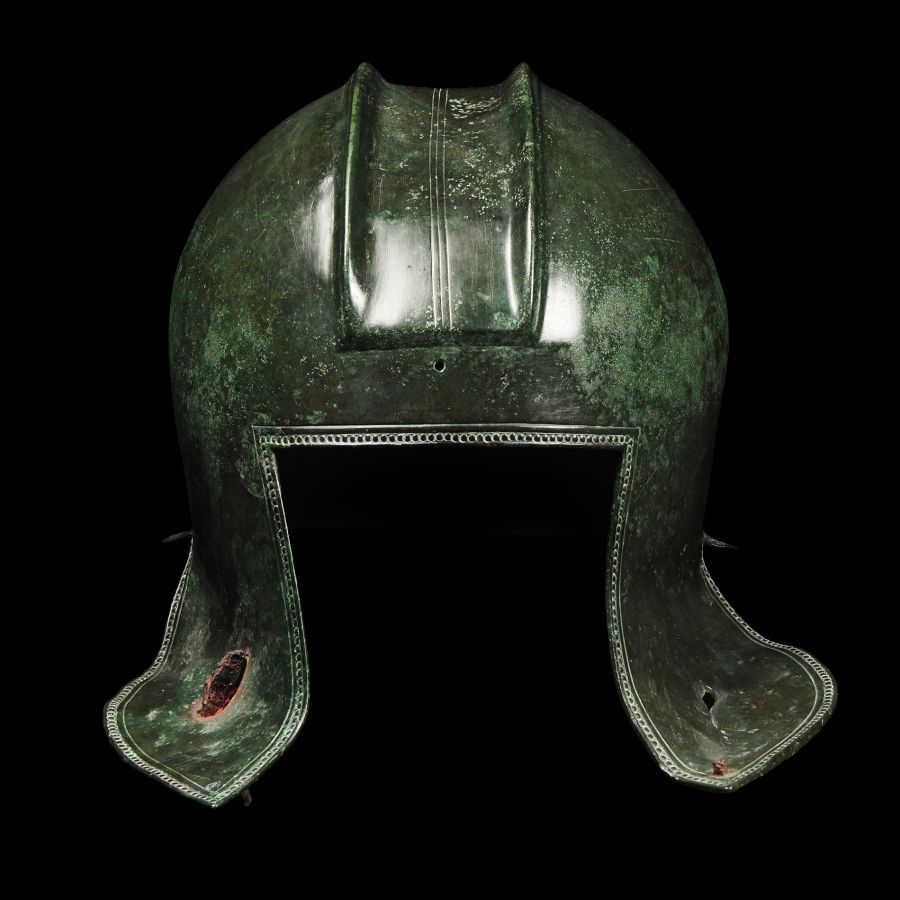
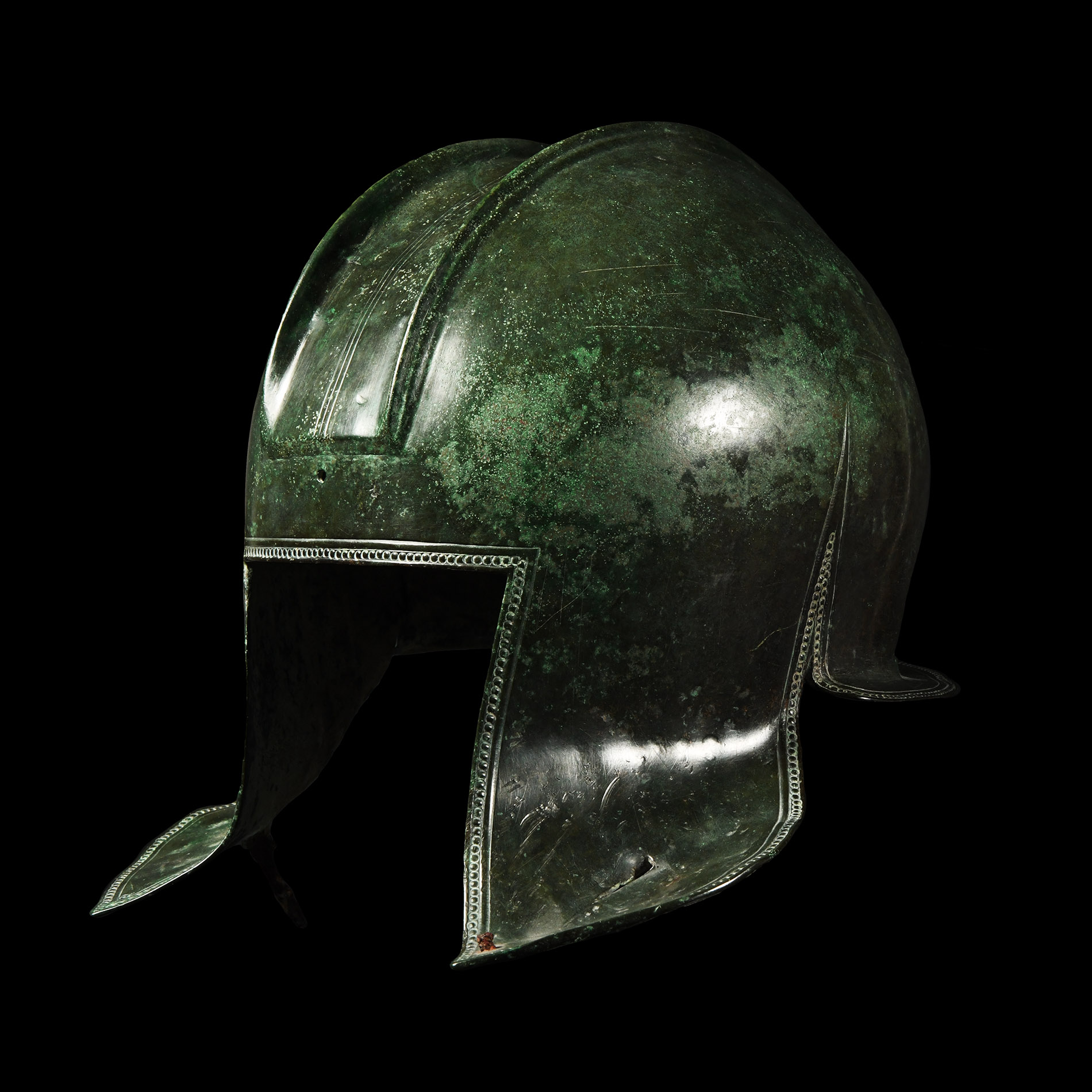
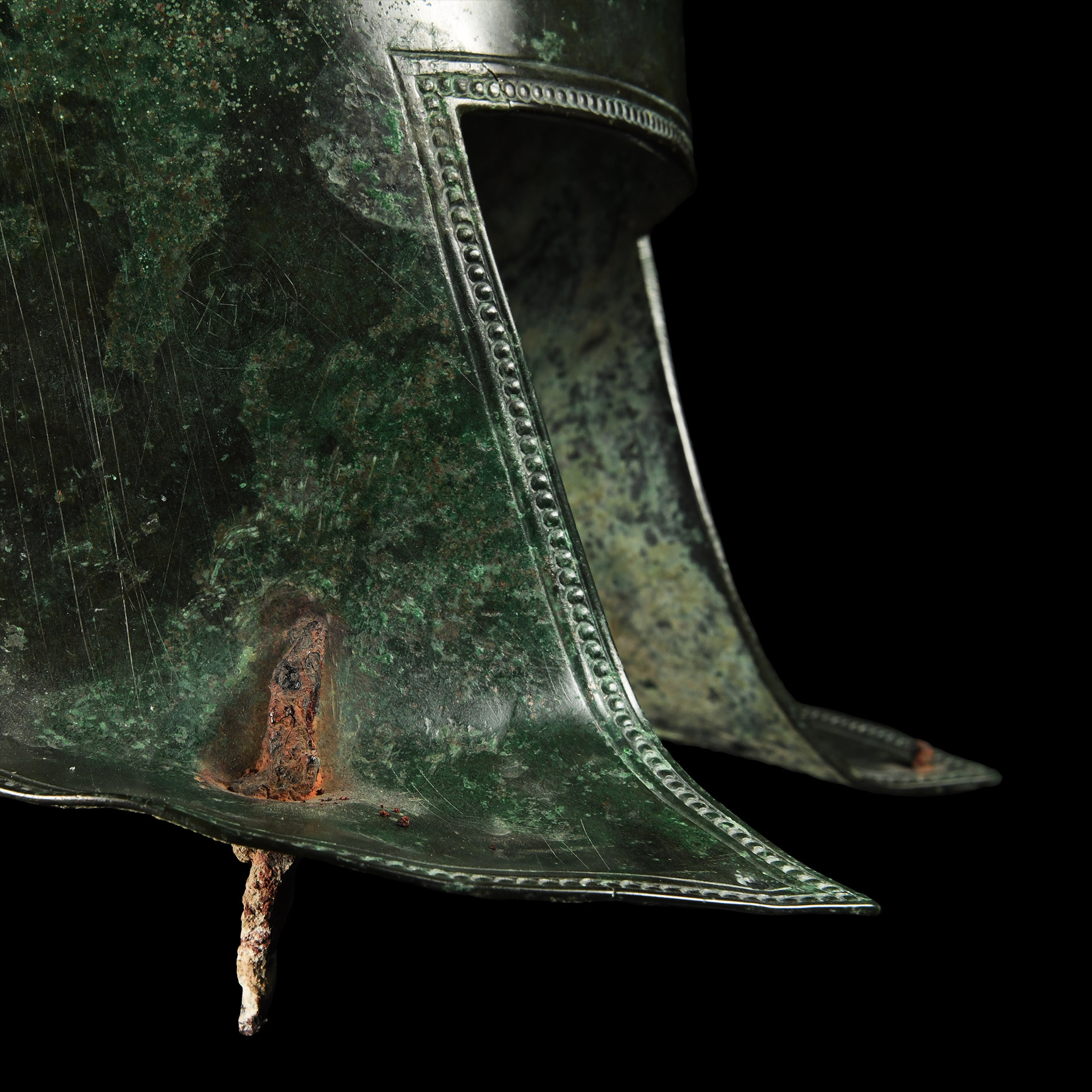
Battle-Speared Illyrian Helmet
MID-6TH-4TH CENTURY BC
11 3/4" (2.7 kg total, 30cm including stand).
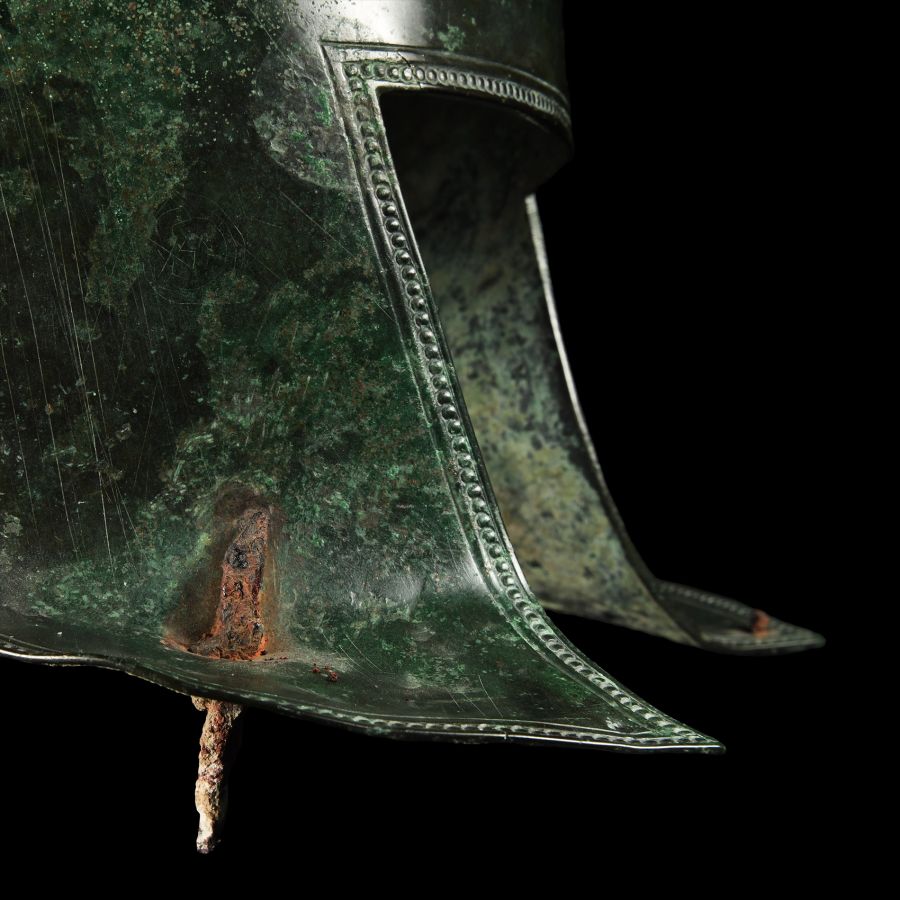
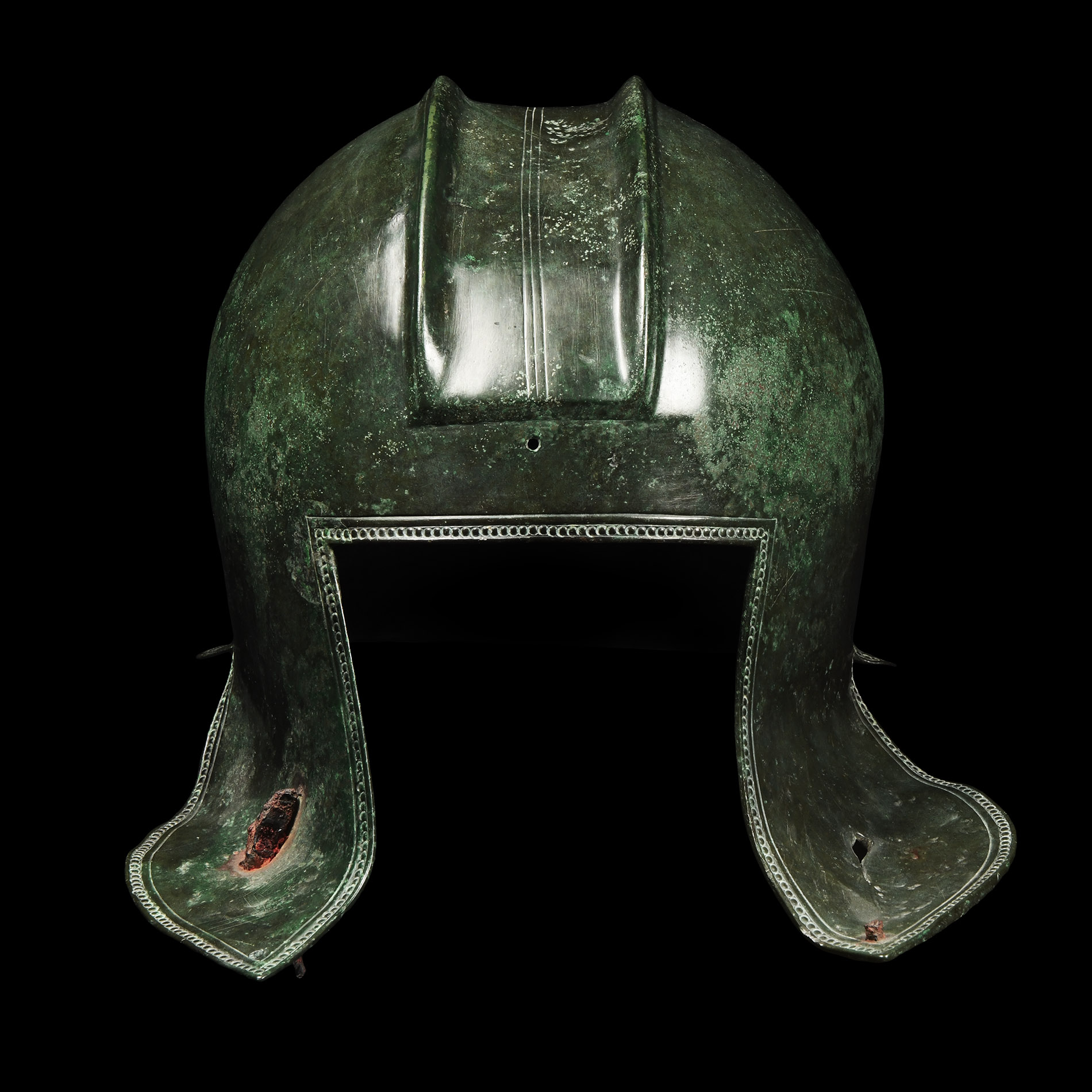
A domed bronze helmet of Illyrian typology IIIA, variant 3, raised from a single sheet with cheek-pieces; two parallel raised ridges to the upper face with three incised lines; the smooth edges with a row of punched dots between narrow bands; short rear flange developing behind the curving cheek-protectors, each pierced for fastening of the chin-strap, one pierced with ferrous remains of a javelin tip(?) in situ, the other with a hole in corresponding place; square-cut frontal opening; button holes to the back of the neck-guard and a pierced hole at the front for attaching a crest; mounted on a custom-made display stand.
ProvenancePrivate collection, London, UK; acquired on the New York art market 22 May 2013; before that with Christie's, New York, 8 June 2012, lot 69 [US$40,000-$60,000]; previously in the private collection of Mr Thomson Murray Jr., USA, 1985; formerly in a private collection, Southern Germany, 1970s; accompanied by a report by military expert Dr. Raffaele D'Amato, and copies of the relevant Christie's catalogue pages; this lot has been checked against the Interpol Database of stolen works of art and is accompanied by AIAD certificate number no.10806-178695.
LiteratureSee Pflug, H., 'Illirysche Helme' in Antike Helme, RGZM Monographien 14, Mainz, 1988, pp. 43-64; Connolly, P., Greece and Rome at war, London, 1981; Christie's, The Axel Guttmann Collection of Ancient Arms and Armour, part 1, London, 2002; Christie's, The Axel Guttmann Collection of Ancient Arms and Armour, part 2, London, 2004; Vasić, R., ‘Reflecting on Illyrian helmets’, in Starinar, LX, Belgrade, 2010, pp.37-55; for an example of similar helmets see Guttman collection (Christie's, 2002, no.52; 2004, p.80, nos.69,73) which shows the same long cheek-pieces and short rear flange.
FootnotesThe so-called Illyrian helmets, with a rectangular opening for the face, triangular or elongated cheek-pieces and a neck guard, as well as a track consisting of two ridges on the top of the crown for the crest, are archeologically distributed over a large territory – from the Balkan Peninsula, Greece, Italy and along the Adriatic Coast, and as far as the Black Sea region, creating a great diversity of forms, with various types or subtypes. The most widespread and most popular was the late form – Type III, which developed from Type II and dates from the second half of the 6th to the 4th century BC. Its division into Types IIIA with side gussets (‘Seitenzwickeln’, Pflug, 1988, p.52) and IIIB with a round opening cut for the ears is generally accepted. In our type IIIA it is interesting to note the presence of an extraneous iron body which pierced the right cheek-guard, maybe the tip of a javelin that could have caused the death of the wearer.
CONDITIONTimeLine Auctions follows a vetting process to ensure the authenticity and legality of all items, reinforcing our commitment to integrity and responsible trading. Each antiquity, antique, and coin lot undergoes thorough examination by a vetting committee of at least ten external specialists, professional trade association members, scientists, and archaeologists: Our Vetting Process
AUCTIONS:
TimeLine is a leading auction house specialising in antiquities, ancient art, collectables, natural history, coins, medals, and books. Our auctions offer museums, collectors, historians, and enthusiasts the opportunity to acquire unique and historically significant pieces.
5th-3rd century BC
Lot No. 1446
Sold for (Inc. premium): £140
3rd millennium BC
Lot No. 0394 Opening bid: £450
9th-12th century AD
Lot No. 1470
Sold for (Inc. premium): £254
