
Loading, please wait...
LOT 2077
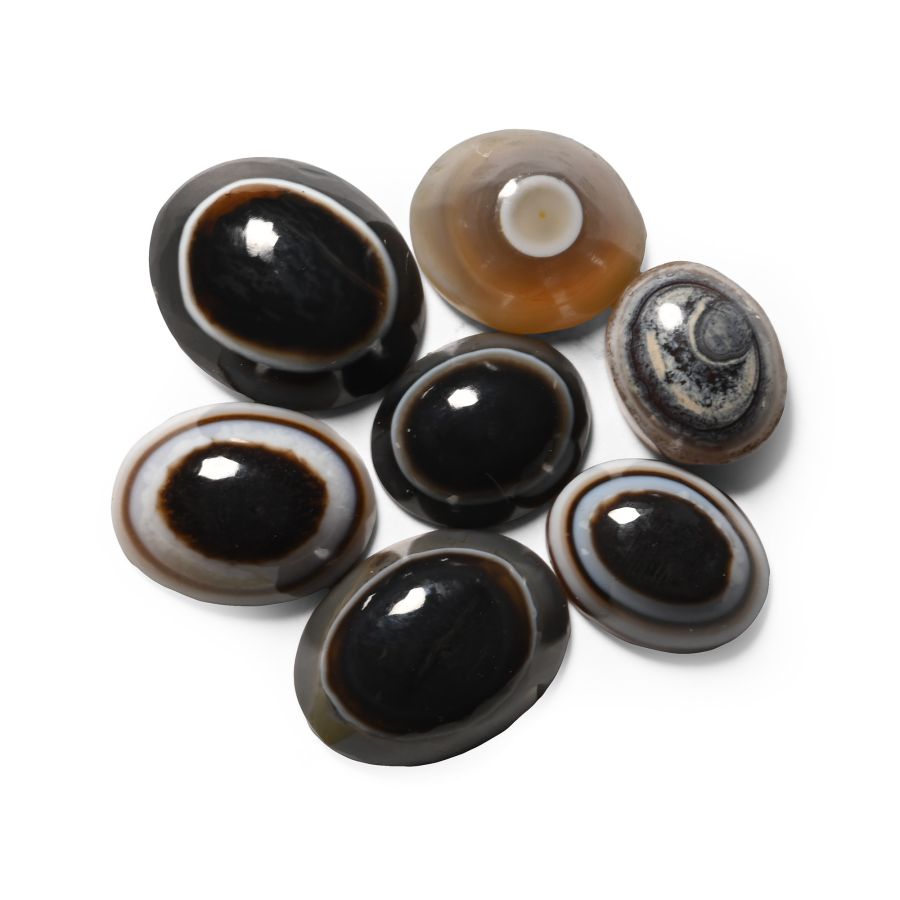
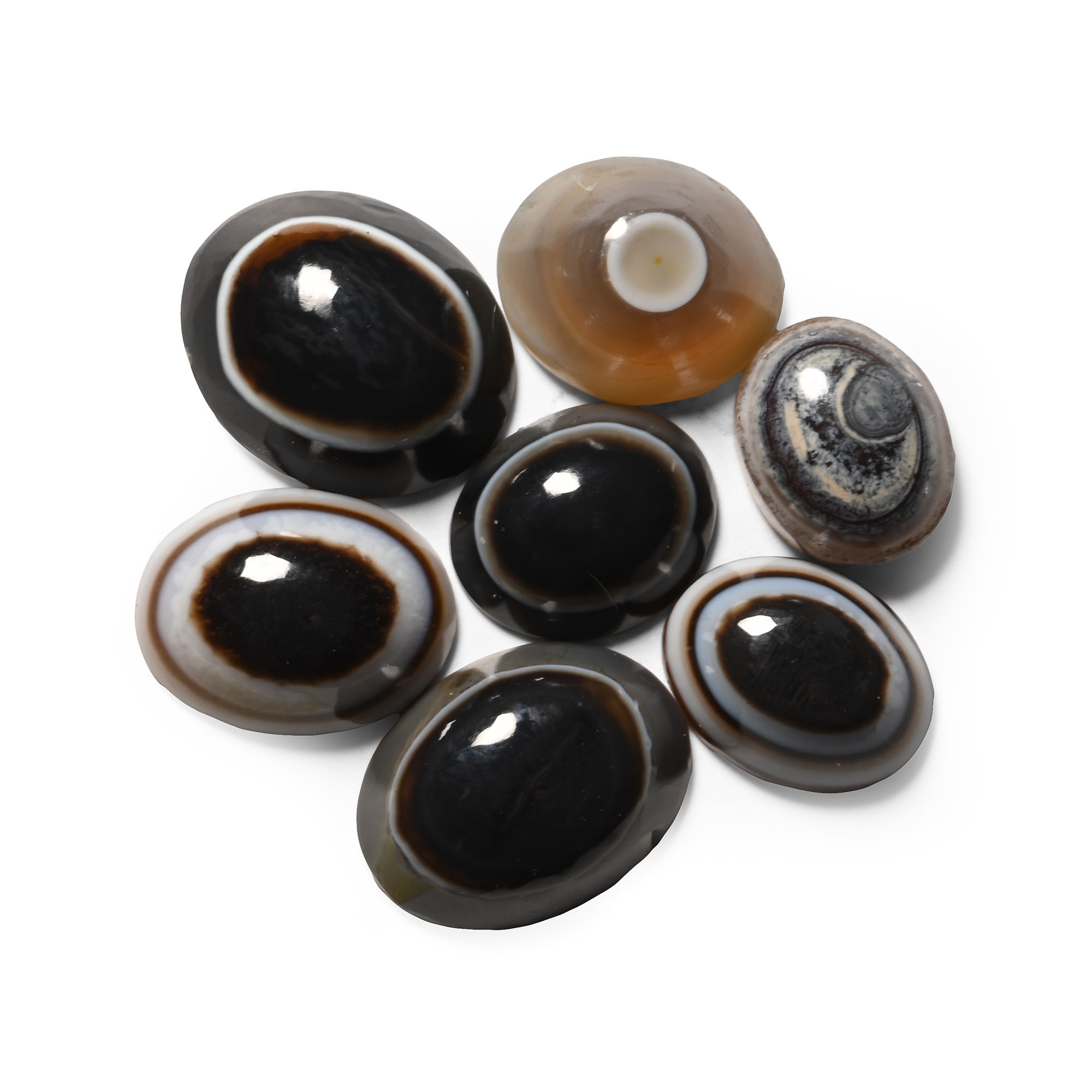
Banded Agate Eye Gemstone Group
20TH CENTURY A.D.
3/8 - 5/8 in. (8.13 grams total, 11-16 mm).
Comprising seven domed cabochons, each polished to resemble an 'eye'. [7, No Reserve]
ProvenanceFrom the private collection of a European gentleman (1942-2024), formed since the 1970s.
CONDITIONTimeLine Auctions follows a vetting process to ensure the authenticity and legality of all items, reinforcing our commitment to integrity and responsible trading. Each antiquity, antique, and coin lot undergoes thorough examination by a vetting committee of at least ten external specialists, professional trade association members, scientists, and archaeologists: Our Vetting Process
AUCTIONS:
TimeLine is a leading auction house specialising in antiquities, ancient art, collectables, natural history, coins, medals, and books. Our auctions offer museums, collectors, historians, and enthusiasts the opportunity to acquire unique and historically significant pieces.
-
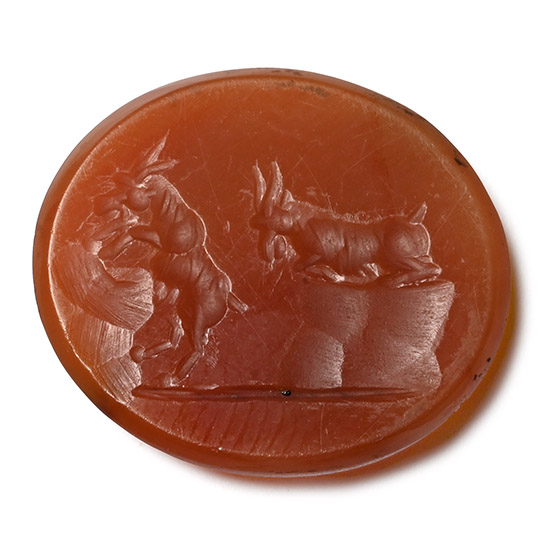
Carnelian Gemstone with a Bucolic Scence
18th century A.D.Sold for (Inc. bp): £20
Oval orange carnelian gem showing two goats, one resting on top of a large stone while the other is standing against another boulder. 1.66 grams, 17 mm
UK private collection, acquired on the English art market in the 2000s. -
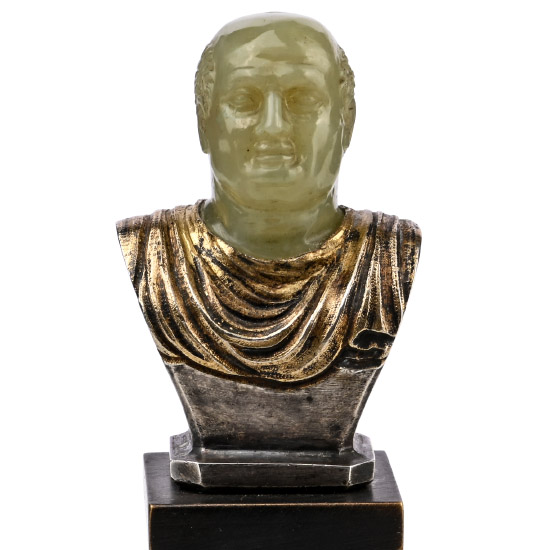
Chalcedony and Silver-Gilt Bust of the Emperor Vespasian
Italy, 17th-18th century A.D.Estimate: £1,500 - 2,000 (+bp*)
Opening Bid: £750
The head, carved from pale green chalcedony, polished to a smooth lustre and with a drilled aperture at the crown, the hair in tight curls around the nape and crown; the silver-gilt torso dressed in a draped toga carefully chased with deep folds and traces of gilding across the high points; mounted on a later patinated bronze column stand in the neoclassical manner. 208 grams total, 10.9 cm high including stand
Acquired on the European art market.
This small-scale portrait evokes the Roman tradition of imperial portraiture and the early modern fascination with the ancient world. From the seventeenth century onwards, artists and collectors revived classical subjects through hardstone and gilt-metal compositions, often intended for display in Kunstkammer or Grand Tour contexts. The combination of a reused ancient or earlier element with a later mount was a practice typical of the Renaissance and Baroque periods, reflecting the period’s reverence for antiquity and its imaginative recontextualisation of ancient forms. -
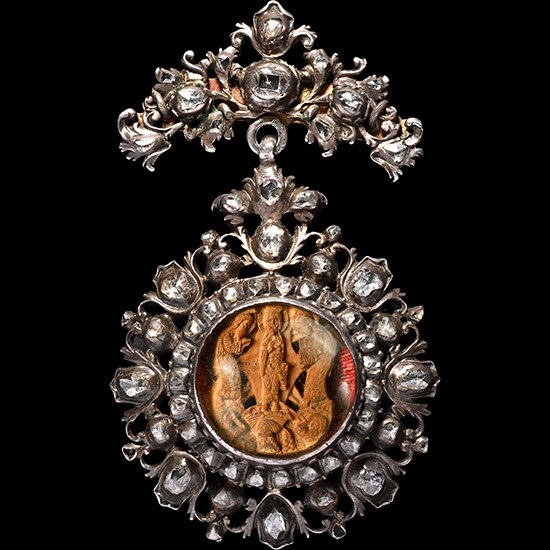
Silver and Diamond Pendant with the Transfiguration
Spain, circa 1700 A.D.Sold for (Inc. bp): £2,340
The elaborate openwork pendant set with old-cut diamonds, the hanger centred with a table-cut diamond; at the centre a circular glazed compartment containing a Greek Orthodox, micro-sandalwood carving of the Metamorphosis, featuring the three elaborately carved nimbate figures of Christ, Heliah and Moises, and the three apostles Peter, John and James at their feet; the reverse of the pendant with a flowering tulip; a brooch pin added in the 19th century to the reverse. 31.97 grams, 66 mm
Acquired on the European art market. This lot has been checked against the Interpol Database of stolen works of art and is accompanied by search certificate no.13450-257984.
The central scene represents the Transfiguration of Christ, as it is described in the Gospels of Matthew, Luke and Mark. Having led his companions up the holy Mount Tabor to pray, the men are awoken the following day by the startling sight of Christ floating above the mountain at Galilee. He is flanked by the prophets Elijah and Moses, who stand serenely talking to him from two rocky outcrops. Christ hovers within an aureole, which represents divine uncreated light, and makes a sign of blessing. As the disciples, still ‘heavy with sleep’, stare with amazement to see him in his deified humanity, a voice speaks out from a cloud: ‘This is my Beloved Son, in whom I am well pleased; hear ye him’ (Matthew 17:5). In confusion they scramble and fall. John loses a sandal. James stumbles and shields his eyes.
