Loading, please wait...

Banded Agate Bead and Pendant Group Banded Agate Bead and Pendant Group Banded Agate Bead and Pendant Group
Use mousewheel to zoom in and out, click to enlarge
Details

LOT 2157

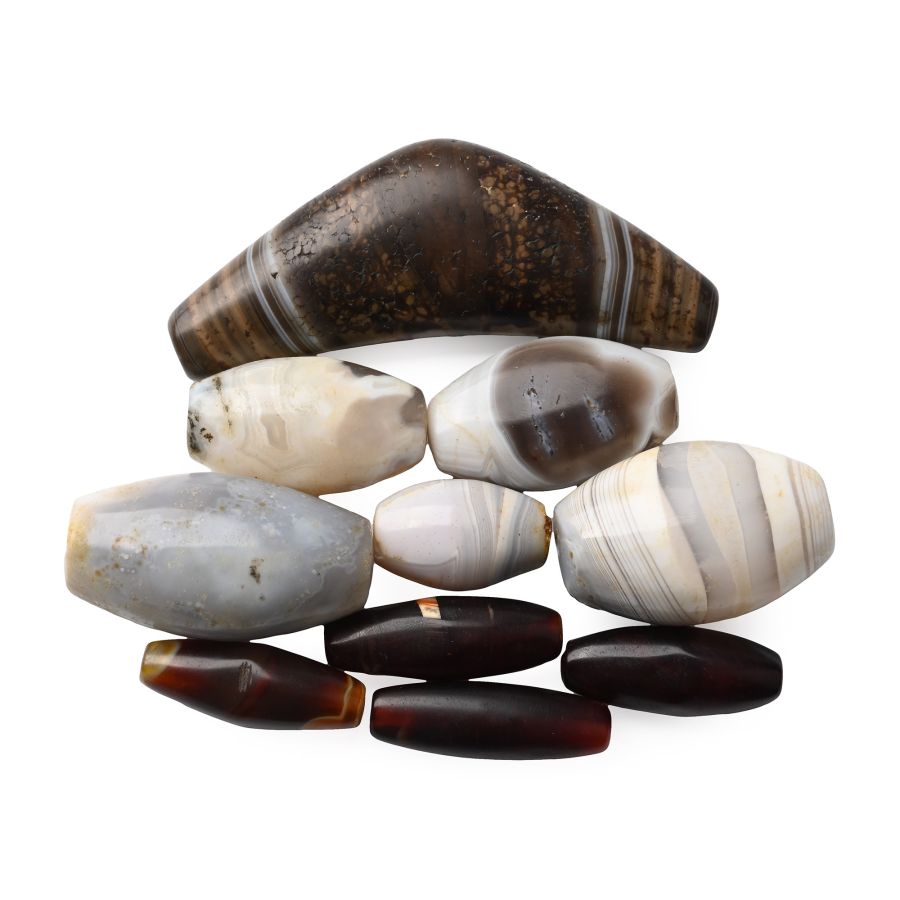
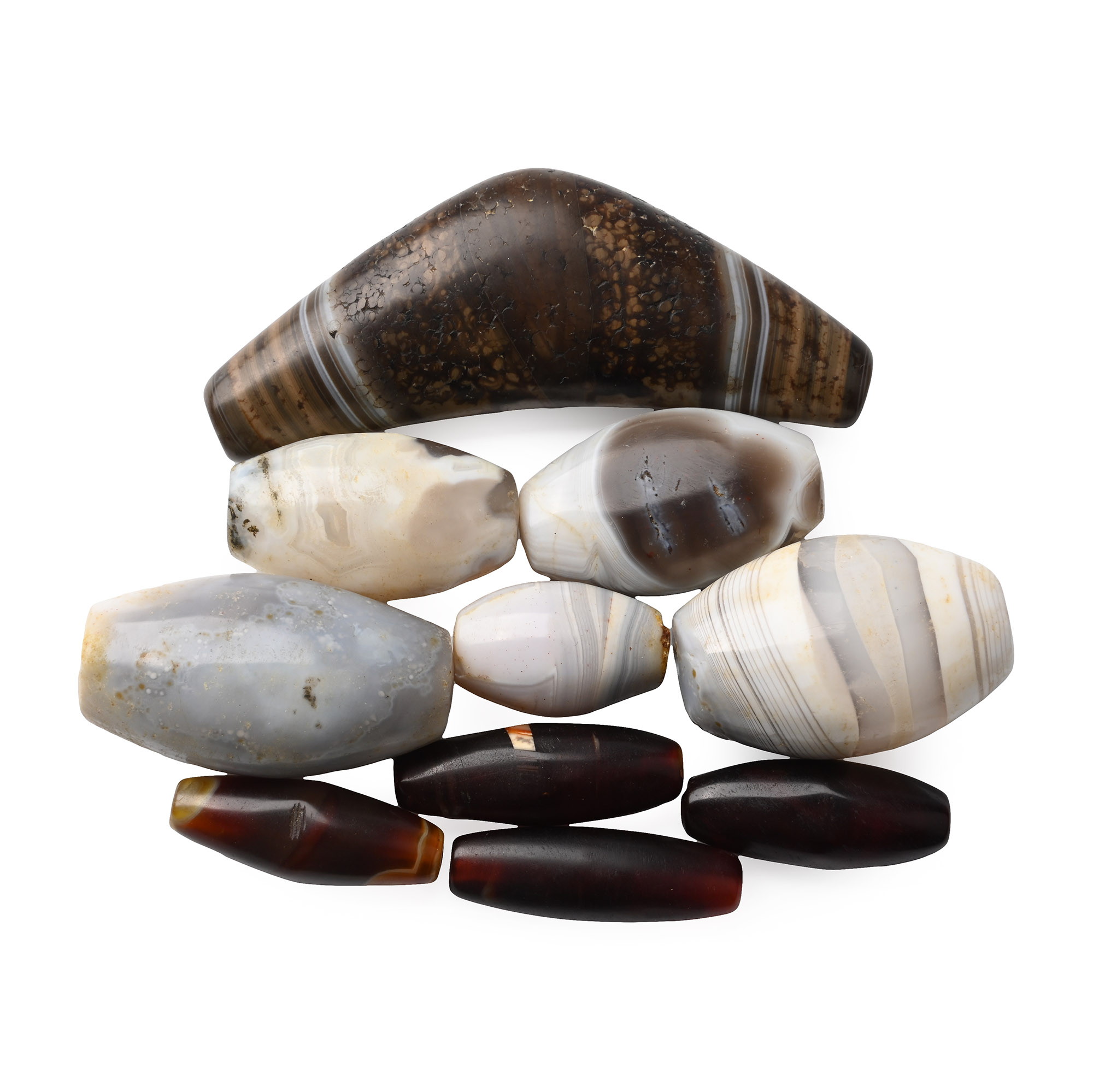
Banded Agate Bead and Pendant Group

20TH CENTURY A.D.

3/4 - 2 3/4 in. (117 grams total, 21-69 mm).

Including fusiform, tabular and other types in banded agate and other materials. [10, No Reserve]

Provenance

Private collection, UK.

CONDITION
VETTING:

TimeLine Auctions follows a vetting process to ensure the authenticity and legality of all items, reinforcing our commitment to integrity and responsible trading. Each antiquity, antique, and coin lot undergoes thorough examination by a vetting committee of at least ten external specialists, professional trade association members, scientists, and archaeologists: Our Vetting Process


AUCTIONS:

TimeLine is a leading auction house specialising in antiquities, ancient art, collectables, natural history, coins, medals, and books. Our auctions offer museums, collectors, historians, and enthusiasts the opportunity to acquire unique and historically significant pieces.

LOT 2157

Banded Agate Bead and Pendant Group

Sold for (Inc. bp): £46

Print page

RELATED LOTS
  • Tudor Period Silver Ring with Amuletic Toad Stone
    Tudor Period Silver Ring with 'Amuletic' Toad Stone
    Western Europe, 16th century A.D.

    Sold for (Inc. bp): £5,720

    Round-section hoop supporting a discoid bezel, claw setting with inset 'toadstone' amulet. 4.53 grams, 29.85 mm overall, 20.51 mm internal diameter (approximate size British T, USA 9 1/2, Europe 21.26, Japan 20)


    Private collection, Europe. Acquired on the French art market. This lot has been checked against the Interpol Database of stolen works of art and is accompanied by search certificate no.13074-248390.

    William Shakespeare’s As You Like It, circa. 1599; ‘Sweet are the uses of adversity, Which, like the toad, ugly and venomous, Wears a precious jewel in his head yet’. Toadstones are mythical stones that were thought to be found inside the head of a toad. They were believed to sweat, change colour or even heat up in the presence of poison. It was thought that a toadstone placed on bites from snakes, insects, spiders and shrews would extract poison from the wound. They were thought to bring good luck and ward off evil, whether in the present life or in the afterlife. The Book of Secrets from the 13th century recommends swallowing the stone to 'cleanse the bowels of filth and excrements'. The stone could then be retrieved and used again. They were often set as amulets and talismans, a practice that continued in Europe until the 18th century. Toadstones are actually the button-like fossilised teeth of Lepidotes, an extinct genus of fish common in the Jurassic and Cretaceous Periods, 200 to 100 million years ago.

    Lot Details

  • Large Post Medieval Providence Divine Hath Made Thee Mine Gold Posy Ring
    Large Post Medieval 'Providence Divine Hath Made Thee Mine' Gold Posy Ring
    Circa 18th century A.D.

    Sold for (Inc. bp): £2,080

    D-shaped in section with minuscule italic inscription to inner face 'prouidence deuien hath made thee mine'. 5.12 grams, 22.51 mm overall, 19.59 mm internal diameter (approximate size British T, USA 9 1/2, Europe 21.26, Japan 20)


    From a collection which predates 1982. Property of a Somerset collector, UK, since circa 2013.

    Lot Details

  • Veneto-Cretan Icon of Marcia Lactans with St Rock
    Veneto-Cretan Icon of Marcia Lactans with St Rock
    17th century A.D.

    Estimate: £3,500 - 4,500 (+bp*)

    Opening Bid: £1,750

    Executed in oil and tempera on a slightly curved wooden panel base depicting the Theotokos (Mother of God), the infant Jesus and Saint Rock on a natural background; Mary with head bowed left wearing a red maphorion mantle over a dark blue robe, with elaborate golden saltires on the shoulders and head of the mantle, fine gold brocade to the hem of the blue robe, nursing the child; the infant Jesus facing away to left, supported on Mary's right arm and dressed in gold tunic, wrapped in a red shawl with gold highlights to folds, both hands holding the mother’s breast; the long-haired Saint Rock covered in a black tabarrino marked with his attributes, the red cross, the pilgrim's staff, the scallop shell and the keys, holds his walking stick in his hand; trees and mountain profiles in the background; gilded wooden frame surrounded by a blue indigo border with gold arabesques; from the Veneto-Cretan guild. 857 grams, 32.5 x 27.5 cm


    Acquired on the European art market. Private collection, London, UK. Accompanied by an academic report by Dr Raffaele D’Amato. This lot has been checked against the Interpol Database of stolen works of art and is accompanied by search certificate no. 13065-249292.

    The icon presents the type known in Greek as the Galaktotrophousa and in Russia as Mlekopitatelnitsa. Originating from the pagan iconography of Isis nursing Horus, the icon presents the Mother of God nursing the child. As is typical in traditional Orthodox iconography, conscious effort is made to remove the image from reality. That is why Mary’s breast is so oddly depicted and placed near her shoulder — an attempt to avoid any trace of sensuality.

    Lot Details

Stay up-to-date with the latest from TimeLine Auctions by joining our mailing list