
Loading, please wait...



LOT 2172
Bactrian Style Lapis Lazuli Bead Necklace String
20TH CENTURY A.D.
22 in. (27.3 grams, 56 cm long).
Composed of alternating tabular, tubular and cushion-shaped beads interspersed with small tubular beads; restrung. [No Reserve]
ProvenanceEx London art market.
Property of a North London, UK, gentleman.
This lot is accompanied by an illustrated lot declaration signed by the Head of the Antiquities Department, Dr Raffaele D’Amato.
TimeLine Auctions follows a vetting process to ensure the authenticity and legality of all items, reinforcing our commitment to integrity and responsible trading. Each antiquity, antique, and coin lot undergoes thorough examination by a vetting committee of at least ten external specialists, professional trade association members, scientists, and archaeologists: Our Vetting Process
AUCTIONS:
TimeLine is a leading auction house specialising in antiquities, ancient art, collectables, natural history, coins, medals, and books. Our auctions offer museums, collectors, historians, and enthusiasts the opportunity to acquire unique and historically significant pieces.
-
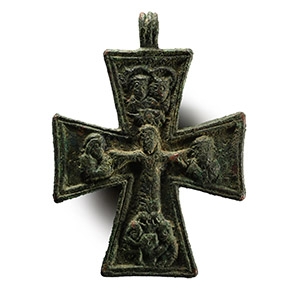
Post Medieval Bronze Cross Pendant
18th-19th century A.D.Sold for (Inc. bp): £59
Bifacial and substantial with ribbed lug pierced transversely, bilinear raised borders; both sides with Corpus Christi surrounded by small crouching figures and busts. 140 grams, 83 mm
Constable-Maxwell and Lord McAlpine in the 1980s-1990s. with Iconastas Russian Fine Art and Antiques, London SW1. Formerly in the private collection of Russian businessman Yuri Golubev (1942-2007), some of his collection was published in his book 'Symbols and Images'. Ex property of a British gentleman. Property of a Californian, USA, collector. This lot is accompanied by an illustrated lot declaration signed by the Head of the Antiquities Department, Dr Raffaele D’Amato. -
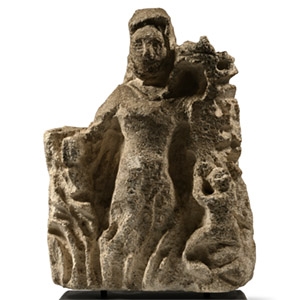
'Our Lady of the Flames' Figural Scene
15th century A.D. or laterEstimate: £500 - 700 (+bp*)
Opening Bid: £222
Carved in the half-round frieze fragment or devotional sculpture of the Madonna del Fuoco, facing female in wimple and long robe with her right arm bent forward, left arm extended above a child gripping the folds of her robe; billowing flames surrounding the pair; mounted on a custom-made stand. 10.55 kg total, 37.7 cm including stand
Acquired Lukas Pearsie, Suffolk, 2012. Property of a Kent collector. From the N.J. collection, Leicester, UK. This lot is accompanied by an illustrated lot declaration signed by the Head of the Antiquities Department, Dr Raffaele D’Amato. -
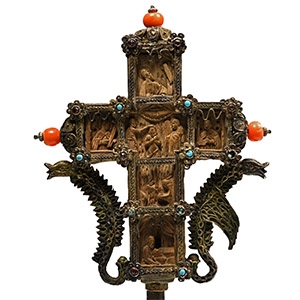
Mount Athos Wooden Cross with Silver-Gilt Mounts
Late 18th century A.D.Sold for (Inc. bp): £2,730
Comprising: a wooden cross with carved scenes from the life of Christ (Nativity and others to one face, Crucifixion and others to the other face) housed in a filigree frame; addorsed winged beasts supporting the arms of the cross; three coral beads to the arms, smaller glass beads to each face; balustered stem and domed base. 170 grams, 21.5 cm
Ex Iconastas, London SW1, UK, in 2004. Property of a London, UK, gentleman collector. Accompanied by a copy of the Iconastas invoice dated 18 February 2004. This lot is accompanied by an illustrated lot declaration signed by the Head of the Antiquities Department, Dr Raffaele D’Amato.
